

In short
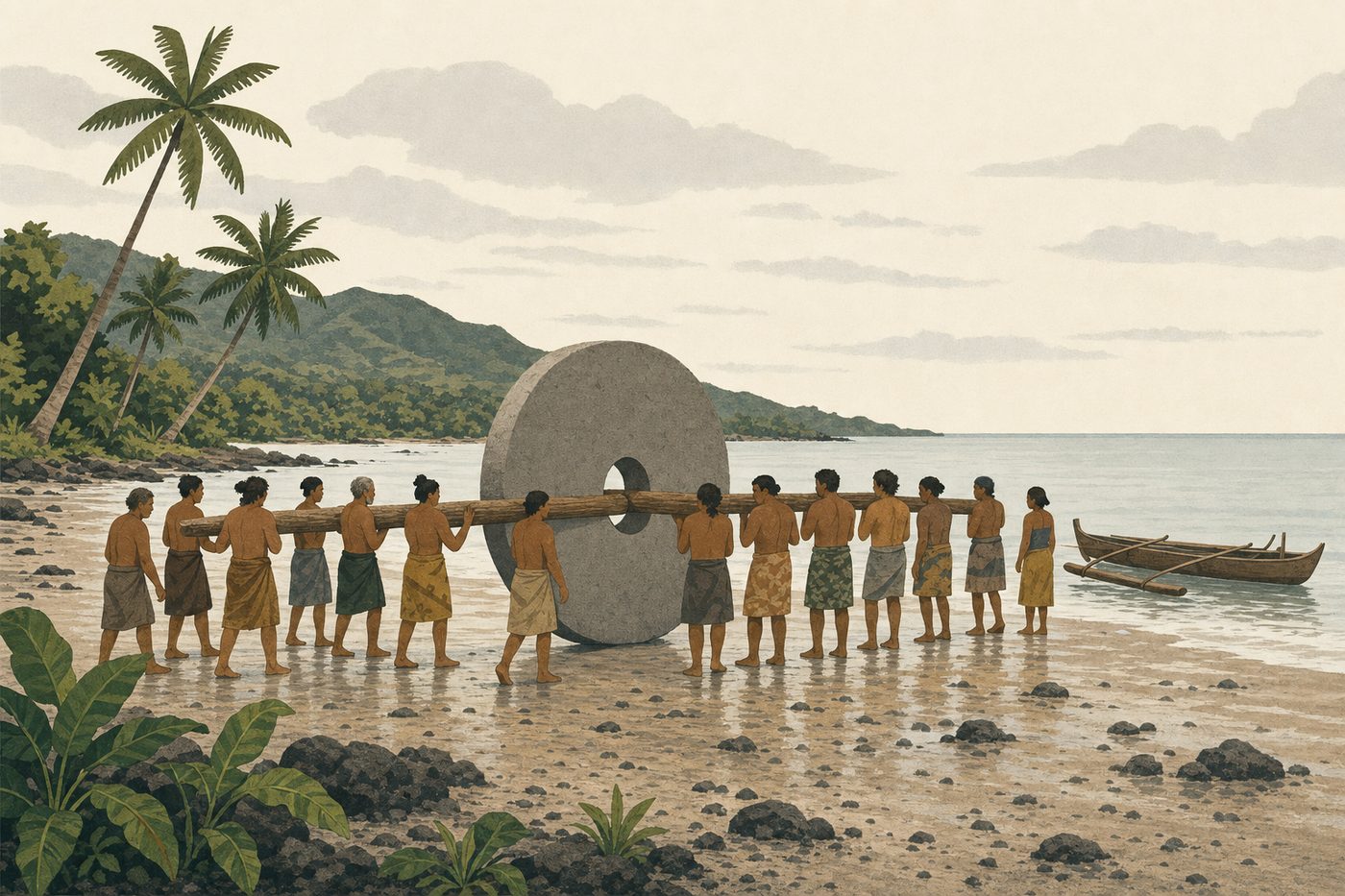
On the island of Yap there are limestone disks that weigh as much as a car, and for centuries they were money. Nobody moved one to spend it; the owner told the village it now belonged to someone else, and everyone remembered. It worked because a new stone meant quarrying it on another island and rafting it across open sea. Then, in 1871, an Irish-American sailor was shipwrecked on the beach, saw a business opportunity, sailed to Hong Kong for a bigger boat and a hold full of explosives, and came back with stones by the dozen. The chief refused them on the spot, on the grounds that they had come too easily. Others took them. Within a generation the money was finished.
The Bitcoin Standard is a history of money told through moments like that, and for most of its length bitcoin is nowhere in it. Saifedean Ammous asks one question of every money people have ever used: how hard was it to make more? His answer is that this one property decides nearly everything else about how a society lives, and that in 2009 someone finally built a money where the answer is "impossible."
The thesis
"Human civilization flourished in times and places where sound money was widely adopted, while unsound money all too frequently coincided with civilizational decline and societal collapse." — Ch. 3, Monetary Metals
The trap
The clearest thing in the book is a thought experiment about a billionaire who decides to keep ten billion dollars of his wealth in copper. The price climbs as his bankers buy, which looks to him like proof he was right. But a higher price is an instruction. Copper is in the ground in quantities nobody can measure, mines expand, new ones open, and the flow of new metal rises until it has met his demand. When he eventually sells, he sells into a market with far more copper in it than the day he began. He loses, everyone who followed him in loses more, and the mining companies keep the difference.
"Anything used as a store of value will have its supply increased, and anything whose supply can be easily increased will destroy the wealth of those who used it as a store of value." — Ch. 1, Money
Ammous calls this the easy money trap, and once you have seen it you cannot stop seeing it. It is every bubble. It is the two Texas brothers who tried to corner silver in 1979 and lost a billion dollars learning that miners can always dig faster than a rich man can buy. It is the reason nobody saves in copper. And it is why gold won five thousand years of monetary competition for no grander reason than chemistry: it cannot be made from anything else, it does not rust, so every ounce ever mined is still around, and a year's digging adds about one and a half percent to the pile whatever the price does. In 2006 the gold price rose 36 percent and world mine output fell. Nothing else people have tried to save in has ever behaved like that.
The word he uses for the property is hardness, and the number that measures it is stock-to-flow: everything that exists, divided by what gets made in a year. Gold's is high. Copper's is about one. The Yap stones' was high until the day the sailor's boat came in.
Rome, and everyone since
The history is one story told with different props. In West Africa it was glass beads, precious where glass was hard to make and worthless in Europe where it was easy, so the ships arrived with their holds full of them and the drain ran so slowly, over centuries, that nobody could point at it. It paid for the slave trade. The distinction Ammous draws there is the one worth keeping: a money that collapses at once is a tragedy people recover from. A money that leaks a little every year moves a society's wealth to whoever can make the money cheaply, and never sets off an alarm.
Rome is the leak told at length. Caesar's gold coin held eight grams and passed anywhere in the known world. Nero was the first emperor to call the coins in and reissue them lighter, and every successor with a deficit used the trick, until the silver coin was a bronze one with a wash that wore off in the hand. Price controls followed the debasement, shortages followed the price controls, and the cities emptied toward the countryside, where a family could at least eat. The Romans at least had to clip a coin. Paper, Ammous notes, lets the same thing be done more smoothly and less obviously.
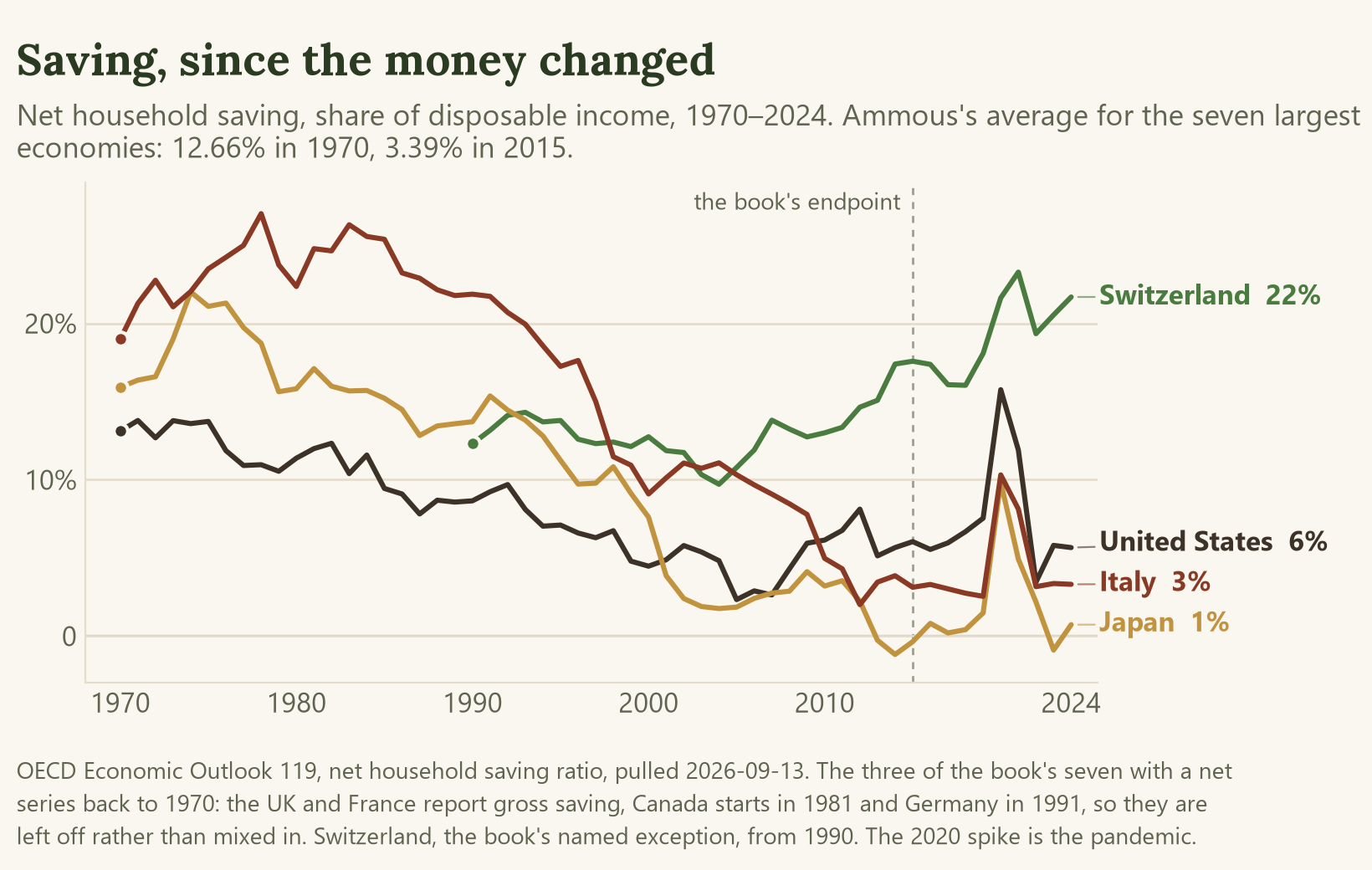
Then 1914. Within weeks of the war starting, every major government suspended the right to turn its paper into gold, and Ammous reads what followed as a monetary event before it is a military one. Under gold a war ends when the treasury does. Under paper it ends when the currency does, which is why a nine-month war in 1870 killed a hundred and fifty thousand people and the one that began in 1914 ran four years and killed millions. The century after produced fifty-six of the fifty-seven hyperinflations ever recorded, and across the richest seven economies the savings rate fell from almost 13 percent in 1970 to under 4 by 2015. That last number is the quiet one. A money that loses a few percent a year makes saving a losing move, so people stop, and debt takes the place savings used to hold.
What held is a short list, because it is always the same thing. Constantine minted a coin at one weight in 312 AD and refused to clip it; his eastern empire outlived Rome by a thousand years, and the same coin is still given at weddings as the Islamic dinar. Florence minted the first sound gold coin in Europe since Caesar in 1252, a hundred and fifty cities copied it, and Ammous puts the Renaissance downstream of that: patrons who could wait decades for a dome had money that could wait with them. Central banks, decades after declaring gold demonetised, still hold a sixth of everything ever mined. He takes the vaults over the statements, and so do I.
Linda's fishing rod
The half of the book that changes how you see your own life is about time. Ammous tells it with two people on a beach. Harry catches fish with his hands, eight hours a day, and eats what he catches. Linda catches for six hours, eats a little less, and spends the other two building a rod. A week later she catches twice what Harry does in half the time, and she uses the time she saved to build a boat. A month later she is catching fish Harry has never seen. Their descendants live in different worlds, and the only difference between them was a willingness to eat less today for more tomorrow.
Economists call that willingness a low time preference, and Ammous's claim is that the money in your pocket sets it. A currency that holds its value makes tomorrow worth waiting for. A currency that leaks makes tomorrow a worse deal every year, and people respond the way people do: they spend, they borrow, they stop building rods.
"A society in which individuals bequeath their children more than what they received from their parents is a civilized society: it is a place where life is improving, and people live with a purpose of making the next generation's lives better." — Ch. 5, Money and Time Preference
He runs the idea through everything. Under the gold standard the nineteenth century invented running water, electricity, the engine, the aeroplane and anaesthetics; the twentieth, on paper, mostly scaled them. Keynes, whose economics the whole century ran on, is quoted on why the long run can be ignored: "in the long run we are all dead," which Ammous reads as a man with a large inheritance and no children describing his own time preference and calling it a theory. And twice, without developing it, he arrives at the farm. Debt-funded consumption is "the eating of the seed crop." A leaking currency causes less saving, more borrowing, shorter horizons in every kind of work, "and perhaps most damagingly, the depletion of the soil of its nutrients, leading to ever-lower levels of nutrients in food."
That is the sentence I underlined. A farmer mining topsoil and a household saving in a currency that leaks are running the same trade. Each spends a stock that took a long time to build and calls the proceeds income. The farmer can at least watch his leave.
The turn
Two-thirds of the way through, the history becomes a proposal, and this is where readers either come with him or leave.
Before 2009 a digital object was a copy. Send a file and you still have it, so every electronic payment needed somebody in the middle keeping the one true record, and whoever kept the record could freeze it, reverse it, or be told to. Satoshi Nakamoto's design gives everyone the same ledger and makes adding to it expensive: to write the next page you spend real electricity on a problem that is hard to solve and trivial to check. An honest page earns new coins. A dishonest one is rejected at no cost by everyone else, and the electricity is simply gone. It is Yap again. The coins never move, the ledger does, and everyone holds a copy; what the islanders could not do was divide a four-ton stone or send one across the sea.
Then the part Ammous calls the most ingenious in the design. When the price rises, more people mine, and in every other money ever used that means more supply. Here the network makes the problem harder instead, so new coins keep arriving on the same schedule however much effort is thrown at them, halving every four years toward a ceiling of twenty-one million. A rising price buys security and nothing else. The billionaire's copper mines cannot open.
"Bitcoin is the hardest money ever invented: growth in its value cannot possibly increase its supply; it can only make the network more secure and immune to attack." — Ch. 8, Digital Money
The last claim is about control, and it is the one that makes the rest matter. The code is trivial to change; getting everyone to run the change is not. Coders can only propose. Miners who break the rules lose the electricity they spent. Node operators who adopt rules nobody else runs have left the network. Every well-funded attempt to force a change, and there were several, ended as a copy with a different name and a fraction of the value. Nobody controls it, Ammous says, and that alone is what makes it money; speed and convenience have nothing to do with it. Bitcoin is the Yap chief's rule, finally built into the money itself: the stones that came too easily do not count.

Through the Orenda lens
Ammous and the soil historians have each written a chapter on why Rome fell, and they found different bodies. He finds the cause in the mint; David Montgomery finds it in the ground, the hills of Italy stripped to bedrock and an emperor unable to give farmland away. Read together they describe one people liquidating two stocks at once, and the reflex was the same reflex. That is where the book takes me, and it is also where I part from him a little. He needs the money to be upstream of the behaviour, but the oldest soil collapses ran under no money at all. If the soil goes whether the coin is sound or not, then hard money lowers time preference without curing it. Sound money is the necessary half. The other half is a practice, and no currency supplies that.
His line about cheap credit is the sharpest thing in the book for anyone who farms. Capital from savings is allocated by people who waited for it and expect to wait for the return. Capital from a central bank goes to whoever can borrow cheapest, which is always the biggest, and Ammous says plainly that this is why the food is what it is: "the triumph of bland, mass-produced junk food cannot be understood outside the great benefits that large scale affords to producers." So the operation that can carry a ten-year soil-building horizon is the one least able to finance it. That is why a small farm that wants to survive sells straight to the people who eat from it. It cannot win the financing contest, so it refuses to enter.
And the energy, since it is the objection I hear most. Ammous and the loudest defender of fossil fuels agree that human time is the only real scarce resource and that energy is what buys more of it, then pull the same lever in opposite directions: Alex Epstein needs energy cheap without limit, Ammous needs the energy spent on the ledger to stay dear, because the expense is the security. Both are right, and this farm lives in both. It runs on cheap diesel and keeps its savings in something that was costly to write down. They are one conviction, that the real is what was paid for, applied to two different things.
What's happened since
The mechanism has held and its one hard prediction landed early: Ammous wrote that bitcoin's supply growth would fall below gold's by 2025, and the halving of April 2024 put it there. The prediction nobody quotes came true too. His ninth chapter says governments will eventually buy bitcoin and that the first to do so will start a reverse bank run among the rest; in March 2025 the United States established a strategic reserve of it by executive order. The state was supposed to shrink as people escaped it, and instead the largest one bought the exit, so the political half of the book has to be rewritten around that. The history is tidier than the record, and the sharpest complaint came from inside his own school: an Austrian reviewer calling stock-to-flow a red herring next to the plain distinction between money that can be printed and money that has to be produced, and pointing out that the golden decades before 1914 contained banking panics the book never mentions. The chapter that blames easy money for modern art is the one a hostile reader reaches for first, and it can be detached without the argument losing anything. Read it for the mechanism. Argue with the history. Skip the art.