

In short
On the last day of July 1914 a crowd stood outside the Bank of England on Threadneedle Street to turn their banknotes into gold before the August bank holiday. Austria had just declared war on Serbia. In the last six working days of that month the Bank paid out £12.3 million in coin from reserves of £26.5 million. It never legally stopped redeeming its notes. It asked the public, in the national interest, to stop asking, told the banks to hand their gold to the Treasury, shipped most of it to America to pay for the war, and never resumed. The papers had called it the August bank holiday war. Saifedean Ammous calls what came out of it the bank holiday that never ended.
The Fiat Standard is his second book, published in 2021, about the money nearly everyone alive has used for their whole lives and almost nobody has examined. He wrote the first as a prosecutor and came back to this one, by his own account, gentler, because when he treated fiat as a piece of engineering and asked what problem it solves, he found one. Fiat is a bad way to hold value across time and a very good way to move it across space, and for most of a century the second was worth more than the first. The rest of the book is the bill for that trade, itemised: the debt everyone carries, the savings nobody keeps, the buildings, the food, the soil, the science, the fuel. Then it asks whether the century can be unwound without a crash.
The thesis
"Fiat may have been a huge step backward in terms of its salability across time, but it was a substantial leap forward in terms of salability across space." — Ch. 1, Introduction
The never-ending bank holiday
The chapter that matters first is a history the Bank wrote about itself and hid. In 1926 the governor had his private secretary, John Osborne, compile an internal account of the war years, and the Bank put it on its website in September 2019, unpublished for ninety-three years. The war bond of November 1914 aimed to raise £350 million from the public at just over four percent and sold less than a third of it, so the Bank lent its own chief cashier and his deputy the money to buy the rest under their own names, and the Financial Times reported the issue oversubscribed. A young Treasury official named Keynes praised the Bank in a secret memo for its masterly manipulation. The Financial Times corrected the story in 2017, a hundred and three years late.
With the public unwilling to lend, the Bank needed their gold instead, and it got it by request. Pay the post office in coin, take your wages in notes. By 1917 the banks had agreed to hold ninety percent of their gold at the Treasury's disposal; by June 1920 they had surrendered £41.8 million in sovereigns, nearly everything they held, for paper, and the whole operation cost the Bank £5,516. Between 1914 and 1921 it took in 455 tons of gold, most of which went to America for credit. A century later it holds 310. The pound was still as good as gold, at Isaac Newton's price of 1717, on the sole condition that nobody tried to collect.
The rest of the century follows from the choice not to admit it. Prices rose 124 percent between 1915 and 1920 while the exchange rate stood still, so the pound was overvalued, so the Bank leaned on the Federal Reserve to inflate the dollar and stop gold draining west, which inflated the twenties and produced 1929. Britain devalued by a quarter in 1931. Roosevelt took American gold in 1933 and repriced it the next year from $20.67 to $35, a forty-one percent default the history books do not call one. Bretton Woods rebuilt the arrangement around the dollar and it failed the same way in 1971 when European central banks came to collect. Nixon told the nation that if it bought American goods in America, "your dollar will be worth just as much tomorrow as it is today."
"The fiat standard was not the design of an engineer. It was instead the central banks' desperate solution to their looming insolvency, the inevitable geopolitical outcome of a sixty-year-long marriage of politics and money." — Ch. 2, The Never-Ending Bank Holiday
Mining by lending
New money under fiat comes from somewhere stranger than a printing press. Fiat is credit. When a bank writes a million-dollar mortgage it does not pass across a million dollars a saver set aside; it types the number into the buyer's account, and the dollars that pay the seller did not exist the moment before. The seller has the money, the buyer has the house, and neither handed over a present good to get it. A claim on the future was treated as cash today because a licensed institution guaranteed it and a central bank guaranteed the institution, and the risk of the buyer failing to pay was spread across everyone who holds the currency, in the form of slightly more of it.
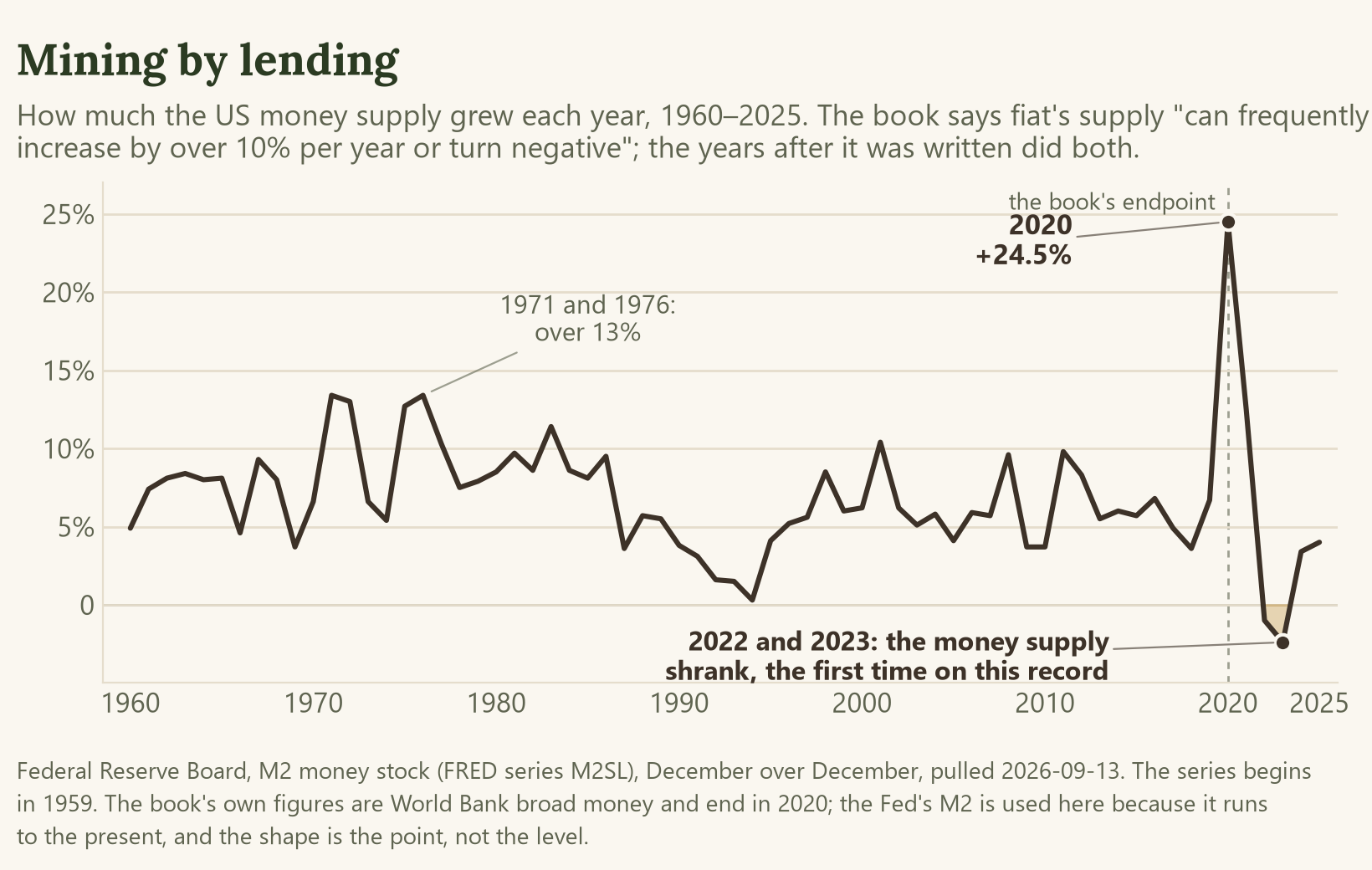
Ammous calls lending fiat's version of mining. Fiat's supply grows with every loan and shrinks with every default, so its quantity is the net of an enormous, unaudited, politically encouraged pile of promises, and the only thing that has ever reliably restrained it is the bust that follows the boom. The norm is a supply that jumps ten percent in a good year and goes negative in a bad one, and the chart above is what that looks like in the country that did it second best. Weighting the world by where the money actually sits gives the average fiat user a supply growing about fourteen percent a year, which on the quarter of humanity's wealth held as money comes to something like fifteen trillion dollars of purchasing power a year handed from the people who hold currency to the people who make it. The poor pay most of it, because the poor hold their wealth as money and the rich hold theirs as things.
There is a tidier way to see the same century, and it is the average American house. It cost $3,500 in 1915 and $269,039 in 2021. Had the supply been fixed in 1914 and prices allowed to fall two percent a year as productivity rose, the same house would cost $411 today, and $411 in 1915, twelve percent of a house, saved and passed down, would now buy one outright. Your great-grandfather's pocket change.
The chapter on balances opens with an observation nobody else seems to have made. Fiat is the only monetary system in history in which the sum of all balances is negative. Every other money was a present good, so every debt in it was lent by someone who owned it first and the books summed to something above zero. Fiat's native unit is debt, so the total owed exceeds the total that exists, and the top tier of users, the people with most of the world's monetary wealth, run negative. Being rich under fiat means owing a great deal of it. Being prudent means being robbed slowly.
A child under the gold standard was given coins at birth and taught to keep them, and the coin held its value across a life. When redemption ended the savings account stood in for it, and for Americans that worked until the spending of the sixties pushed inflation past what a passbook could pay. After 1971 saving became a job: bonds until yields fell under inflation, then the stock index. Every one of these is an investment carrying risk, and none of them is cash.
"You effectively need to earn your money twice with fiat, once when you work for it, and once when you invest it to beat inflation. The simple gold coin saved you from all of this before fiat." — Ch. 5, Fiat Balances
The Narrow Bank
The book's best small story is what happened when someone offered the missing thing. In 2018 a firm called the Narrow Bank applied for a licence with a business model a child could follow: take deposits, park every dollar at the Federal Reserve, the safest balance sheet on earth, and pass the interest through minus a fee. No lending, no risk, nothing to run on. The Fed refused it. A safe place to hold cash would have drained the banks that are not safe, and a system built on everyone being a little bit in debt cannot survive a door marked exit. The last line of the chapter is where the third part of the book will start: bitcoin is a savings technology that did not need to ask the Fed for a licence.
"Instead of saving for the possibility of a rainy day, fiat makes you borrow against all of your future sunny days." — Ch. 5, Fiat Balances
Why gold lost
The chapter that changed the author's mind is about shipping. In 1917 the Bank of England loaded 3,211 gold bars, forty tons, onto the SS Laurentic at Liverpool, bound for Canada as payment for the war. It hit two German mines off the north coast of Ireland and went down. The Admiralty put a naval diver named Guybon Damant on it, and over seven years his team, working in hard hats through the wreck, brought up 3,186 of the bars. Three more surfaced in the 1930s. Twenty-two are still down there. The salvage cost about three percent of the cargo, and it is still the largest recovery of sunken gold by weight ever made.
That is the number the book turns on. Ammous wants a measure for salability across space the way stock-to-flow measures it across time, and he settles on what it costs to settle a 400-ounce good-delivery bar across the Atlantic. In 1919 the Bank paid two dollars a thousand to bring its gold home from Canada. When Germany brought 54,000 bars back from New York and Paris between 2013 and 2017 the bill, including melting and recasting every bar to prove what was in it, was $9.1 million on $27 billion, and it took four years. A Zurich dealer quoted him $3,000 to fly one bar today, half a percent, two to three days, verification not included. A bank wire costs ten to fifty dollars, and the message is all that moves.
That is the whole case. Gold in a vault with a settlement network attached was worth more than gold in your hand, so people put it in the vault, and once it was there the operators of the network could issue more claims against it than there was gold to meet them. Fiat was what you got when the claims became the money. He no longer thinks the move was insane; it was the cheapest way, with the technology of 1914, to run a world economy at the speed of the steamship and the telegraph, and a hard money that needs a brick building to clear it will always end up belonging to whoever owns the building.
Fiat life
The second half of the book walks through a fiat society room by room, and the argument in every room is the same: money that leaks makes tomorrow cheaper, and a society that discounts tomorrow builds, eats, studies and fuels itself accordingly. His first exhibit is two adjoining buildings. The Boston Public Library's McKim building went up between 1888 and 1895 for $2.268 million in gold-backed dollars, about seventy million today, and after a hundred and twenty-five years it stands with little repair as one of the handsomest rooms in America. The Johnson building next door went up in 1971, the year of the Nixon shock, and by 2013 needed a $78 million overhaul, which is to say that forty years of maintaining the concrete box cost more than building the palace. Cheaper construction is what a rising time preference looks like from the street. When money burns a hole in your pocket a shoddy table becomes a reasonable purchase, because even a shoddy table holds its value better than the cash.
The food chapter is the reason this book is on a farm's shelf. In 1971, as prices started to climb, Nixon put an agribusiness board member named Earl Butz in charge of the Department of Agriculture with one instruction, to make food cheap. His method was to flood farmers with credit and tell them to get big or get out. Yields rose, prices fell, small farms sold to large ones, and the country got what industrial scale is good at, which is more of the cheapest thing. Butz was right about the arithmetic. What Ammous adds is that a government on gold could not have paid for the policy, and that the price it hid was paid in the nutrient content of the food and the condition of the ground.
His cleverest passage is about the index the government uses to measure inflation. Suppose you earn ten dollars a day and spend it on a ribeye. The price of the ribeye goes to a hundred. You cannot pay a hundred, so you eat a ten-dollar soy burger instead, and the index, which measures what people actually buy, records no inflation at all. The basket is a function of the prices it claims to measure, and the substitutions run one way, from the foods that take land and animals and time toward the ones that come out of a factory at a steady price. The Fed chairman of the seventies, by the account of an economist who worked under him, fought inflation by removing from the index whatever was rising, food and energy first.
The harvest
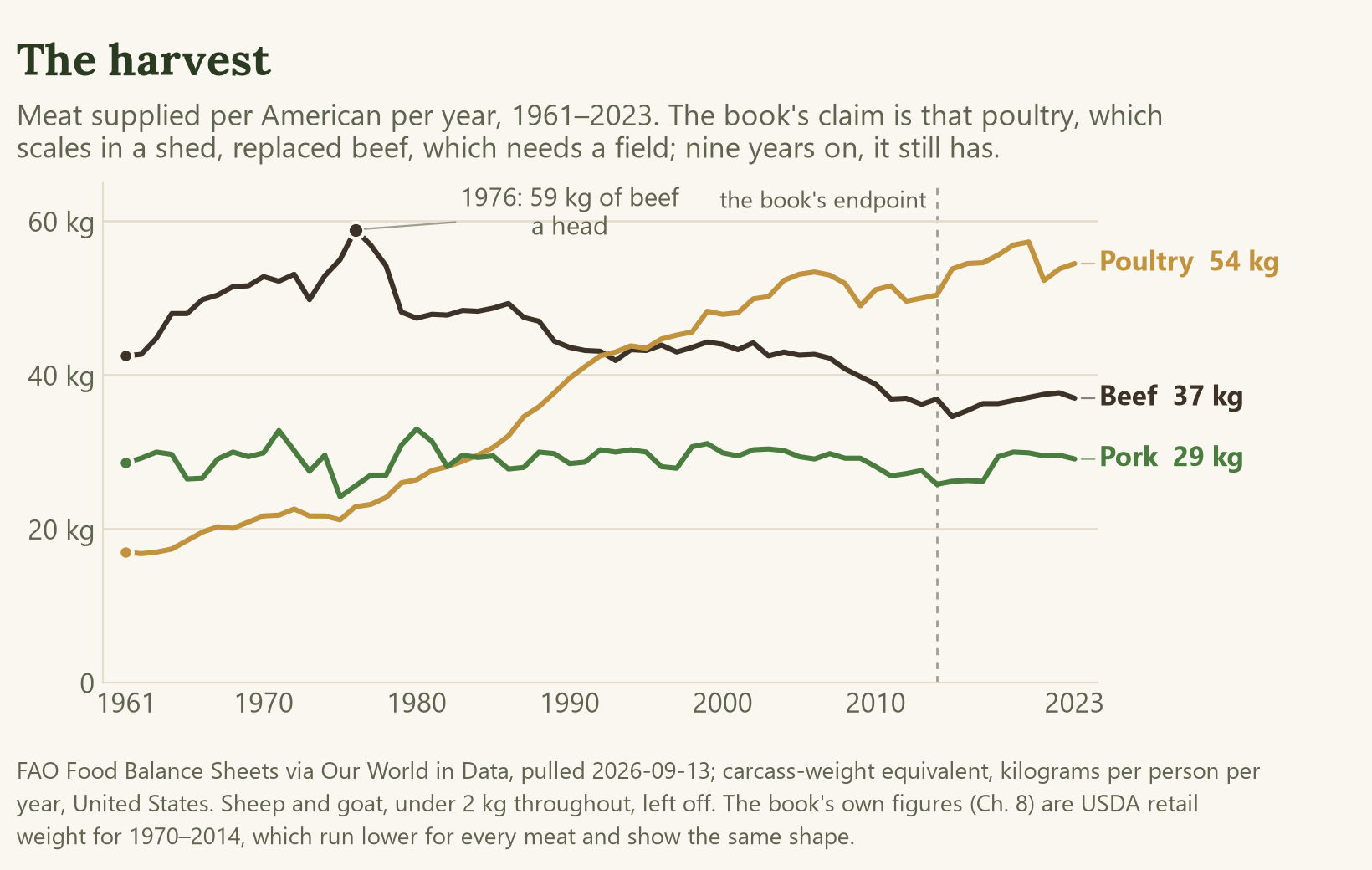
The first federal dietary guidance appeared in 1916, three years after the Federal Reserve, and the pyramid arrived at the end of the seventies with six to eleven servings of subsidised grain at its base. Between 1970 and 2014 Americans ate twenty-eight percent less red meat, seventy-nine percent less whole milk, twenty-seven percent less animal fat, eighty-seven percent more vegetable oil and twenty-eight percent more grain. Meat overall held steady, because poultry, which scales in a shed, replaced beef, which needs a field; the chart above is that sentence drawn from the FAO's series and carried nine years past the book. He is fierce about seed oils, corn syrup, soy and refined flour, and a reader can weigh that for themselves. The claim underneath the fierceness is the one that lasts.
"Americans are not fat because of prosperity and abundance; Americans are fat because they are malnourished and nutritionally impoverished." — Ch. 8, Fiat Food
His witness for what the food used to be is a Canadian dentist who practised in Cleveland. Weston Price spent the 1930s travelling to the last places on earth that still ate their own food and found the same thing everywhere: people on their traditional diet had sound teeth and no chronic disease, and the same people a generation into white flour and sugar had neither. On one Pacific island the trader ships called only while copra fetched $400 a ton, paying ninety percent in flour and sugar; when the price fell to $4 the ships stopped coming, the islanders went back to their own food, and Price found mouths full of cavities that had simply stopped decaying. He never mentioned money. He dated the decline he was seeing to the first decades of the twentieth century.
The chapter ends in the ground, and this is the passage that made me stop.
"Soil, being the productive asset from which all food comes, is capital. And as fiat encourages the consumption of capital, it will encourage the consumption of soil." — Ch. 8, Fiat Food
He quotes the Department of Agriculture's own conservation service on the plow: it turns the soil, mixes it with air, releases a flush of nutrients that feeds one crop, and over time strips the organic matter that held the water and the life. That is an extraction, and fertiliser is what makes it look free. Against it he sets Allan Savory's grazing and the older practice of rotating a field between crops and cattle, and he draws the line where a farmer would: a field of subsidised grain pays a large profit now, a field managed for its soil pays a smaller one for as long as you care to keep it, and the money you are paid in decides which of those looks like the sensible choice.
Science, fuel and the misery industry
Three more chapters run the argument through the university, the power grid and the developing world, and they are where the book either wins a reader or loses them. The science chapter has Ancel Keys dropping France from his seven countries and Harvard nutritionists taking $6,500 from the sugar industry in 1965 to blame fat, one of them writing back that they were "well aware of your particular interest." The fuel chapter has the child who wants to be at Disneyland and will not get in the car, and a stretch on carbon dioxide that a reader who wants the rest taken seriously will wish he had cut. The chapter on the IMF and the World Bank, which he calls the misery industry, is the angriest thing he has written, and its core stands: an institution with a credit line from the Federal Reserve cannot fail, so it cannot learn, and seven decades of loans to governments have mostly financed the governments.
The liquidator
The last third answers the first. If fiat won because it moved value across space, the thing that beats it has to do that better. A 400-ounce bar costs $3,000 and three days to cross the Atlantic and must be melted to be trusted; the same value on the bitcoin network costs about a dollar, clears in hours, and a node built for a few hundred dollars can check it. Fees will rise, and he expects them to price coffee off the chain and leave it to banks settling between countries, which is what the chain is for. Everything smaller lives on a second layer, as it did under gold and does under fiat, except that the asset underneath cannot be issued by whoever runs the rails.
Two consequences follow that the first book could not reach. A money that settles every ten minutes and can be withdrawn in an afternoon puts every custodian under the permanent threat of a run, so a bank holding it cannot quietly lend the deposits, and a bank that cannot do that cannot promise a fixed return on them either. He expects lending at interest to shrink toward nothing and finance to become equity: take a share of the venture and its risk, or keep your cash, which under hard money pays you by holding its value. The second is a jubilee. Most of the demand for debt in a fiat world is savers looking for something that holds value, and the bond market is the result. Give them a hard asset that owes nobody anything and the demand for issuing debt falls with the demand for holding it.
The energy chapters answer the objection everyone makes. Difficulty adjustment means more mining buys security and never more coins, and the same mechanism guarantees that only the cheapest electricity on earth can mine for long, which means stranded electricity: the methane an oil field flares because no pipeline reaches it, the water a dam spills, the third of all power generated that is lost before it reaches anyone. Flared gas alone holds ten times what bitcoin burns.
Then the ending, calmer than a reader of the first book expects. Hyperinflation is always a supply event, a government printing, and so long as fiat stays credit money the busts that liquidate it keep working; he calls the business cycle fiat's own crude version of the difficulty adjustment. Bitcoin removes demand for fiat and the incentive to create it at the same time, and the likeliest path is that the fiat economy shrinks for fifty years until it is a small thing governments use among themselves. The threat to that orderly exit is the central bank digital currency, money issued straight from the central bank with no lending and no bust to correct it, every balance visible and revocable, the Soviet Gosbank with an app. In that world, he says, the black market is bitcoin.
Through the Orenda lens
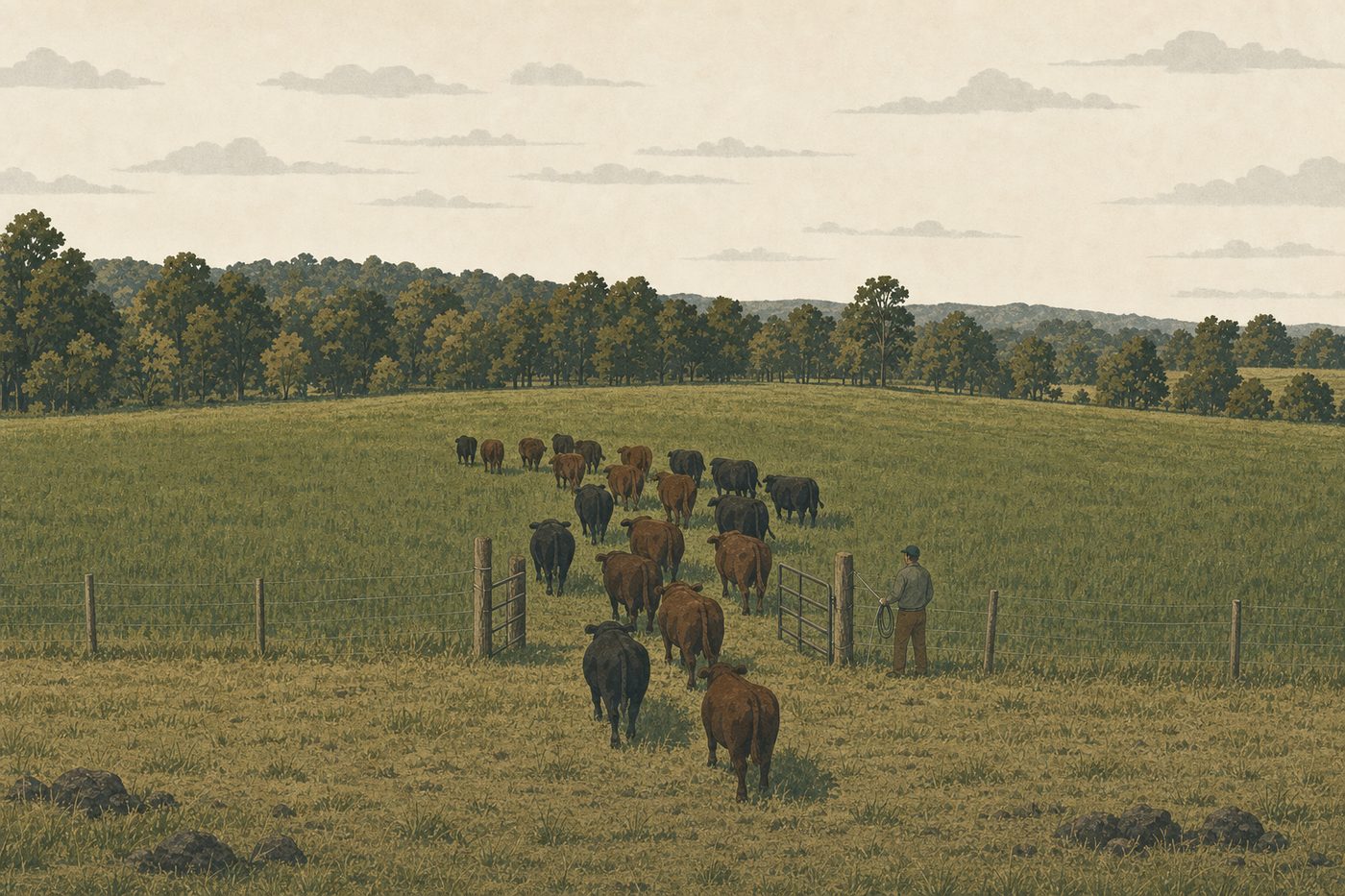
The first book gave the farm its frame for money. This one hands it a mirror: the food chapter is a farmer's own operation described by someone who has never run one. Meat has small margins and a long horizon; grain scales and pays now. Ammous puts the whole difference down to the money, and I part from him only on the mechanism. The pressure fiat puts on a small farm arrives through the land before it arrives through the plow. He gives the tool himself, borrowed from Michael Saylor: inflation is a vector rather than a number, industrial goods barely move, and the scarce, durable things a rich man can park money in rise fastest of all. Farmland is that thing. A grazing farm on fiat is a real-estate holding with a cattle problem. The balance sheet appreciates at the rate of the scarcest asset in the county while the income arrives at the rate of grass, and every year the question of whether to keep grazing it or sell it to someone who will build on it gets harder to answer the way you want to. That is fiat's pressure on the soil, and it works on the people who love the ground as hard as on the people who mine it.
Which is why a farm keeps its savings in the hardest thing it can find, and why the chapter on balances reads like a description of the place. Ammous says the fiat saver earns every dollar twice, and a farm has less time than anyone for the second job; the money it holds between one sale and the next has to keep itself while everyone is in the field. A bitcoin standard is the Narrow Bank the Fed would not license, a place to hold cash that owes nobody anything and does not need to be managed, and savings held that way let the operating business be small, and slow, and thin-margined, which is the only kind of business that raises an animal properly. I wrote the mechanism in the book for exactly this reason:
"What the bank actually does is conjure a new deposit in your account out of thin air. It types the number in. Your loan creates the money. Before you signed those papers, that money did not exist in any form. After you signed, it does. Your debt is literally the money supply."
And the soil passage is the one place the two books meet without either of us bending. He says fiat encourages the consumption of capital and soil is capital; I had already written the farm's side of that, from the field rather than the ledger:
"On a conventional farm, you spray synthetic fertilizer, get a big yield this year, and degrade the soil for next year. Then you need more fertilizer, more chemicals, more intervention, just to maintain the same output. It's the same pattern as debt-fueled growth. More stimulus, more printing, more intervention, diminishing returns. The extractive loop."
Where I leave him is tone, and it costs him readers this farm would like to keep. The nutrition chapters are a war on soy, and the case for animal fat and real food that Price built stands without one; a farm that sells beef does not need its customers to hate anyone. The climate section is the same mistake at larger scale. This farm keeps its ground covered and its cattle moving because that is what builds soil, and it does not need the weather argued either way to want that. His equity chapter, though, is the one I would hand a new farmer before any other. A place like this does not run on a loan from a bank that guarantees the return. It runs on people who eat from it and hold a share of the risk, and if he is right that hard money turns finance from interest into equity, then the way a small farm has always had to raise capital turns out to be the way everyone will.
What's happened since
The book came out in the autumn of 2021 with inflation already past six percent and the Federal Reserve calling it transitory; it reached 9.1 percent the following June, the highest in forty years, and the chart in the mining section says why. Then the correction he describes arrived on schedule: rates went past five percent, the money supply fell in 2022 and again in 2023, the first annual contractions on the Fed's own record, and in March 2023 two American banks failed in a weekend because the Treasury bonds they held as their safe asset had lost value, and the Fed opened a facility to lend against those bonds at face value. His chapter on lenders of last resort had described the play to the letter. Rochard's speculative attack, borrowing the weak money to buy the hard one, which the book treats as a possibility, is now run in public: the firm he cited for its first $250 million holds about 845,000 bitcoin as of this summer, four percent of every coin there will ever be, financed with convertible debt and preferred stock alongside new shares. The misery industry did what he said it does: El Salvador, which he noted as the first country to make bitcoin legal tender, repealed the obligation to accept it in January 2025 as a condition of a $1.4 billion IMF programme. The CBDC he feared has been banned by executive order in the United States and legislated toward instead as private dollar tokens backed by Treasury bills, which is the Narrow Bank arriving by another door, while the European Central Bank voted in October 2025 to keep building its digital euro for a launch pencilled in for 2029. The food chapter aged strangely well: in January 2026 the federal dietary guidelines flipped the pyramid he mocked, with steak, full-fat milk and butter drawn at the wide end and processed food named as the thing to limit, and kept the ten percent cap on saturated fat in the small print, which is the compromise he would have predicted. The fuel chapter aged worst: solar panels and batteries have fallen in price faster than any hydrocarbon since he wrote, and his claim that they remain far more expensive is the one the market has moved most. His passage on the 2020 lockdowns, which says the drop in driving and flying had no effect on the growth of atmospheric carbon dioxide and treats that as a refutation, is the weakest thing in the book: emissions fell about six percent for one year against a stock built up over two centuries, and nobody expected the measurement to move. Read it for the Osborne history, the balances, the Laurentic and the food. Take the science and the fuel chapters as the argument of a man who is right about incentives and out of his lane on evidence.