

In short
In 1988 Jeff Booth's employer gave him a cellphone as a leaving present. It was a Motorola 8000, the size and weight of a brick, with an antenna, thirty minutes of talk time, ten to twelve hours on the charger, a price of about $2,000 and calls at a dollar fifty a minute. His first bill, with roaming, came to $1,200. He tells the story to set up a question he wants you to answer with the phone in your own pocket: how big is it, what did it cost, and what can it do? The thing that turned a brick into a camera, a map, a wallet and a guitar tuner for almost nothing is, he says, the most powerful economic force alive, and the whole of our economic system is arranged to fight it.
The Price of Tomorrow came out in January 2020, six weeks before the world shut down. Booth is a Vancouver entrepreneur who spent twenty years running a company called BuildDirect, and the book is a businessman's argument rather than an economist's, built from what he watched happen to prices in his own industry. It says that technology makes things cheaper, exponentially and without stopping; that our money and our debts were designed for a world where prices rise; and that the gap between those two facts is being filled with borrowing on a scale nobody can picture. Then it asks what happens when the borrowing can't.
The thesis
"Technology is deflationary. That is not conjecture. It is the nature of technology." — Introduction
Four dollars of debt
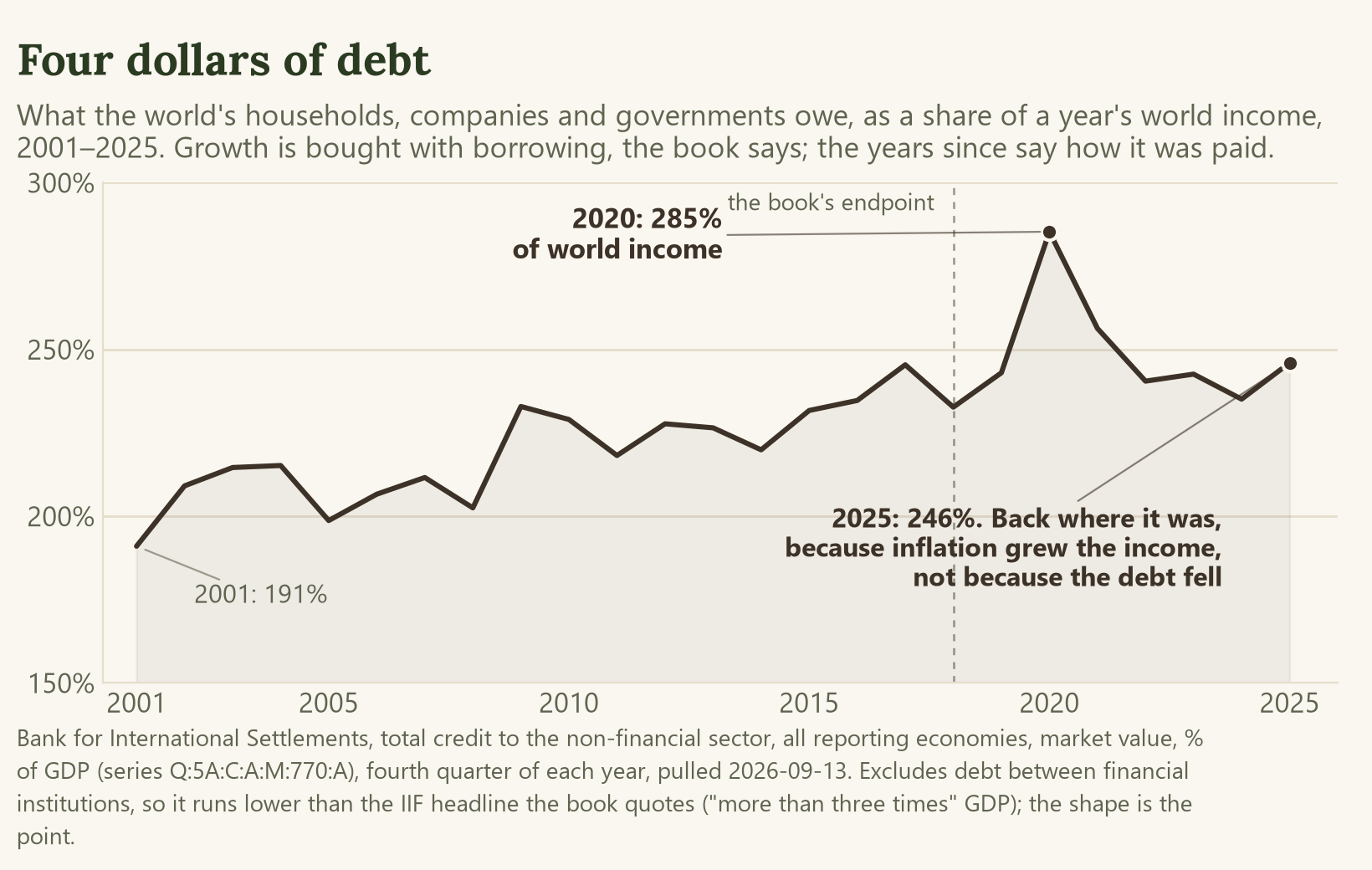
His arithmetic is on the second page and he keeps returning to it. In 2000 the world owed about $62 trillion on an economy of $33.5 trillion. By the third quarter of 2018 the economy had grown to $80 trillion and the debt to $247 trillion, which means it took $185 trillion of new borrowing to buy $46 trillion of growth. Four dollars in for every one out. Pay it back at a thousand dollars a second and you'd be at it for eight thousand years. He says he can't imagine walking into a bank with that as a business plan, and that if he taxed the whole dollar of growth at a hundred percent it would never repay the four.
"The mirage of growth today is nothing more than a debt-fuelled spending binge." — Introduction
The chart above is the same ratio drawn from a different desk, the central banks' own bank in Basel, and it runs past the book. Debt against income climbed through the 2010s, jumped forty points of GDP in the year the book came out, and has since fallen back to roughly where it was, which nobody should read as repayment. The numerator kept rising. The denominator, the world's income in dollars, rose faster for three years, because inflation is the one thing that shrinks a debt without anyone paying it.
Booth takes his four levers from Ray Dalio: spend less, default, print, or tax the rich and transfer it. Dalio's finding across every past debt crisis is that policy makers always print, because austerity hurts too much, restructuring wipes out too much wealth too fast, and transfers of the size required don't happen without a revolution. Booth agrees they'll print again. He thinks it's the wrong answer this time, because none of the crises Dalio studied had technology pushing the other way.
Currency wars, then trade wars
The first chapter opens at a dinner with a friend, Chen Fong, whose elderly in-laws had watched the response to 2008 from a position of comfort and were frightened anyway. They'd seen it before. Their line was "First currency wars, then trade wars, then real wars," and Booth uses it as the spine of the book's politics.
He lays out the Bernanke record from 2005 to 2008 in the man's own words, from derivatives being safely in the hands of sophisticated institutions to Fannie and Freddie being in no danger of failing, dated eight weeks before they were nationalised. His point is that the experts were wrong in the same way, along the established path, and that the system has not become safer since, only the particular room where the fire started. Then he does the thing the book is best at, which is to make the response legible to someone who never read a central bank statement. Quantitative easing is an estate divided among ten heirs instead of nine, a pizza cut into twelve slices instead of eight. Nobody has more; every slice is smaller. Through three rounds of it oil went from thirty dollars a barrel to over a hundred, and the people holding cash and wages paid for the whole exercise without being told they had.
He is fair to the people in the room in September 2008. Bail out the banks and create moral hazard, or let them fail and risk a depression with no floor. They chose the first, and then he asks you to imagine the second, with real estate nowhere near today's price and half our politicians gone with their debts. Under the pizza is the line that carries the rest of the book. Much of the wealth the comfortable enjoy, he says, came from governments deciding to print rather than from anyone's ingenuity, and the people on the other side of that decision know something was taken from them even if they cannot name it. He quotes Volcker at ninety on the plutocracy of people who have convinced themselves they're rich because they're smart.
Creative destruction
The second chapter is about how the old thing dies, and the case is Blockbuster: 84,000 employees, 9,000 stores placed close to customers, a distribution advantage that became a noose the moment delivery went digital. The most innovative thing they managed was candy aisles. Booth doesn't call them stupid. He says they were trapped in a framework that had worked, and that the cost of keeping the old business alive while building the new one is what kills incumbents, which he knows because he did it to himself.
BuildDirect was doubling sales every year in 2013 and failing its customers because it couldn't hold enough inventory. He went to his board and proposed opening everything the company had, its data, its logistics, its onboarding, to the suppliers, and getting out of the way. It launched in 2016 and went from 6,000 products to 150,000 faster than the software could cope with; customers couldn't find anything, revenue stalled, and he took on debt to get to the other side. The technology caught up and growth returned, but the debt came with partners whose clocks ran differently from his, and he left with nothing. It reads as the most honest thing in the book.
The chapter's real lesson is about platforms, and it's the one a farm selling anything online should read twice. Every platform wins by aggregating all of the supply and making it compete for the buyer's attention: on Facebook the supply is you, on Amazon it's five hundred million products, on Airbnb six million rooms. His own experience of Google in the early years was picking up hundred-dollar bills off the ground; organic search was nearly free and BuildDirect grew on it. Then competitors arrived, the bills became twenties, and Google offered a way to the top for five cents a click. That rose to five dollars. Someone will always pay more than makes sense to win the market.
"As I learned the hard way, you are either the platform or the arbitrage on the platform. In the long term, there is no in-between." — Ch. 2
Then he turns the lens on the economy as a whole. Schumpeter, who coined creative destruction, expected capitalism to undermine its own supports. Minsky is remembered for the moment a debt bubble breaks, but his more important call was that governments preaching free markets would always act as lender of last resort when it did, and that every rescue legitimises the instrument that failed. Booth puts the two together.
"It is not the debt itself that acts to undermine capitalism. It is the act of stabilizing an economy through socializing the losses when faced with a collapse that undermines capitalism's own institutional framework." — Ch. 2
It is hard to think differently
Kodak invented the digital camera. Steve Sasson built the first one inside the company in 1975 and the first digital SLR in 1989, pitched both to executives protecting film, and Kodak filed for bankruptcy in 2012 after 130 years. Sears invented the mail-order catalogue in 1892, opened its first store in 1927, was the largest retailer in America until the nineties and filed in 2018 while a company built on the catalogue's own principle became the most valuable in the world. Walmart's executives built a box with 130,000 products in it, then watched a store with no shelves offer five hundred million.
The chapter uses these to make a point about heads rather than companies. We build our knowledge on foundations we stop questioning, because questioning everything would leave us exhausted before breakfast, and the longer a pattern holds the more confidently the experts explain it, which is why a beginner's mind wins in times of change and loses in every other. Kahneman's anchoring and sunk-cost biases get a page each, and the sunk-cost paragraph is where Booth says what the book is really about.
"I personally believe that the sunk-cost bias is making us hold onto an economic system that is clearly failing for fear of loss of the status quo." — Ch. 3
He borrows Campbell's hero's journey to explain why we need a villain, and warns that a society unwilling to face a real change will invent one. The correction he offers is Bob Sutton's rule for leaders: argue as if you're right and listen as if you're wrong.
The penny and the paper
At twelve, Booth was offered a choice at dinner: a million dollars now, or a penny that doubled every day for thirty-one days. He took the million. The penny would have been $10,737,418.24. A few years later a teacher told him the chess story, one grain of rice on the first square and doubling on each of the sixty-four, and the final square holds a thousand years of the world's rice. He has since asked tens of thousands of people how thick a sheet of paper would be if you could fold it fifty times. Most say a couple of inches. It reaches the sun.
Moore's law has run about thirty-three doublings, which on the paper is roughly Boston to Detroit, a long way and nowhere near the sun. A megabyte of storage cost a million dollars in 1967 and two cents when he wrote. His argument is that every doubling from here is larger than all the doublings before it combined, that the technologies feed each other, and that all of it removes waste, and the waste is where the jobs are. Cars sit idle 95 percent of the time and an industry is sized to build for that; fourteen percent of Los Angeles County is parking. A spatial-data startup saved one forest company $55 million a year in surveying, and every dollar of it was somebody's job.
"The problem is that waste and cost are today's jobs." — Ch. 4
Then he puts the two exponentials together. If it took $185 trillion of debt to hold back the deflation of the last twenty years, and the technology doubles every eighteen months or so, then the next $185 trillion buys about three years, and the one after that eighteen months. A jet passing the speed of sound leaves its own noise behind and the rules change at once; that's his sonic boom, and it is where my own book picked him up. He is careful to say the debt did real good, that extreme poverty fell from half the world to under a tenth on the back of it and that the technology itself was financed by the cheap money. The boom has simply led to another boom.
The sun
The energy chapter starts from the two laws of thermodynamics and uses them to describe a tank of gasoline. Every joule in the oil came from the sun through plants; the oil is found with energy, pumped with energy, shipped, refined, shipped again, and an engine turns a quarter to a half of what's left into motion and the rest into heat. Most of an economy, he says, is that chain of extraction and conversion, and most of the jobs in it are the inefficiency. Getting energy from the sun directly removes the supply chain.
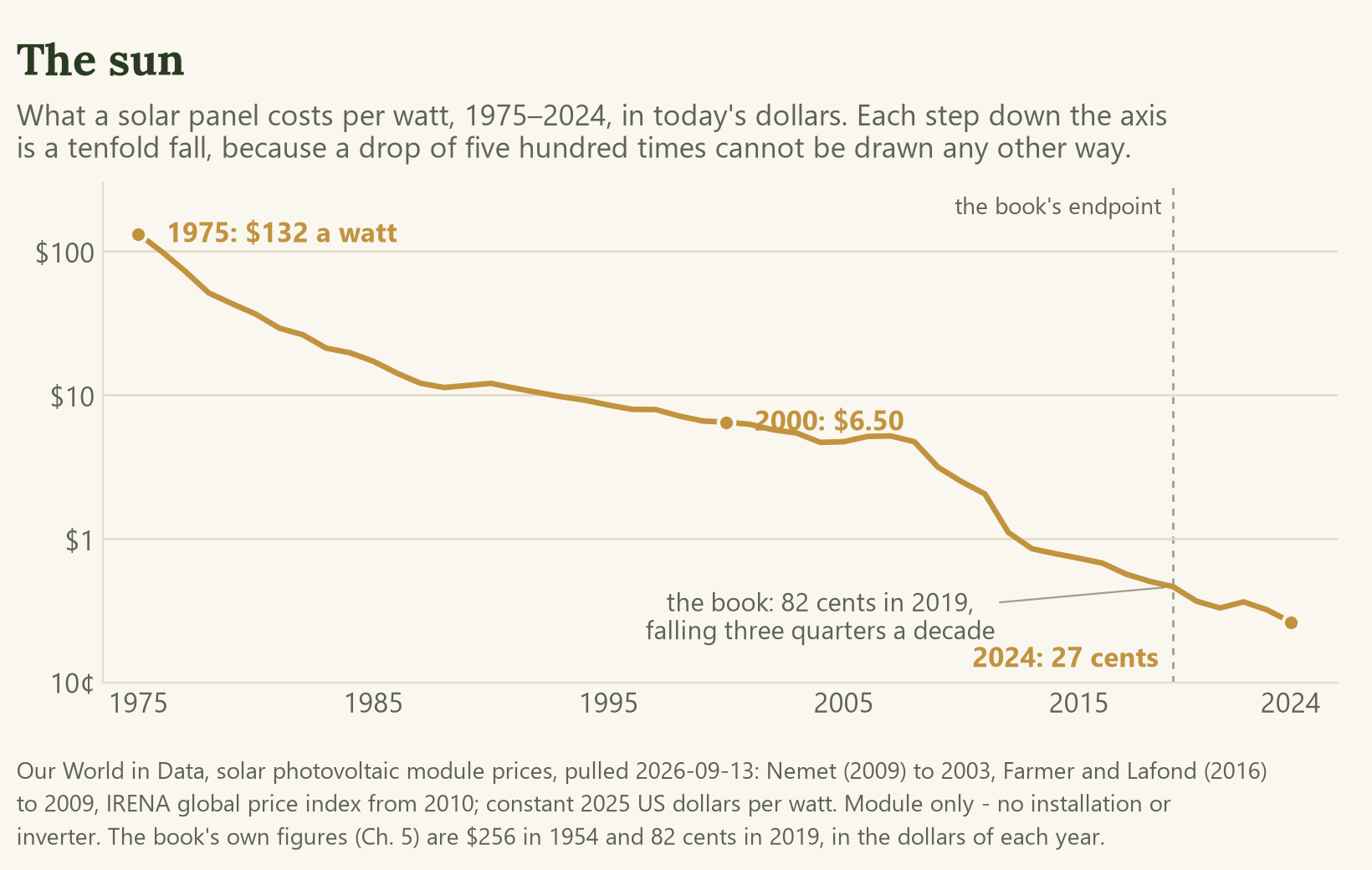
His numbers: Bell Labs made the modern cell in 1954 at six percent efficiency and $256 a watt, and by his writing it was 82 cents. Swanson's law holds that the price falls twenty percent for every doubling of what's shipped, which at recent volumes is three quarters every decade. Carbon Tracker found 42 percent of the world's coal plants running at a loss in 2018. The land to power the whole world on solar comes to about 497,000 square kilometres, and the land leased to oil and gas in the United States alone is 104,000. The chart above is what the module has done since he wrote: it has kept falling at about the rate he said it would, and it is the reason the rest of the chapter, desalination, carbon capture, homes cutting the cord from the grid the way they cut it from cable, reads less like a prediction than it did in 2020. Energy is an input to nearly everything. Cheaper energy is deflation in nearly everything, on top of what Moore's law already does.
The masters
He heard Mark Carney compare artificial intelligence to electrification, a general-purpose technology that first destroyed jobs and then created industries nobody had imagined, and thought the governor was describing what he wanted to be true. Electricity didn't double every eighteen months and nobody expected it to become smarter than the people using it.
"If electricity was a match, artificial intelligence is the sun." — Ch. 6
The chapter's history is worth the price of the book on its own. Imagine a group exiled to an island with everything they know and no way to write it down, and count the generations until their descendants are, by our measure, primitive. Our brains have been the same for 300,000 years; we've had the printing press for under six hundred, and what changed was that knowledge could be stored outside a skull and then argued with. Twenty million books by 1500, the scientific method as a machine for finding your own mistakes, Popper's line that all our knowledge grows only through correcting them.
"Error correction is the basis of all intelligence." — Ch. 6
Then the machine does it faster. AlphaGo beat Lee Sedol in 2016 with a move on the thirty-seventh turn of the second game that the commentators called a mistake until they understood it; a year later AlphaGo Zero, taught nothing but the rules, played itself for three days and beat the version that had beaten the champion a hundred games to none. Booth's reasoning from there is simple and uncomfortable. Every job is a function of intelligence. Intelligence is error correction at scale. Computers correct errors faster and never forget the ones they made. A radiology model in 2019 already outperformed six experts on a single scan, and he asks whether you'd choose the cheaper, better option or the one that protected the jobs if it were your family on the table.
Us versus them
The book's second half is about what a rigged game does to people. It opens with Alex Mocevic, who grew up middle class in the Sarajevo that hosted the 1984 Olympics and watched, at eleven, his grandparents' village burn from an upstairs window. Religion was used to divide him from his friends almost overnight. He came out on the last UN convoy and spent three years in a refugee camp before Canada took him. Booth's question is what in us allows that to happen so fast, and his answer runs through the need to belong, which by its nature means not belonging somewhere else.
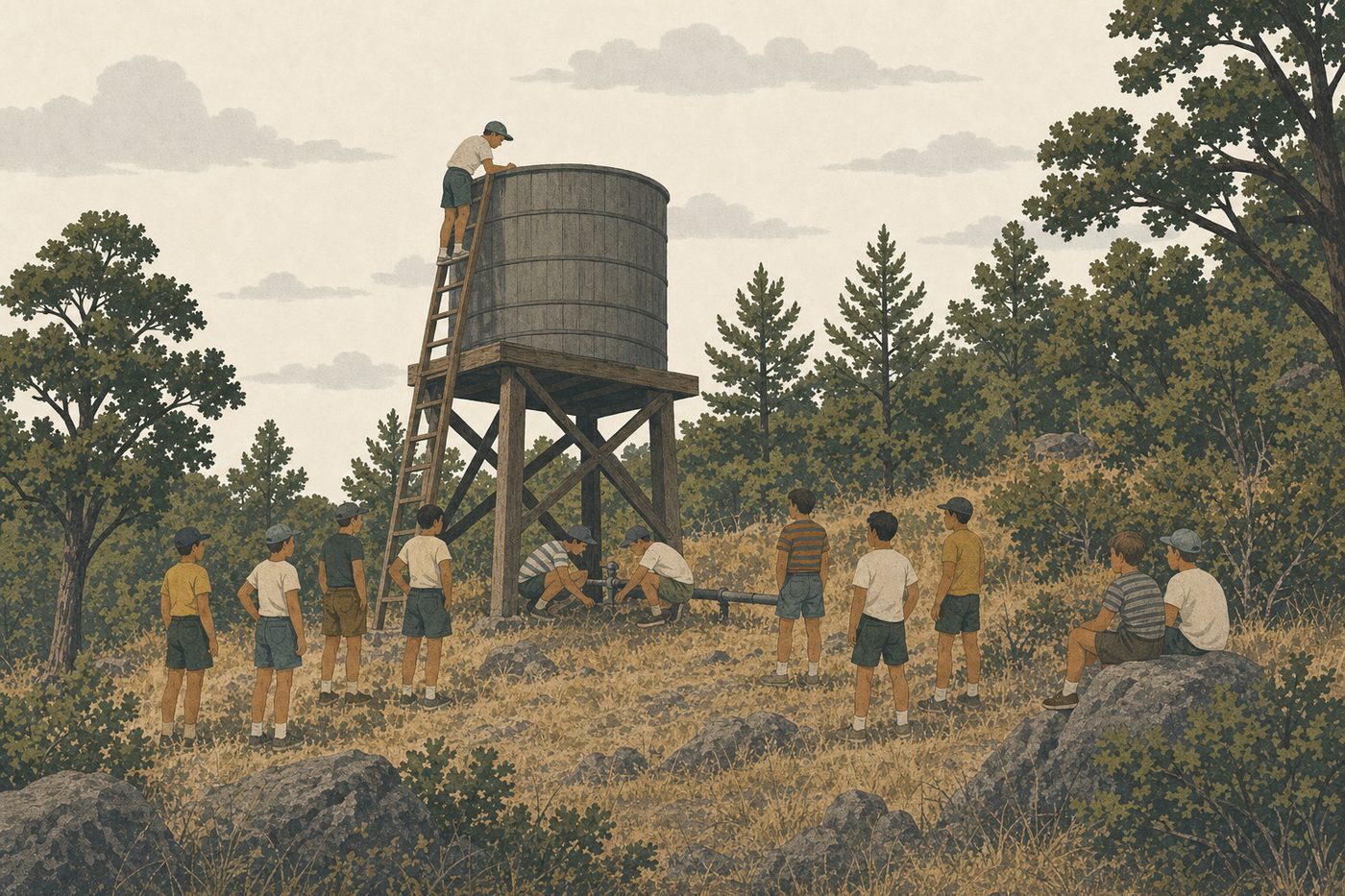
Muzafer Sherif's Robbers Cave experiment is his evidence. Two groups of ordinary boys, given a week of competition for pocket knives, went from good sportsmanship to raids and rocks in their socks. Bringing them together to eat and watch films made it worse. What worked was a problem neither could solve alone: the camp's water supply failed, both groups walked the mile to the tank, found the blocked valve and fixed it, and after enough of those the winners spent their prize money on malted milks for everyone. Then Weimar, four marks to the dollar in 1914 and 4.2 trillion in 1923, savings gone, a party at nineteen percent of the vote in 1930 and absolute power three years on. Then Milgram, where 65 percent of ordinary people delivered what they believed was a 450-volt shock because a man in a lab coat told them to continue. His conclusion is that inequality in a world of possible abundance breeds the extremism, and that the extremism is a symptom.
"The simple fact is that there is only one human race and all of us belong to it." — Ch. 8
The game-theory chapter that follows is the argument for hope. The prisoner's dilemma makes betrayal rational once; Axelrod's tournaments found that when the game is played over and over, tit for tat, cooperating first and forgiving as soon as the other side does, beats nearly everything. Booth reads the twentieth century as a long run of the cooperative strategy, bets rewarded and losses eaten, and 2008 as the moment the cheaters were paid, which is his definition of crony capitalism. His last thought there ties the halves together: abundance shrinks the prize for betrayal. Nobody fights over oxygen.
The simple solution
The final chapter sorts every proposal he's heard by Dalio's levers and finds them all on two: print, or tax and transfer. Universal basic income gets a fair hearing and is set aside because it treats the symptom and hardens a two-class society around it. Then he asks the question the title was built for.
"What if the natural order of things was permitted?" — Ch. 10
Let prices fall. Let the deflation happen at the rate technology makes it happen, so that a family earning less each year lives better, so that the people who lose their jobs to the machines share in what the machines make cheap without anyone having to take it from anyone else, and so that things which reach zero are allowed to be free. He admits at once that no government will give up the printing press voluntarily and that one country can't do it alone. His route around that is trust. A currency is paper with faces on it and an agreement, and every time a government changes the value of the paper the agreement weakens. Bitcoin arrives on the second-last page, cautiously, "or something different," with a fixed supply and no one to manipulate it, already a lifeline in Venezuela, and he settles the volatility objection in one line: in 2018 he would rather have lost thirty percent on bitcoin than 1.8 million percent on the bolívar. He ends with the death of his brother and the one lesson he took from it, that a life is measured by its effect on other people, and asks the reader to argue with him.
Through the Orenda lens
My own book borrowed Booth's sonic boom because he had named something I'd been watching from the grocery shelf rather than the screen. The line I wrote beside it:
"Technology keeps making the screen cheaper. Nothing is making the food cheaper."
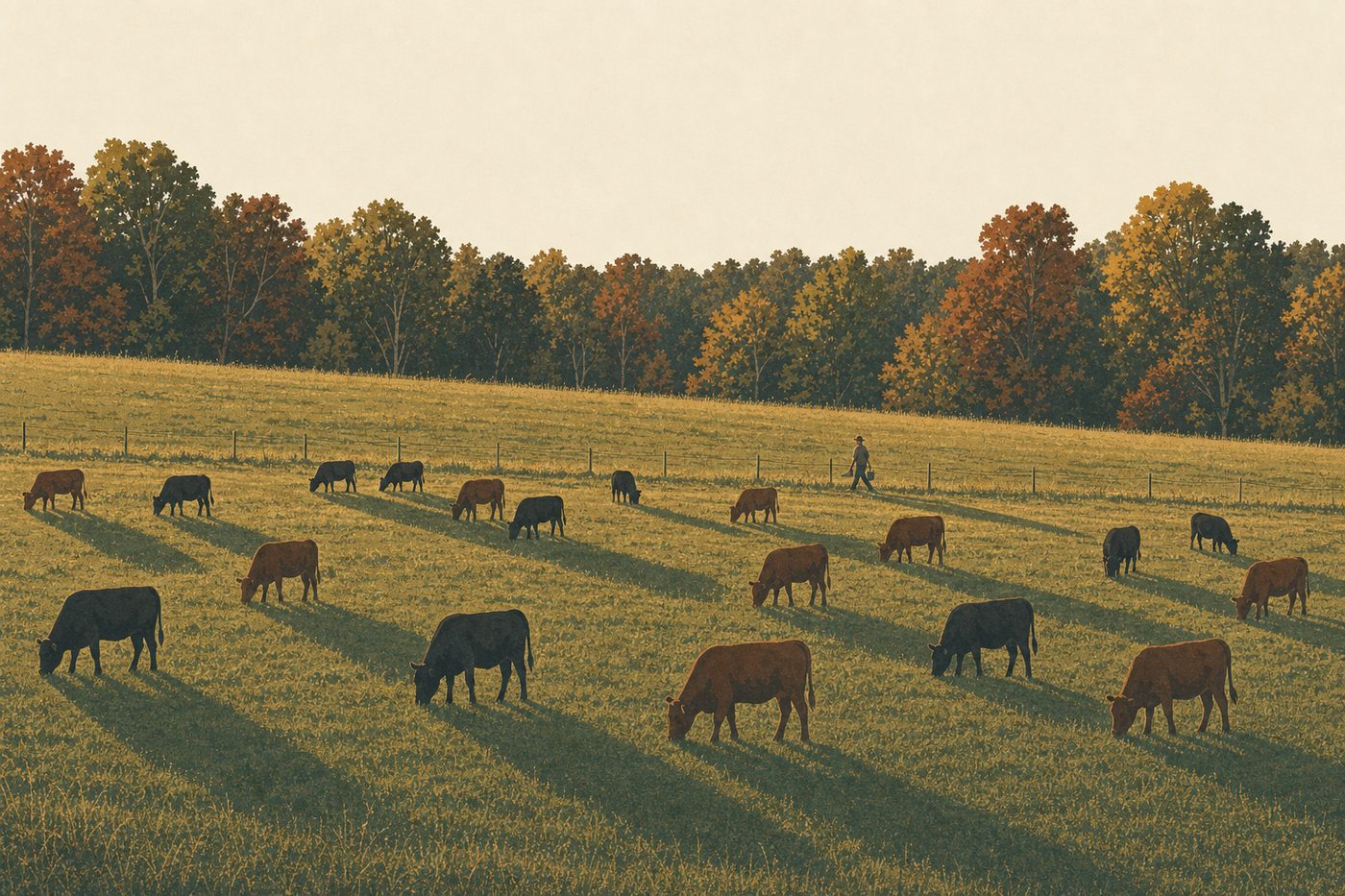
Six years of price data since his book have made it plainer than either of us expected. A television is a doubling machine and a steer is not. Grass grows at the rate of grass, a calf takes the months it takes, and no amount of compute changes the length of a season. So the first thing a farm takes from this book is a division Booth draws without quite saying it: deflation belongs to made things. The things that are grown have a floor, set by sunlight and rain and the biology of the ground, and when everything manufactured has fallen toward free, what a farm sells is what will still be worth paying for.
The second thing is his energy chapter, which is a description of this farm written by someone who has never been on one. Every joule in a barrel of oil came from the sun through plants, and the economy he wants is one that stops digging up stored sunlight and takes it straight. A pasture does that. Sun to grass to cattle, no exploration, no refinery, no ship. The industrial version of a farm runs the oil supply chain onto a field, because the nitrogen in the fertiliser is made from natural gas and the diesel in the tractor is the rest of his gasoline story, and the only reason it looks cheap is the money. Keep the ground covered, move the cattle, let the roots feed the soil and the soil feed the grass, and you have let the sun shine in on a piece of land the way he wants it let in on a grid. The thing he'd call abundance, energy arriving at no cost from the sky, is the oldest business model there is.
Where he and I meet without either bending is the debt. His four dollars for one is the world's figure; the chart in my own book found the same number for the United States:
"In the 1960s it took about a dollar-thirty of new debt to buy a dollar of growth. By the 2000s it took nearly four. It has settled around two-sixty since, which is not a recovery — it is double the 1960s price, permanently."
Booth's answer to that is a money nobody can print, and he gets there carefully, because in 2020 saying it plainly still cost a businessman credibility. This farm got there by a shorter road. A herd is a slow, thin-margined asset, and the savings that carry it between one sale and the next have to hold their value without being managed, which is the whole reason this farm keeps its savings in the hardest money it can find.
Where I part from him is on jobs, and it matters here because a farm is work. He treats labour as the waste technology removes, and for a warehouse or a radiology department he may be right. The work on this ground is moving animals, reading grass, mending fence, and none of it is a combinatorial problem waiting for a bigger model. It is a biological process attended by a person at the speed of the process. The abundance he describes would make everything around that work cheap, the fence wire and the truck and the phone in my pocket, and leave the work itself as one of the few things a machine does not do better. That is the best future for a small farm I have read in a technology book, and it's the reason his is on this shelf rather than on the pile that wants to disrupt agriculture. He never says the word regenerative. The only farm in his book is a pesticide startup in the preface. But the physics he lays out in the energy chapter is the case for grazing, and he made it without knowing.
What's happened since
The book was published on the fourteenth of January 2020, and the sonic boom he expected arrived inside two months as a pandemic, which produced the largest single year of printing in the record. Then the thing his title says can't hold went the other way for a while: consumer prices in the United States are up 29 percent since the month he published, and food bought to cook at home is up 32 percent, while the government's own index for personal computers is up less than one percent, which is his whole first chapter in three numbers. He would say, and did say, that the inflation was the printing meeting the deflation, and the record of the money supply in those years is on his side. Global debt reached $348 trillion at the end of 2025 by the count he used, a hundred trillion more than when he wrote, and the ratio to income came back down only because inflation grew the income. The negative interest rates he found so alarming are gone; Japan, the last to hold them, ended them in March 2024. Solar did what he said and faster: a module that cost 47 cents a watt in 2019 cost 27 in 2024 in the same dollars, and the world made 2,778 terawatt hours of solar electricity in 2025, six times the figure in his chapter and a third more than the year before. The self-driving car came later and smaller than his "widespread by 2025": Waymo carries about half a million paid rides a week across fourteen American cities, and drivers are still more than three percent of the workforce. The intelligence chapter aged best. The chatbot that put his question on every front page was released to the public in November 2022, and the argument he was having with Carney about whether the jobs come back is now the argument everyone is having. Bitcoin was under ten thousand dollars when the book came out and passed a hundred thousand in December 2024, and the author who reached for it with "or something different" attached now runs a venture fund that invests only in companies built on it. Read him for the four dollars, the steamroller, the paper folded to the sun, and the water tank. Take the timelines as a founder's timelines, early by habit, and right about the direction every time so far.