

In short
On the day before harvest in 1995, a hailstorm took every acre of Gabe Brown's spring wheat. His in-laws had farmed the same ground for thirty-five years and been hailed twice, so he had not bought hail insurance. The following July it happened again. The April after that, a blizzard buried a ten-foot windbreak and his cattle crowded together in it and trampled fourteen of their own calves, which he dug out of the drifts over the following days. Then the summer went hot and dry and he did not harvest a single acre. Then, in June 1998, the hail came back and took eighty percent of what was standing.
Four years, four disasters, and none of his neighbours had all four. What makes the book worth reading is what he found in the wreckage. With no money for fertilizer he had not fertilized; with no money for herbicide he had not sprayed; with nothing worth harvesting he had left four years of flattened biomass lying on the ground. And when he put a spade in that ground he found earthworms, which had never been there before, and soil that had gone dark and crumbly like chocolate cake. The land had started rebuilding itself while he was going broke.
Dirt to Soil is the account of the twenty years after that, written by the operator rather than an observer, which is what makes it rare. Brown grew up in town in Bismarck, North Dakota, married a farmer's daughter, and bought 629 acres from his in-laws in 1991 on sixteen inches of annual precipitation. The ranch is now around 5,000 acres seven miles east of the city, running cattle, sheep, pigs, laying hens, bees and orchards across seventeen stacked enterprises, with no synthetic fertilizer since 2007 and yields about twenty percent above the county average. He wrote it with Courtney White, who describes his own job as word-wrangling, and who interviewed the eight other farmers whose stories fill chapter nine. The evidence throughout is Brown's own: his soil tests, his infiltration rates, his cash flow.
The thesis is in the title, and it is a claim about life rather than chemistry. Geology gives you sand, silt and clay. Only biology turns that into something that feeds.
The thesis
"Dirt becomes soil not simply because there is enough organic matter in the soil but because there's life in the soil—and not just any life but the full spectrum of soil biology." — Ch. 3, The Fusion of Life
The great white combine
The thing to understand about the disaster years is that Brown was doing everything correctly. He had studied agricultural economics and animal science, joined Future Farmers of America in the ninth grade, and learned the where, why and how of fertilizers, pesticides, insecticides, fungicides, artificial insemination, feedlots and balancing rations. He had done better than his father-in-law, who practised what Brown calls recreational tillage and loved to sit on a tractor pulling a heavy disc through a field. In 1994 a friend in the north of the state talked him into no-till, and gave him the only piece of advice that could make it stick: sell all your tillage equipment so you cannot go back. He did, and bought a fifteen-foot John Deere 750 drill with the proceeds, and used it for twelve years.
The first no-till year was the best he had ever had. Yields up, field peas added to fix nitrogen out of the air, spring wheat at fifty-five bushels an acre selling at $4.58. Then the hail.
What the failures did to the balance sheet is the part most accounts of this book skip. The banker would not lend against anything but what the surviving calves would fetch at commercial prices, and would not count grain income above what federal crop insurance guaranteed, which after two zeroes in the proven yields was almost nothing. Brown and his wife Shelly both took off-farm jobs barely above minimum wage. He worked forty hours a week and farmed at night, nodding off in the tractor, and his father-in-law remarked on how crooked the rows were. Their daughter Kelly had scoliosis and needed a new moulded body brace every six months at several thousand dollars each, which insurance did not cover. The only reason the bank did not take the farm was that the land was on a contract for deed with Shelly's parents, so all the bank could have seized was two John Deere tractors, a square baler and the drill, and they judged the paperwork was not worth it.
After the last hailstorm the crop was gone early enough to seed something, so he put in sorghum, sudangrass and cowpeas. It grew well. He could not cut it for hay because he did not have the money for twine. So he left it standing and let the cattle graze it through the late fall and into the winter, which he now recognises as his first winter grazing and which at the time was simply what a man does when he cannot afford string.
He is not romantic about it and he is not quiet about what it cost. He is also unambiguous about the result.
"Today, I tell people that those four years of crop failure were hell to go through, but they turned out to be the best thing that could have happened to us because they forced us to think outside the box, to not be afraid of failure, and to work with nature instead of against her." — Ch. 1, Seeing Things Differently
The worms came back
He noticed the earthworms first, and the way he puts it is that he used to joke they could never go fishing because there were none on the farm. Then there were. Then he looked out of a window one evening and a pheasant flew past, which had never happened, and deer and coyotes and hawks started turning up. The Natural Resources Conservation Service came back and retested the soils and found the organic matter had risen during the years he was failing.
Two realisations came out of that, and the first is the one the whole book turns on. He had been trying to hold a degraded place steady. He had accepted its condition as the baseline and was working to stop it getting worse, which is what everyone around him was doing and what the word everybody uses describes exactly.
"Why in the world would we want to sustain a degraded resource?" — Ch. 2, Regeneration
The second realisation was mechanical. By not tilling for five years, adding legumes, leaving the biomass where it fell and running almost no chemistry, he had accidentally rebuilt the habitat. Mycorrhizal fungi had repopulated, and those fungi secrete a glue called glomalin that binds soil particles into aggregates, and the spaces between aggregates are where water goes and where most soil microbes live. The house had been rebuilt, so the tenants came back. His summary is that there is always some life left in even the most abused ground, and if you stop destroying it, it responds.
The framing he uses for all of this came later, from a soil scientist called Ray Archuleta, who arrived on a ranch tour wearing an expression Brown read as disagreement and which turned out to be a man having his training come apart in real time. Archuleta had spent eight years studying agronomy and had been taught, as Brown had, that agriculture is the business of killing things with pesticides, insecticides and fungicides and then applying chemicals to drive growth. What he was looking at was an eight-way cover crop mix thriving in a dry year. He called what he saw the fusion of life, and the line he ends on is the cleanest statement of the book's title: without life, we might as well be farming on the moon.
The sentence that gave Brown the shape of the change came from a Canadian rancher named Don Campbell, at a conference in Bismarck he scraped together the money to attend in the winter of 1997.
"If you want to make small changes, change the way you do things. If you want to make major changes, change the way you see things." — Ch. 1, Seeing Things Differently
Four years of split fields
In 2003 Brown met Kris Nichols, a soil microbiologist at the USDA station across the river in Mandan, and asked her out to look at the ranch. She walked it and delivered a verdict he has quoted ever since: he had come a long way, but his soils would never be sustainable until he removed his synthetic fertilizer.
The mechanism she explained is the engine of the book, and it is an economic one. A plant does not get its minerals for free. It manufactures sugars by photosynthesis and spends a large share of them underground, leaking them out of its root tips as exudates to buy nutrients from microbes that can solubilise what the plant cannot reach. The Australian soil ecologist Christine Jones, whose work Brown found through her website and quotes throughout, calls the exudates liquid carbon. Some species push up to seventy percent of everything they capture into the ground this way. The fungal network that receives it is what Brown calls the streets and avenues of the soil.
Spread soluble fertilizer and the trade stops, because the plant no longer needs to pay for what is being handed to it.
"Synthetic fertilizer interrupts the relationship between microbes and plant roots because the fertilizer gives plants “free” nutrients, so they don’t need to trade carbon for nutrients from microbes." — Ch. 2, Learning More About Mycorrhizae
Brown's response was not to believe her. It was to test it, on his own ground, for long enough that weather could not explain the answer. Starting in 2004 he split fields in half, fertilized one side at a reduced rate and left the other bare of inputs, and ran it for four years to cross wet seasons and dry ones. Every year, on every field, the unfertilized half matched or beat the fertilized half. He has bought no synthetic fertilizer for his own land since 2007 and none for rented land since 2010.
He attaches a warning to that which is easy to skip and shouldn't be. Soil that has been fed for decades cannot be cut off at once, because the biology that would do the work is not there yet.
"Soils accustomed to synthetic fertilizer are like drug addicts: They need to be weaned off their addition slowly." — Ch. 3, opening
There is a larger version of the same finding that is not his, and it is the most damning number in the book. The Morrow Plots at the University of Illinois have grown corn on the same ground for over a century. In 2009 the researchers running them published a paper reporting that despite applying at least sixty percent more nitrogen than the corn removed as grain, total soil nitrogen had fallen by between 624 and more than 1,600 pounds per acre. More going in than coming out, and the account still shrinking. Their conclusion is the flattest sentence in the literature.
"The prevailing system of agriculture does not provide the means to intensify food and fiber production without degrading the soil resource." — Ch. 7, Principle One, quoting "The Browning of the Green Revolution," 2009
We make our own drought
The Brown ranch gets about sixteen inches of moisture a year, of which eleven is rain and the rest arrives as seventy-odd inches of snow, and a good part of the rain comes in thunderstorms that drop an inch or two in a few minutes. When the NRCS tested the ground in 1991 it could absorb half an inch an hour. That is the whole problem stated as a single number: the sky delivers water faster than the soil will accept it, so most of a storm leaves the property across the surface, taking topsoil with it, and the crop is thirsty three weeks later on land that was flooded.
By 2009 the rate was above ten inches an hour. On the fifteenth of June that year it started raining at half past five in the evening and did not stop until the following morning, and 13.6 inches fell in twenty-two hours. Almost all of it went into the ground. Jay Fuhrer, the county conservationist, came out to look and said you could have driven a vehicle across the fields without making a rut. In 2015 a researcher filmed an infiltration test on the cropland: one inch of water disappeared in nine seconds, the second inch in sixteen.
"It's not a question of how much total rain falls on your land, it's how much can infiltrate into your soils and then be stored there that counts. That storage ability is called effective rainfall. If we have low amounts of effective rainfall, we create our own drought." — Ch. 3, opening
The storage half of that runs on organic matter. Every one percent of it holds somewhere between 17,000 and 25,000 gallons of water per acre, so his ground went from holding roughly 40,000 gallons an acre in 1991 to well over 100,000 by 2017. He tells the story of touring a California ranch where the owner talked at length about the drought they had been suffering for five years; the pastures were annuals with a few inches of growth and roots that went nowhere. He asked how much rain had fallen that year. Thirty-two inches, she said, only thirty-two inches. He has the same comparison in row crops: farmers in an Arkansas county that receives fifty-four inches a year putting another fifty inches of irrigation on to make 175 bushels of corn, which is 1.7 bushels for every inch of water, against his own 127 bushels on 15.7 inches, which is 8.08.
The cleanest evidence he produces is a comparison he did not control. Four farms on the same soil type, close enough together that the weather is identical, sampled and infiltration-tested on the same day, with the soils run by Rick Haney's lab in Temple, Texas. One is a diverse tilled grain operation using no synthetics at all. One is minimum-till with anhydrous ammonia. One is long-term no-till with medium diversity and heavy chemistry to chase yield. The fourth is his.
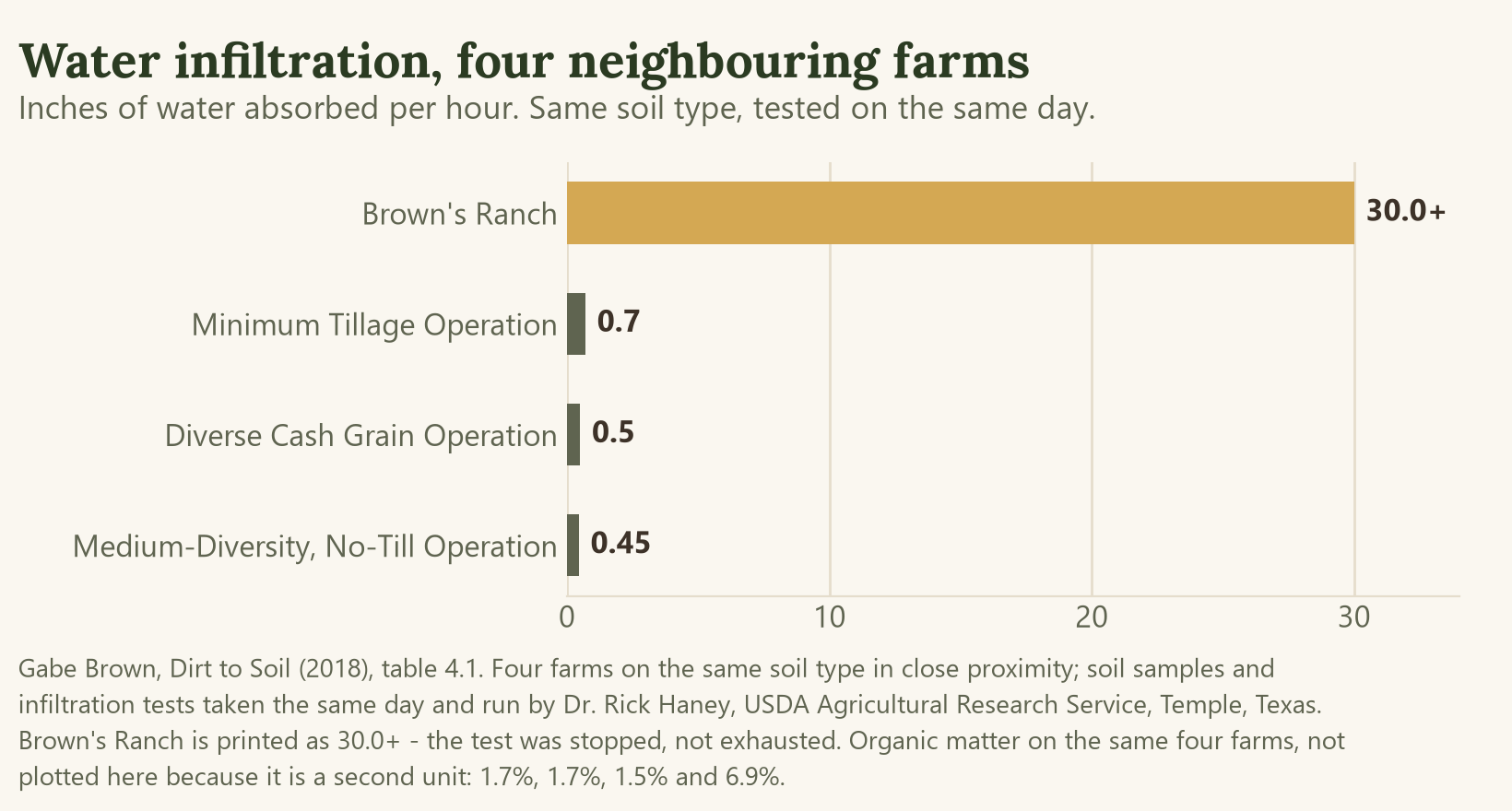
What he draws attention to is not his own bar. It is that the other three are indistinguishable from each other, at 1.5 to 1.7 percent organic matter and under an inch an hour, despite being farmed in three different ways — one of them with no synthetic inputs whatsoever. Dropping the chemistry while keeping the tillage bought that operation nothing the instruments could find.
Seven or eight species
The first thing Brown did with his new pasture ground in 1993 was seed 200 acres of cropland back to perennial grass, using a mix of smooth brome, intermediate wheatgrass and pubescent wheatgrass because that is what was recommended. It established beautifully and produced almost nothing. The plants were spindly, the leaves small and thin, almost nothing set seed. He had put three cool-season grasses into ground whose fungal networks had been destroyed by decades of tillage and fertilizer, with no legume and no forb, and the seedlings germinated into starvation. The experts he asked told him to apply fertilizer. He had no money, so he ran a trial instead, interseeding ten different legumes one to a paddock with one left as a control, and learned by watching which ones persisted.
The idea that changed his cropping came from a Brazilian agronomist, Ademir Calegari, speaking at a No-Till on the Plains conference in Kansas. Two things stuck. The first was that you can grow a cover crop on two inches of annual precipitation or two hundred, and the excuse Brown hears everywhere — too dry here, too wet here — is an excuse. The second was that cover crops are meant to be planted as mixtures, and that the benefits stop being additive somewhere around seven or eight species growing together. Brown's own recorded reaction is Gabe, you idiot! That is how prairie ecosystems function!
The test ran the following year and it ran in a drought. The Burleigh County Soil Conservation District seeded one-acre plots in late May: eight species as monoculture strips, and six of them together as a blend. About an inch of rain fell between seeding and late July. The polyculture plot produced three times the biomass, and they clipped, dried and weighed a comparable area of each to prove it, although Brown says you could see it from the road. Nichols's explanation is that the fungal network does not serve one plant; the hyphae connect many of them, and a diverse stand feeds a diverse microbial population that in turn can supply a wider range of needs.
He took it further than was sensible, which is a habit. In 2012 he planted thirty acres with more than seventy species — twenty-odd cover crops, twenty-odd annual flowers, and a long list of vegetables including five varieties of sweet corn, four of peas, four of beans, squash, melons, kale, beets, cabbage, cauliflower and onions — in a below-average rainfall year, and it thrived. It was called the Chaos Garden. It was also impossible to harvest. Shelly would send him out for a vegetable for supper and he would bring back whatever he had tripped over.
The principle survived; the layout did not. The home garden now runs in rows fifteen inches apart, corn beside peas beside beans, a grass cycling phosphorus next to legumes cycling nitrogen with fungi carrying the trade between them. Nothing is tilled, including the potatoes, which are laid on the surface under a thin layer of alfalfa hay and lifted by pulling the hay back. In late fall the mobile chicken coops are towed onto the garden to clean up what was not picked, and then a round bale of alfalfa is unrolled over the whole thing for the winter, because in North Dakota there are not enough frost-free days to grow a cover crop after vegetables and bare ground is not an option.
A bite is a wound
In early 2006 Brown gave a talk at a forage conference in Manitoba and was cornered afterwards by a short bald man with a handlebar moustache who insisted he come up to his hotel room. Brown declined, repeatedly, and eventually relented. The photographs on the laptop were of a ranch near Wawota, Saskatchewan, where Neil Dennis was running cattle at stock densities Brown had not believed were possible. They talked until three in the morning, at which point Dennis's wife asked to borrow Brown's room key so she could get some sleep.
Stock density is simply liveweight per acre at a given moment. Brown's in-laws ran about 250 pounds an acre and moved the cattle rarely. Brown at that point was at 50,000 pounds an acre, moving daily, and thought he was doing well. Dennis was regularly at 800,000 and had touched a million, with the cattle in a paddock for hours rather than days. His organic matter had more than doubled and his infiltration rate had reached sixteen inches an hour. The first person to notice anything was the man who graded the county roads, who stopped one day to ask why Dennis's place looked better than everyone else's along the route.
Why an animal should build soil at all is the mechanism Brown had been missing, and Nichols supplied it.
"Grazing can also stimulate exudate production (carbon secretions) in roots because physiologically a plant considers a bite by an animal to be a wound, which requires a healing process analogous to what happens when a scab forms on your body." — Ch. 2, Bale Grazing
A grazed plant needs nutrients to repair itself, so it spends more carbon buying them, so the microbes eat better. Grazing also holds the plant in a vegetative state rather than letting it run to seed, which keeps the carbon flowing down instead of up. Nichols's framing is that an ungrazed plant is lazy and a plant, like an athlete, needs the right amount of stress to perform. The prairie soils Brown farms were built this way, by bison that ate hard in one place and then left because something was hunting them, and did not come back for a long time.
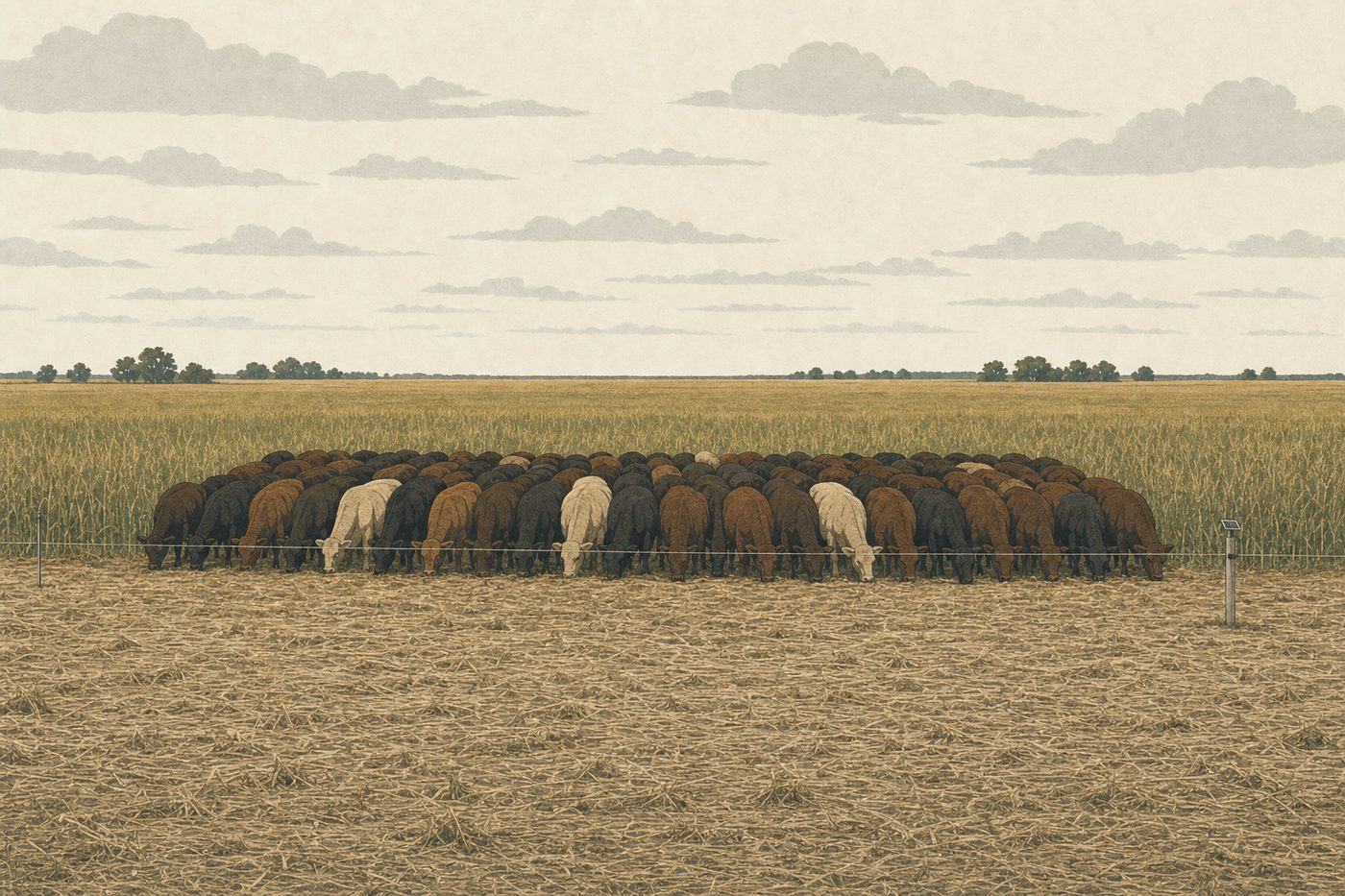
Driving home from Saskatchewan, it occurred to Brown that if the animal was the tool, he had been keeping the tool off most of his farm. Livestock had been confined to pasture in the growing season, allowed onto the crop fields only after harvest. So he began seeding cover crops on cropland and grazing them during the growing season at 600,000 to 700,000 pounds an acre, rotating fast. It worked, and the cropland began to behave like the pasture.
The same logic ended the winter feeding routine. Rather than hauling hay out to cattle standing in a corral for five months and then hauling their manure back out to the fields, he sets the bales out in the pasture in the autumn and gives the herd access to a week's worth at a time behind a wire. The tractor gets started once a season. The dung and urine land where they are wanted. Burleigh County staff came out and clipped and weighed the forage the following year and found bale-grazed paddocks producing three times the biomass of the others, at higher protein. Brown's own verdict on the years he spent in a loader tractor for three or four hours a day: he had forgotten his cattle had legs.
It is also the ground for the one argument in the book he seems to enjoy having.
"It is not the cattle that are the problem, it is our management of them!" — Ch. 7, Principle Five: Integrate Animals
Nature does not care about yield
By 2007 the cows averaged over 1,400 pounds, because Brown had spent twenty-six years selling registered Gelbvieh bulls into a market that pays for weaning weights, yearling weights and expected progeny differences. The bull business had grown into six breeding herds, a sale catalogue, photographs, free delivery, and a December he had learned to dread, since the day after Christmas was when the bull-washing and trimming started. He noticed that the few small cows left in the herd were always in good condition and always bred back. The big ones cost a fortune to feed. The numbers he had been touting for a quarter of a century turned out to have nothing to do with whether the operation made money.
The sentence that ended it came from his son Paul, in 2010, after Brown complained that their corn yields were good but not as good as the neighbours'.
"Dad, don't you think that you are trying to outproduce our environment?" — Ch. 10, opening
They held the February 2009 sale and then stopped. They stopped worming, fly-tagging and vaccinating, on the grounds that those were treatments for symptoms of a broken ecosystem rather than solutions. They pushed the breeding season back until the cows calved in April instead of February, which is to say they calved when the deer were fawning, and in one move deleted blizzards, mud, frozen ears, sick calves, dirty udders, bedding corrals and the business of babysitting first-calf heifers in the dark. Calves are not weaned in the fall any more; they stay on their mothers through the winter, eating lower-quality forage and learning from the cow which plants to take, how to read a storm and how to use snow for water, and are fence-line weaned in April with the pair able to see and touch each other through a wire.
What replaced yield per acre was profit per acre, and the arithmetic that makes it work is not agronomy. It is the observation that a commodity producer is selling into the thinnest slice of the food dollar there is.
"Producers typically earn only fourteen cents out of every dollar the consumer spends on food products. Why would I be satisfied with only fourteen cents for my products when there is another eighty-six cents out there? Yes, I am a capitalist!" — Ch. 6, Nourished by Nature
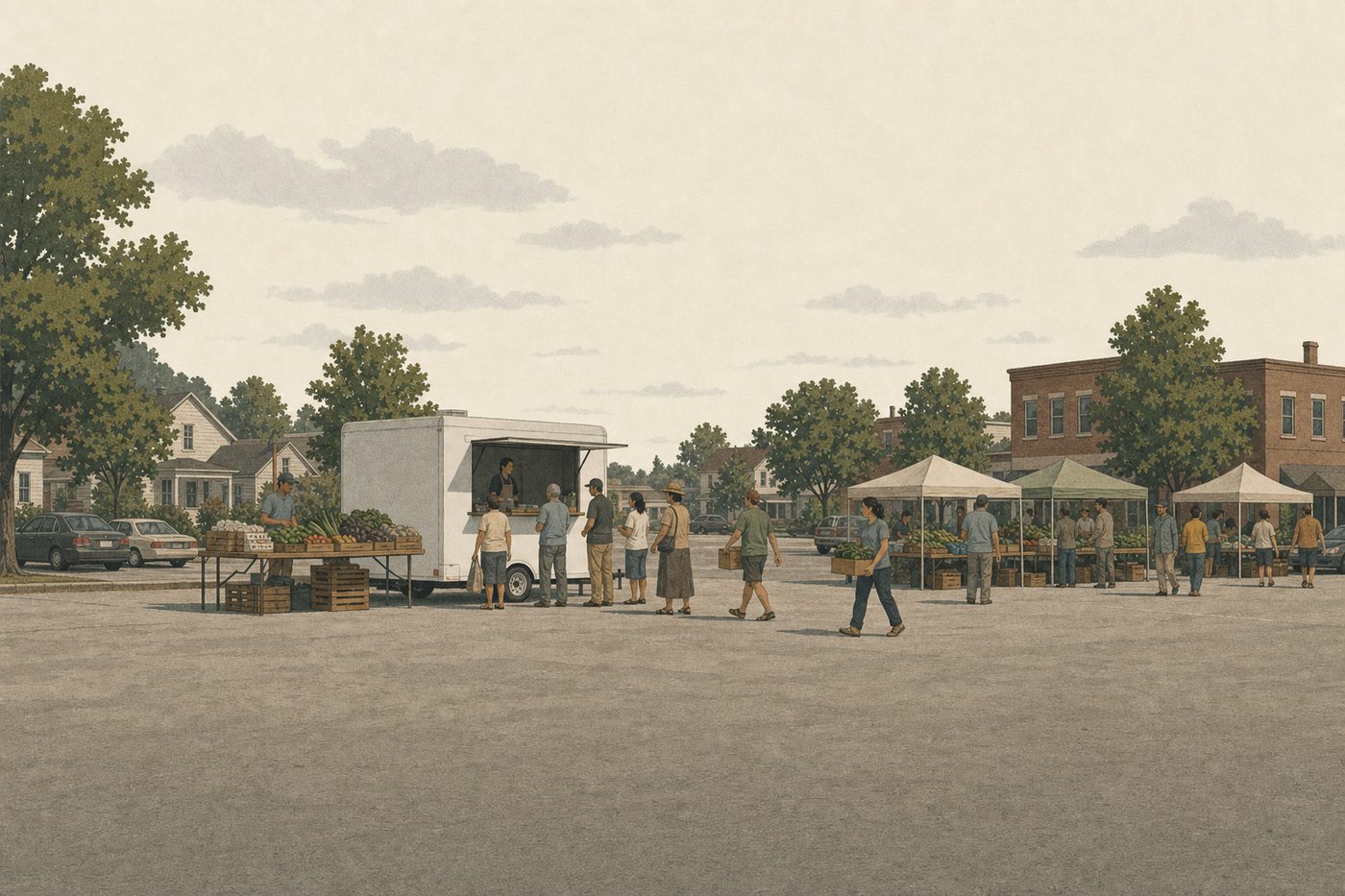
Going after the other eighty-six cents meant building everything downstream of the gate. There were four state-inspected slaughter facilities in all of North Dakota and a thirteen-month waiting list, so in 2012 they joined other producers and investors to raise $1.3 million and build a plant in the town of Bowdon, ninety-three miles away, which opened in 2014. They set up a separate marketing company under the trademark Nourished by Nature, with Paul as sixty percent owner and president making the decisions, deliberately, because Brown has watched too many farm families where a fifty-year-old child has never been allowed to run anything. They gutted the 1950s laying-hen building Shelly's parents had put up, insulated it, filled it with chest freezers, and started with $10,000 and no borrowing. It now holds eleven freezers and three refrigerators and supplies over 1,200 families.
The enterprises stack on each other's waste. Grain is cleaned for seed and feed, and the screenings that an elevator would dock him for go to the laying hens and the hogs. The hens follow three days behind the grass-finished beef herd so that the fly larvae in the manure are exactly ready, in portable coops Paul built out of an old stock trailer with expanded metal for a floor and a photosensitive door. Eggs from a factory go for about sixty cents a dozen; Paul charges $4.50 and cannot keep up. An apiary keeps hives on the ranch and reports getting nineteen percent more honey there than on its other sites. Hogs root through the previous winter's bale-grazing residue instead of a harrow doing it. There are seventeen enterprises, run by four people and a couple of summer interns.
"The way to make a healthy profit is by taking the waste stream from one enterprise to fuel the profit in another." — Ch. 10, Focus on Profit Per Acre
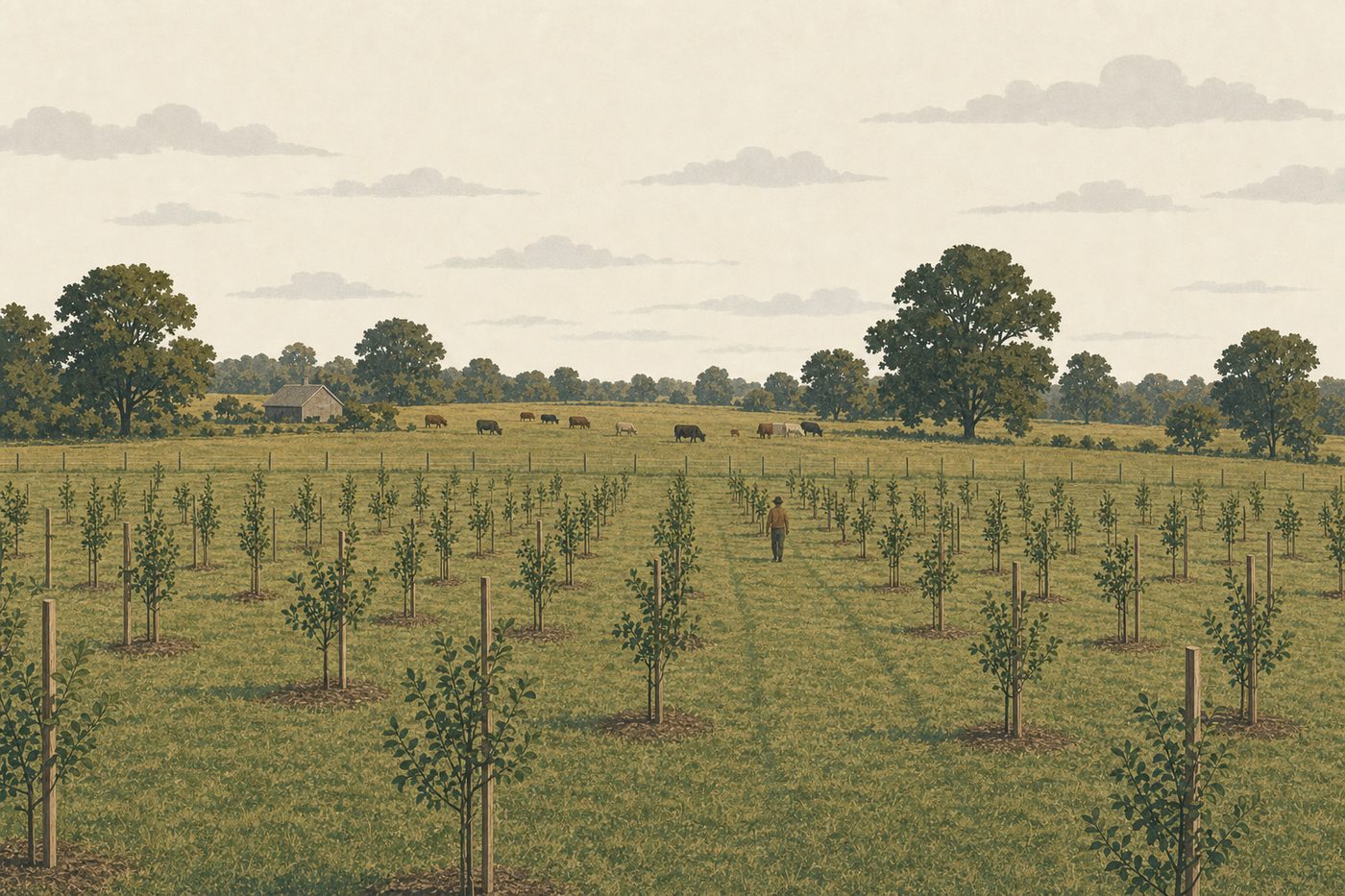
And underneath all of it sits a two-hundred-year plan, which includes a living trust holding the land as one unit so that it cannot be broken up by an estate or a nursing home, and 1,500 fruit trees and a stand of chestnut, hazelnut, filbert and walnut that will not produce for thirty years. Brown treats succession as an ecological test rather than a legal one.
"I believe that a farm or ranch is not truly sustainable until it is transferred to the next generation, family member or not." — Ch. 5, Planning for the Long, Long Haul
Ma and Pa's restaurant
The most politically uncomfortable chapter is the one about money, and its central claim is that American cropping decisions are not being made by agronomy at all.
"I contend that over 95 percent of planting decisions farmers make today are based on how much money they can guarantee themselves by insuring through crop insurance programs." — Ch. 10, The Trouble with Subsidies
The reasoning is simple and it is a price-floor argument. A farmer knows before planting the minimum gross dollars per acre the insurance will deliver. Keep costs under that and the year is profitable regardless of what the field does. No other business gets that, and Brown's example of who does not get it is the restaurant on Main Street. The second-order effect is the one worth carrying around: the guarantee does not stay with the farmer.
"This also drives input suppliers to charge more for their products because they know that farmers are guaranteed this revenue stream." — Ch. 10, The Trouble with Subsidies
Which is to say the subsidy is captured upstream, margins stay thin, farms get bigger to survive the thinness, and the towns empty out. He quotes an Iowa farmer, Paul Aackley, listing from memory the occupied farmsteads and two schoolhouses within a mile of his desk in 1950 and what is there now, and ending on a line about watching a twenty-four-row planter work the adjoining land and realising what the American Indian must have felt when the white man showed up.
Brown took the payments for years — cost share for trees, fences, wells, even auto-steer on the tractor — and then stopped taking all of them. No crop insurance subsidy, no EQIP, no CSP. He calls the decision liberating, mostly because it means nobody else's priorities are inside his cropping plan, and he is careful to say he thinks a case exists for programmes aimed at young producers and veterans. The test he applied to himself was whether his relatives in town could buy their trees at cost share. They could not.
The summer of 2017 is the case he uses. North Dakota got no spring rain and then several days over 100°F followed within forty-eight hours by a frost. Forage collapsed, thousands of cattle were sold off, a disaster was declared and the money started moving. A neighbour's pastures looked like a golf course and he was supplementing feed within two months of turnout. Brown grazed the same number of animals as the year before, stopped moving them daily so they would take more of what was in front of them, and got through it. He was urged to sign up for the assistance, and would have collected tens of thousands of dollars for a signature, and did not, on the grounds that he had not had a disaster. His reading of that summer is that it was mostly a management event wearing a weather event's clothes.
The sharpest thing in the chapter is what he says about the subsidised capital he did accept. Brown's Ranch built over a hundred paddocks of permanent fence with cost-share dollars, and is now tearing nearly all of it out, because permanent fences fix where the animal impact lands and leave the ground beside and beneath them permanently under-treated. Temporary wire can move somewhere new every year. Public money did not merely fail to help; it built a structure into the land that the land did not want, and that now has to be removed at his expense.
Through the Orenda lens
Montgomery gave us the loss and this book gives us the reversal, and they ought to be read in that order. Dirt reads civilizational lifespans as soil budgets: an inch of topsoil every five hundred years against erosion that removes centuries of it in a decade, which gives a plowed society somewhere between eight hundred and two thousand years. Brown attacks the denominator in that arithmetic. In October 2017 he had 119 samples taken to four feet across the ranch, and some of them showed twenty-nine inches of topsoil with good aggregation past three feet, on ground that tested between 1.7 and 1.9 percent organic matter when he bought it. If soil formation is a biological rate rather than a geological one, then Montgomery's clock is not a law of physics. It is a description of what happens when nobody reinvests.
That is the hopeful reading and it is real. The reading I keep coming back to is less comfortable, and it is about how the change actually arrived. Brown did not choose regeneration. He ran out of money for inputs and the land healed while he was failing, and he was three or four years into the recovery before he understood what he was looking at. He is honest enough to put that at the front of the book rather than hide it behind a conversion story. Which raises the question nobody in the movement wants to sit with: if the cheapest, best-documented operation in the country is one that got there by going broke, what exactly is the mechanism by which anyone solvent changes their mind?
The book answers it accidentally, in chapter nine, and the answer is not data. Darin Williams read an article, then talked four neighbouring farmers into driving with him to Emporia to hear Brown speak. All five were no-tillers. One of them changed. The other four went home and told him it would never work on their places, and then made fun of him for three years. Russell Hedrick, a fireman with no farming family and no equipment, cold-called a stranger in North Dakota and got an hour of his time. Jack Stahl sat scowling in the front row in Alberta and was hooked inside two sentences, because he was already about to hit a wall economically. Every single conversion in that chapter runs through a person, usually at the exact moment the old model had stopped paying. Nobody was argued into it. Peer pressure, as Gail Fuller puts it, is the biggest obstacle in agriculture — and it is also the only lever that has ever moved anybody, just pointed the other way. Twenty-five years of measured proof, seven miles east of Bismarck, and the neighbours mostly did not move.
Then there is the part that matters most here, which is the money. Brown's account of crop insurance is a time-preference argument wearing overalls. A guarantee that resets every twelve months makes the twelve-month horizon rational, and once every operator around you is optimising a twelve-month horizon, the input suppliers price to the guarantee and the margin is gone anyway. It is the same shape as every monetary argument on this shelf, and it is why the sound money reading and the soil reading keep arriving at the same place: the financing contest is what sets the horizon, and the only reliable way to win it is not to enter. His answer was to leave the programmes entirely, put the land in a trust so it cannot be split, plant nut trees that will not pay for thirty years, and sell his food to the people who eat it. Two hundred years is not a slogan when it is written into the ownership structure.
Where I would push back is on the arithmetic being bundled. Brown's profitability rests on two changes he made at the same time and never separates: the agronomy, and capturing the eighty-six cents. The agronomy is demonstrated beyond argument on his ground — the infiltration, the organic matter, the yields at twenty percent over county average with no purchased fertility. The claim that this feeds a commodity system is not demonstrated, because he is not in one. He left it on purpose. A grower who adopts the five principles and keeps selling into the elevator gets the input savings and none of the eighty-six cents, and that is a much thinner case than the book's momentum implies. The honest version is that the soil work makes you resilient and the direct marketing makes you money, and you need both, and the second one is a different business with different skills. Selling is the half nobody puts in the soil-health curriculum.
And the line I will take away is the one he throws away in a chapter about resource concerns. I have never been on a farm or ranch, including my own, that is not degraded. That is a man with twenty-nine inches of built topsoil refusing to declare victory. Everything else in the book is more credible because of it.
What's happened since
The movement got infrastructure. In 2017 Brown, Ray Archuleta, David Brandt and Allen Williams founded Understanding Ag, a consultancy that now advises on tens of millions of acres, alongside the non-profit Soil Health Academy that runs the schools. Brown sits on the board of Regenified, a third-party verification scheme that certifies land and products against regenerative practice and outcome standards — which is the movement doing the thing Brown declined to do with organic certification, and worth watching for that reason. The five principles have become six; the one added at the front is context, on the grounds that nature never operates without it and neither should a prescription.
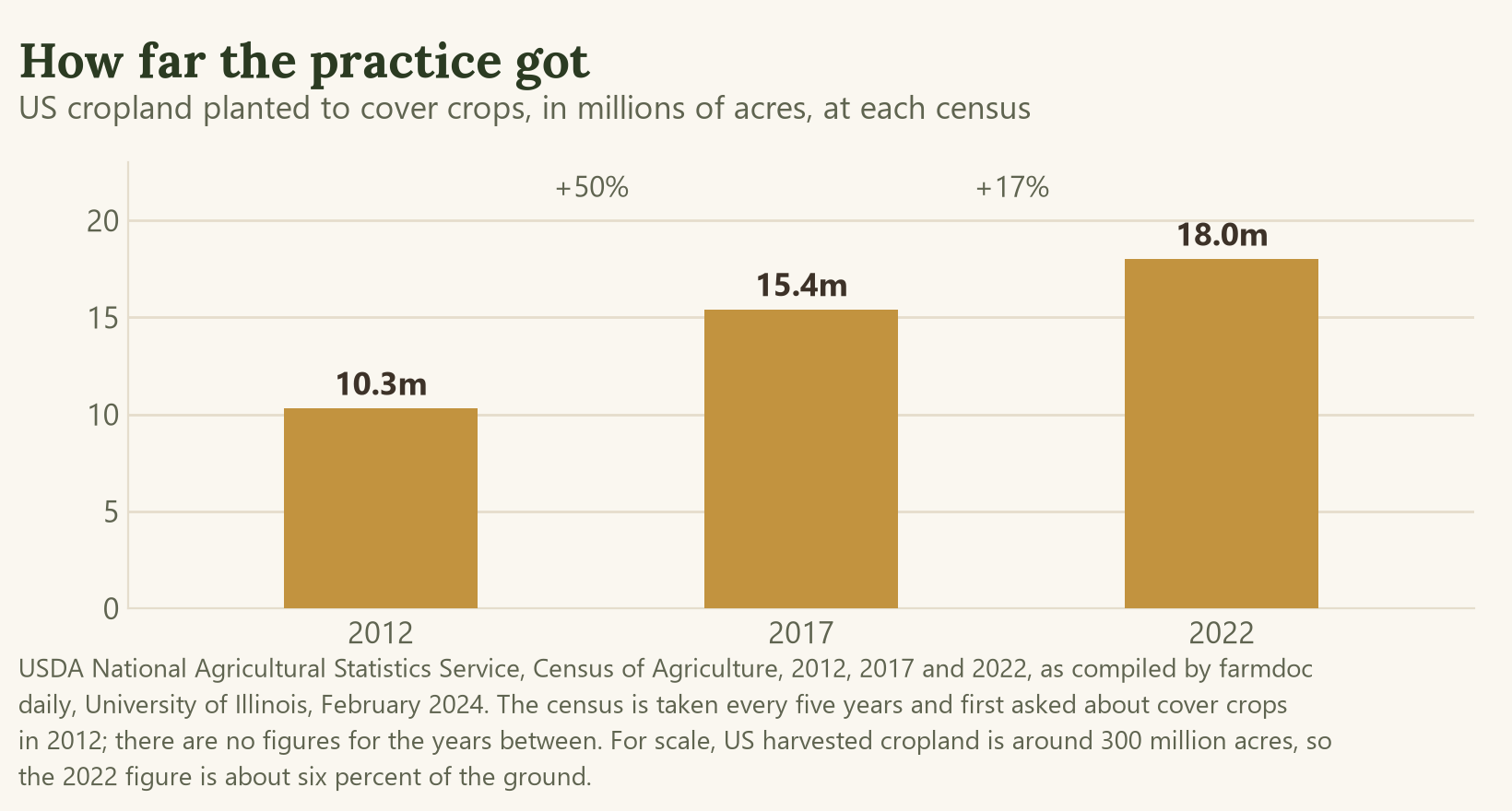
The practice spread, and spread more slowly than the talk. The Census of Agriculture is the only national count, and it says American cover crop acres went from 10.3 million in 2012 to 15.4 million in 2017 to 18.0 million in 2022. Real growth, on the order of eight million acres in a decade, and against roughly 300 million acres of harvested cropland it is still about six percent of the ground. The rate of increase halved between the two intervals. The lever works. It is being pulled slowly.
The claims took fire, and the fire landed on exactly the right place. Andrew McGuire, an agronomist at Washington State, has argued for years under the heading solid principles, extraordinary claims that the practices are sound and the numbers attached to them outrun the evidence; his specific challenge was to Brown's reported organic matter figures, including a jump from 6.1 to 11.1 percent in three years, which Brown says was one field and an outlier and which McGuire suspects is explained by hay hauled in and bale-grazed rather than carbon built in place. That is a fair fight and a useful one. The wider version is the climate claim: the World Resources Institute's read is that regenerative practice is good for soil and a poor lever on emissions, estimating that cover-cropping 85 percent of American cropland would offset about 1.5 percent of US emissions. None of that touches the infiltration rate, the input bill or the food. It touches the part of the story that was being sold hardest.
What has not been contradicted is the operating case. A man on sixteen inches of rain, who started with no farm background and went broke four years running, is farming without purchased fertility at yields above his county, on ground that now takes an inch of rain in nine seconds. Read it for the mechanism, and then go and put a spade in your own ground, because the book's last instruction is two words long and it is not think about it.