

In short
Two men who wrote an investment newsletter published a book in 1997 saying the nation-state was about to go the way of the medieval Church, and for the same reason. James Dale Davidson was an American venture capitalist and the founder of a taxpayers' union; William Rees-Mogg had edited The Times of London for fourteen years and sat in the House of Lords. Together they had already written two books of forecasts, one in 1987 that called the crash and the fall of Communism, and one in 1991 that called the breakup of Yugoslavia, and they open this one by reprinting the record and the reviews that laughed at it. The revised edition, which is the one most people own, came out in 1999 with a long passage on the Y2K bug and an opening scene in which the United States fires two hundred million dollars of cruise missiles at one man's satellite phone.
The argument is that the most important thing about any age is what violence costs and what it pays, and that the microchip has just changed both. For five hundred years the returns to organising force on a large scale rose, which is why the nation-state beat every other kind of sovereignty and why, at the end, democracies and Communists were the two left standing. Now those returns are falling, because the most valuable assets can be made and held in a place with no territory, protected by mathematics rather than by soldiers. A government that cannot reach the wealth cannot tax it or inflate it away, and will have to charge for its services what they are worth. They call the person who takes advantage of this the Sovereign Individual. They say plainly that most people will hate it, and that the transition will be ugly, and they turn out to be right about that part before anything else.
The thesis
"The theme of this book is the new revolution of power which is liberating individuals at the expense of the twentieth-century nation-state. Innovations that alter the logic of violence in unprecedented ways are transforming the boundaries within which the future must lie." — Ch. 1
Persistent make-believe
The second chapter is about why nobody notices when an age ends. In September 476 the last Roman emperor in the West, Romulus Augustulus, was removed from the throne at Ravenna and sent to a villa in Campania on a pension. The man who removed him, Odoacer, did not call himself emperor. He convened the Senate and had it offer the whole empire to Zeno in Constantinople, and made himself Zeno's deputy for Italy. The Senate went on meeting. Consuls were still named for the year, the high offices went on being held by eminent Romans, the imperial insignia came out on public occasions, and the barbarians professed fealty to the East and to Roman law. It was a generation before a chronicler first wrote that the western empire had perished with Augustulus, and Charlemagne believed himself a legitimate Roman emperor in the year 800. The authors borrow a phrase from the Shorter Cambridge Medieval History for the whole period: persistent make-believe. Their point is not that the Romans were fools. It is that every social order makes it taboo to think about how it will end, because the more obvious it is that a system is finishing, the less reason anyone has to obey its laws. A system in its last days says, with all its remaining authority, that nothing has changed, and most people are glad to believe it.
Newsweek had called their first book an unthinking attack on reason; the Wall Street Journal said the second was the nattering of your dopey aunt. They are not wounded by it. They are making a claim about what counts as evidence, and it is the claim the whole book rests on.
"Most political analysts and economists write as if violence were a minor irritant, like a fly buzzing around a cake, and not the chef who baked it." — Ch. 2
What they call megapolitics is the study of the four things that set the price of violence: topography, climate, microbes and technology. Nobody has ever monopolised force on the open sea, which matters for a realm with no territory at all. Greece became a democracy because most of it lies within twenty miles of the coast, so a small farm could sell oil and wine and afford the armour of a hoplite. The seventeenth century was the coldest of the modern period, cold enough that wine froze on the Sun King's table, and the crop failures produced a world of rebellions clustering in 1648. And technology, which now matters more than the other three together, turns on whether the weapons of the day favour attack or defence, whether amateurs on foot can use them, and how widely they have spread. When Jefferson wrote that all men are created equal, a farmer with a rifle could outshoot a redcoat with a musket, and the sentence was truer than it had ever been. Nobody wrote it in 1276, when a farmer had a pitchfork and the man on the horse had everything else.
East of Eden
The third chapter is about what farming did. For ninety-nine percent of the time humans have existed they hunted and gathered in bands of twenty-five to fifty, on thousands of acres a head, working perhaps eight to fifteen hours a week, storing almost nothing because there was almost nothing to store. They had little to steal and could walk away from a quarrel, so violence stayed small and personal. Then, five hundred generations ago, some of them picked up sharpened stakes and went to work, and the authors read Genesis as a memory of what that felt like. Eden, they note, comes from a Sumerian word for wilderness. The expulsion is the move to the field, thorns and thistles and the sweat of thy face, and the first murderer is a tiller of the ground.
"Farming was an incubator of disputes. Farming created stationary capital on an extensive scale, raising the payoff from violence and dramatically increasing the challenge of protecting assets. Farming made both crime and government paying propositions for the first time." — Ch. 3
A crop has to be tended for a season, so the farmer cannot leave. A harvest can be stored, so it can be taken. Raids at harvest time raised the scale of war, larger groups won, and the specialists in violence who took a cut of the crop as the price of protection became, with the priests, the first rich men in history. The first states charged as much as a quarter of the grain and half the increase of the herds. You cannot tax without records, so writing began in the tax collector's ledger. And at the bottom of every farming society, for most of history, sat the closed village: households that dealt with one landlord for everything, paid him a share of the crop rather than a fixed rent so that he carried part of the risk of a bad year, and let the headman redistribute the fields, because when two seeds in three went back into the ground, a field a hundred yards from the next one could be the difference between eating and not. The peasants took the arrangement that lowered the worst case and gave up every chance of getting ahead. Their taboos against trying anything new were, the authors say, their insurance policy, and they would not have needed the taboos if they had had savings.
"Higher savings allow self-insurance of riskier behavior." — Ch. 3
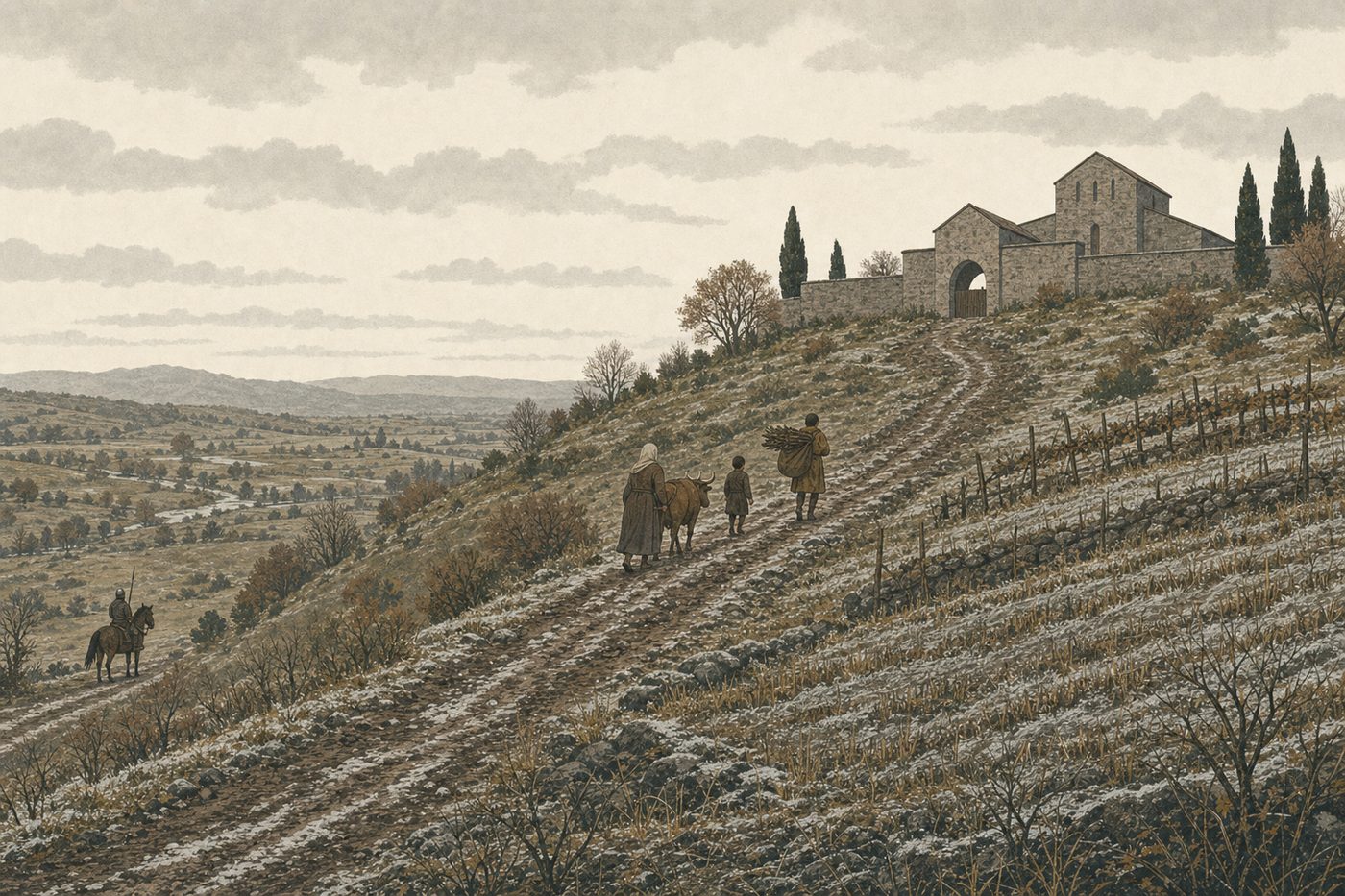
Then the story the whole chapter exists to tell. After Rome fell, the small farmer did rather well for five centuries. The barbarians let the Roman land tax lapse, deserted farms came back into production, the heavy plough opened the northern forests, and before the year 1000 two-thirds of the villagers in a typical part of France held their land freehold. There were few serfs and no nobility as such. Then four things happened at once. Population had recovered and holdings had been divided by inheritance until land was scarce again. The weather turned cold: three crop failures in a row from 982 to 984, another in 994, plague in 997. The stirrup, the nailed horseshoe and the curb bit had made a man on a horse worth dozens on foot, and a war horse cost four oxen or forty sheep, the armour sixty sheep more. And the end of the world was expected, so the devout gave their land to the Church. The freeholders, in debt after the failures and unable to defend themselves, did the only thing left. They gave their fields to the Church or to a bigger neighbour on the condition that their families could stay and work them. The Church negotiated the Peace of God, land deeds began to carry the word nobilis beside names that had carried no title a few years before, castles went up, and within a quarter of a century the yeomen were gone. The nobility as a class was created in about thirty years by cold weather, debt and a change in the price of a horse. The chapter's heading for it is a proverb: only a poor man sells land.
The senile Church and the nanny state
The fourth chapter argues that the nation-state at the end of the twentieth century is where the Church was at the end of the fifteenth, and it spends its length on the Church, which is more fun. Politics, they point out, is a modern word; its first English use is 1529, as an insult. What the Middle Ages had instead was the oath. The Knights of the Star swore never to retire more than four acres from the field, and ninety of them died of it. Henry V, having ordered his patrols to take off their coat armour so that honour would not forbid them to withdraw, got lost in his own armour on the night before Agincourt and, being unable to turn back, slept behind enemy lines. There were vows to keep one eye shut, to eat only standing, to wear a leg iron, and an order whose members dressed in furs by a lit fire in summer and in a thin coat in winter, of whom a great many froze. The authors find it exactly as ridiculous as our great-grandchildren will find a man travelling halfway round the world to die for a nation-state, and for the same reason: a vow that makes people fight is worth any amount of theatre to the institution that needs the fighting done.
By the fifteenth century the institution was the Church, and it was, in a historian's phrase they like, impoverished, grasping and extravagant all at once. Canon law forbade business for a whole year on whichever weekday the last twenty-eighth of December had fallen, in honour of the Innocents. The Vatican owned the alum mines at Tolfa, so buying cheaper Turkish alum was declared a sin. The Church held fisheries, and the faithful ate fish on Fridays. Incest was defined so broadly that most couples in a small village needed a paid dispensation to marry, and married couples were forbidden relations on three days a week and for forty days before Easter and Christmas, which by the authors' arithmetic put more than half the year under licence. Indulgences were sold to the rich and packaged as lottery prizes for the poor. A bishop closed a Paris church for twenty-two days in 1436, weddings and burials included, until two beggars who had bled on the floor paid an impossible fine. And the faithful loathed the clergy for it, high and low, long before anyone said aloud that the system did not work.
"The Church then and the nation-state today are both examples of institutions grown to a senile extreme." — Ch. 4
What broke it was gunpowder and print, and the authors count what the Protestants did with the opening as a downsizing. Faith over works, so no more endowed masses running thirty years; the miser stopped being the arch-villain and the dying paid their debts by dying. The monasteries closed, and the scriptoria with them, because a press did in hours what a monk did in months. And forty feast days were scrapped, which they reckon at three hundred working hours a year handed back to every man who stopped keeping them. The Church had suited a farming world in which a lost day cost little. It could not suit the workshop and the counting house, and it went.
Who controls the government
The fifth chapter opens on the Berlin Wall being broken up with sledgehammers and sold as paperweights, and says the buyers should hold. They rank it as the most important pile of rubble since the walls of San Giovanni came down to Charles VIII's bronze cannon in February 1495, the first blast of the gunpowder age, and they read the two piles in opposite directions. San Giovanni fell because the returns to violence had just gone up. The Berlin Wall was built to keep people in rather than raiders out, which is itself a measure of what the state had become in five centuries, and it fell because the returns to violence had started down. Four years later a President of the United States proposed an exit tax on Americans who renounced their citizenship, and the authors call it a Berlin Wall for capital, justified in the terms Honecker used, that the state has an investment in its people. They put beside it the questions Egyptians asked the oracle in the last years of Roman taxation. Am I to become a beggar. Shall I take to flight. Is my flight to be stopped.
The chapter's real work is a question they say nobody asks: why the last two systems standing at the end of the industrial age were Communism and the democratic welfare state. Their answer comes from Frederic Lane, a historian of Venice who wrote in the 1950s about government as a business that sells protection, and who sorted governments by who controls them. A proprietor, like a medieval lord or the Sultan of Brunei, cuts his costs and keeps his prices high. Employees want more jobs and more spending and will run a deficit before they will cut. Customers, like the merchants who ran Venice, want the service cheap and good. Democracy is supposed to be the customers in charge. The authors look at how it behaves and say it is the employees, with the welfare state as the device that put enough voters on the payroll to make a majority of them. Their test is what a customer would stand for:
"Suppose the phone company sent a bill for $50,000 for a call to London, just because you happened to conclude a deal worth $125,000 during a conversation. Neither you nor any other customer in his right mind would pay it. But that is exactly the basis upon which income taxes are assessed in every democratic welfare state." — Ch. 5
Then the turn. This inefficiency was not a flaw in the age of massed force; it was the winning move. A state that let people get rich and then took a large share of it had more to spend on war than one that owned everything and produced nothing, and far more than one whose customers could refuse. Poland in 1760 had a royal army of eighteen thousand while its nobles fielded thirty thousand between them, because the king had to bargain with magnates who could say no; Austria, Prussia and Russia had found ways round their magnates, kept a hundred thousand men each, and within a few years Poland ceased to exist. The French Revolution did the same thing with a vote instead of a bargain. Direct rule over millions of people who cannot coordinate is cheaper than negotiating with a few hundred who can, and democracy was the decision rule that let the state reach into the pockets of the rich without asking them. The welfare state and the Communist state were fraternal twins. One of them died of old age in 1989, and the authors say the other has the same condition.
Cows with wings
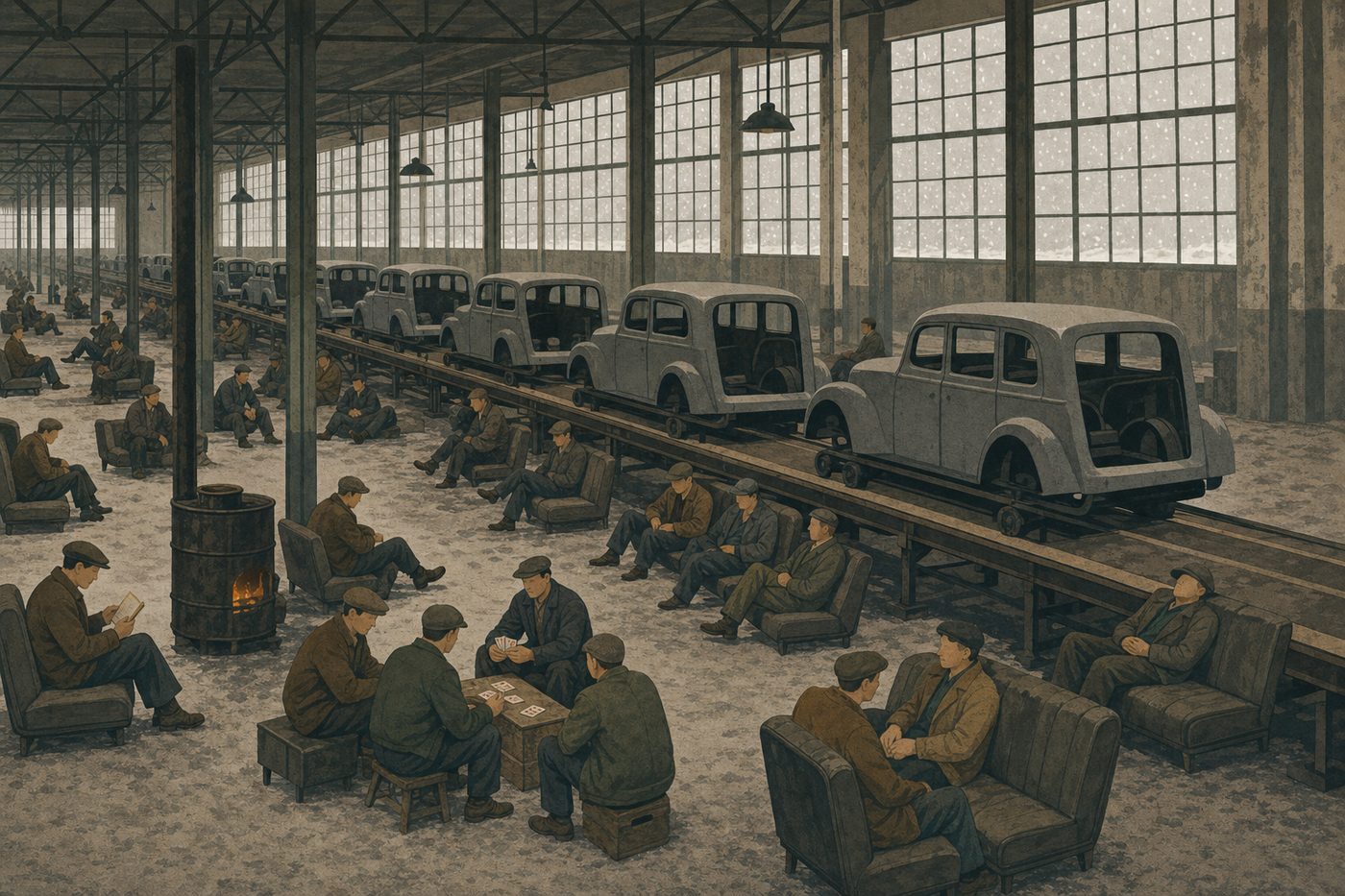
The sixth chapter, the megapolitics of the microchip, starts on the floor of a factory. On the thirtieth of December 1936 auto workers seized two General Motors plants at Flint, Michigan, sat down, and in the ten days after they took a third the largest industrial company in the world built a hundred and fifty-three cars. GM settled. There were nine million Americans out of work, fourteen percent, most of whom could have done a job that took one day to learn; the wage went up anyway, and a hundred and seventy more sit-downs followed in March. The authors call it the exploitation of the capitalists by the workers and explain it as a matter of physics. In 1834 Irish gangs tried to seize the Chesapeake and Ohio Canal, which a muskrat could sabotage, and Andrew Jackson sent troops; the Molly Maguires terrorised the anthracite fields; the railroad riots of 1877 burned a hundred and twenty-five locomotives in Pittsburgh. None of it got the unions recognised, because the firms were small and the government could still protect them. What changed was the assembly line: a plant that cost a fortune, could not move, ran in a fixed sequence that stopped if one part stopped, was owned by thousands of anonymous shareholders and run by managers with no stake in defending it, and employed men by the tens of thousands who outnumbered them thirty to one. It was a sitting duck, and everything that let the union tax it let the state tax it, at the factory gate, out of wages the company's own accountants withheld. The welfare state and the trade union were both artefacts of the machine.
Information technology, they say, has none of those characteristics. It weighs nothing, ties itself to no ore body, runs on machines a small firm can afford, works in parallel rather than in sequence, and produces work whose value varies wildly from one person to the next using the same tools, so the case for averaging incomes collapses on the spot. A software company can put its algorithms on a laptop and take the next plane. Cyberspace cannot be occupied. And then the sentence that is the hinge of the book:
"It is easier to multiply than to divide." — Ch. 6
Any child can multiply two large primes; the world's computers choke on unravelling the product. That asymmetry is what public-key encryption is, and the authors saw in it a change in the oldest balance there is, between the cost of protecting an asset and the cost of taking it. For all of history extortion had the upper hand, and the price of protection was a government that could also take everything it protected. Now an asset could be made that no one could seize without the key. They quote a Chinese proverb that of all thirty-six ways to get out of trouble the best is to leave, and they had already said what that would mean for the state:
"The state has grown used to treating its taxpayers as a farmer treats his cows, keeping them in a field to be milked. Soon, the cows will have wings." — Ch. 1
What they expect to follow is the return of the medieval march. Andorra survived seven hundred years between France and Spain because two weak lords split its tribute and neither could tax it; it was remote, snowed in, deforested and dirt poor, and that was the secret of its independence. Frontier lords let settlers choose whose law to obey, because a tax would have sent the settlers to the other side. Cyberspace, they say, is a march between hundreds of jurisdictions rather than two, and it will be rich. They find the new sovereignties already forming in odd places: the Knights of Malta, nine hundred years old, issuing passports and negotiating to get Fort St Angelo back; the Iridium satellite phone network, which the world's telecom authorities had to treat as a country and give the code 8816; the Seychelles offering a diplomatic passport to anyone who invested ten million dollars, which Washington called a Welcome Criminals act. Governments, they predict, will lease sovereignty the way they lease free ports, and a hotel chain will one day bid for a tax-free enclave.
Bermuda in the sky with diamonds
The seventh chapter is the money, and it opens with a number. In 1946 a three-minute call from London to New York cost six hundred and fifty dollars; when they wrote it cost ninety-one cents. Once a transaction can happen anywhere it will happen wherever protection is cheapest, and they describe the stages: first the internet as a catalogue, then services that could not have existed before, then true cybercommerce with its own money, its own banks, and no jurisdiction at all. The pressure driving it, they say, is hydraulic. Each five thousand dollars of tax paid every year for forty years is 2.2 million dollars of net worth at a ten percent return; the top one percent of American taxpayers paid a hundred and twenty-five thousand a year, and the Swiss would take forty-five thousand flat under a private treaty and be glad of the profit. Encryption software cost less than a broker's commission on a hundred shares. Fifty-five dollars, they wrote, rather than fifty-five million. Then they describe the money.
"This new digital form of money is destined to play a pivotal role in cybercommerce. It will consist of encrypted sequences of multihundred-digit prime numbers. Unique, anonymous, and verifiable, this money will accommodate the largest transactions. It will also be divisible into the tiniest fraction of value." — Ch. 7
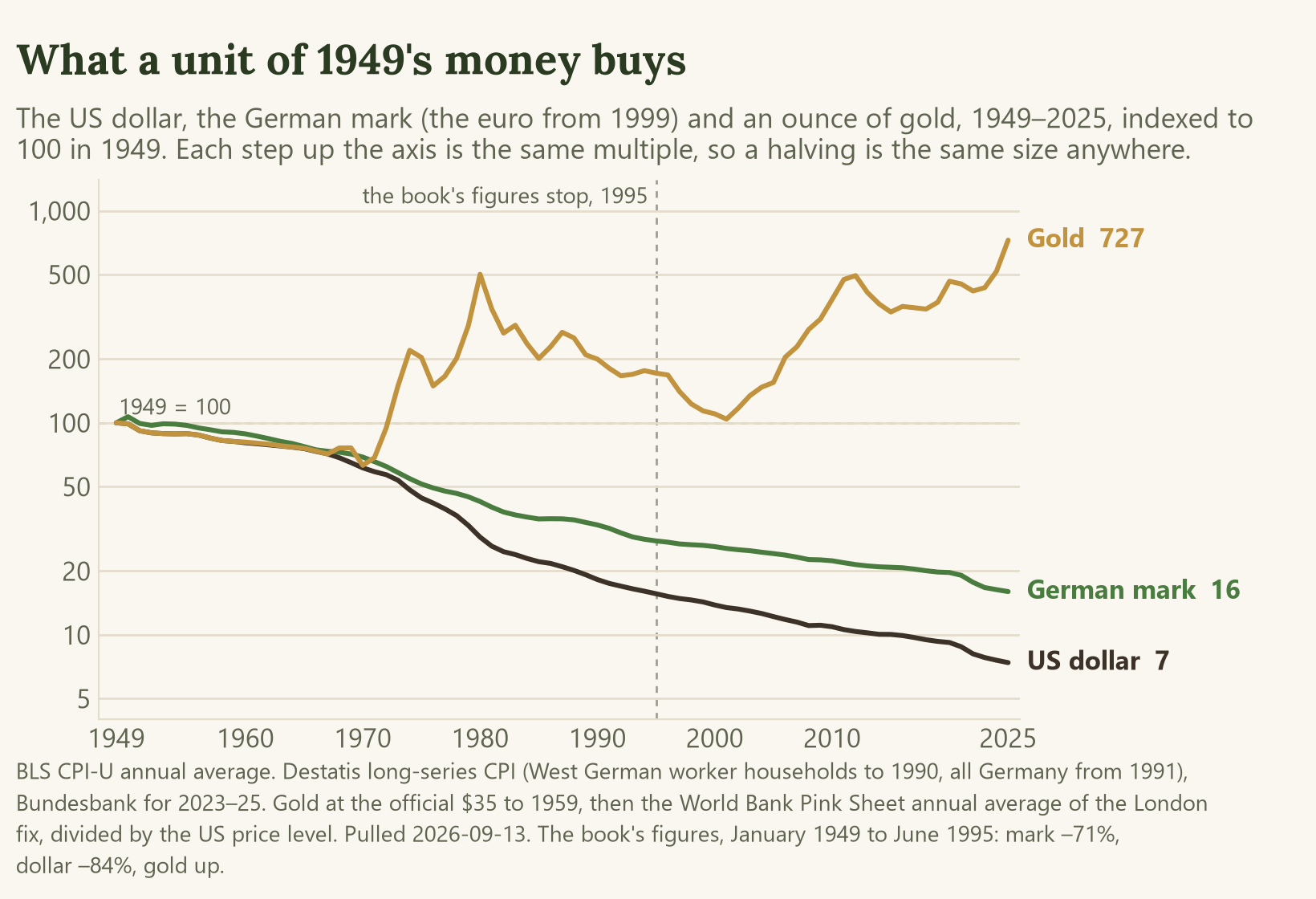
They saw the shape of it with some precision. Every unit would be verifiably unique, so it could not be counterfeited, officially or otherwise, which is what a gold certificate could be as soon as the issuer printed more receipts than it had gold. Micropayments would become possible, a third of a penny to tour the Louvre, and with them businesses that could not exist while the cost of billing exceeded the sale. Transactions would migrate to whichever jurisdiction recognised digital signatures and enforced digital debts. But the money they imagined was a receipt. It would probably be denominated in grams or ounces of gold and issued by an institution of greater repute than any government, a leading mining company or the Swiss Bank Corporation, with the bars identified by molecular signature. It would carry an explicit fee, perhaps one percent a year, in place of the hidden fee that was inflation, which they price at 2.7 percent a year for the best national currency of the postwar period and something close to a hundred for the worst: between 1960 and 1991 Argentina struck seventeen zeros off its money, so that all the wealth of the world converted into pesos and buried in 1960 would not have been worth digging up. Hayek's 1976 case for private competing currencies is here, and Scotland's free banks, which ran without a central bank until 1844 with little fraud and no contagious runs. The chart below is the claim the chapter makes in a series. From the first of January 1949 to the end of June 1995 the German mark, the best currency of the age, lost seventy-one percent of its value and the dollar lost eighty-four, while the purchasing power of gold rose. They call this the wealth governments expropriated by their monopoly on legal tender, and they say the technical problem of keeping money's value is trivial, because gold had done it since 1560. The end of seigniorage, they write, will mean a one-time spike in real interest rates, a deflation that drags on, and then, once capital is in the hands of people who can use it, a long boom.
Ammon's turnip
The eighth chapter is about who gains, and it borrows a picture from a German economist of the 1890s. Throw four dice and the total of twenty-four turns up once in 1,296 throws; so does four. The middle third of possible scores comes up two throws in three. Otto Ammon argued that human abilities, mental, moral, economic and bodily, are distributed the same way, and that a society's shape is therefore not a pyramid but a turnip, thick in the middle and narrow at both ends. The factory, the authors say, was a machine for hiring the middle of the turnip. A genius and a moron on successive shifts produced the same car, so they were paid the same, and nobody could tell from the product who had made it. A machine that runs itself takes that niche away, and a small rise in the skill a task needs pushes a large slice of the turnip out of work while a small rise at the top cuts the number qualified from a third to one in twenty. They put a name on what is being lost:
"A 'good job,' as Princeton economist Orly Ashenfelter put it, 'is a job that pays more than you are worth.'" — Ch. 8
Jobs, they say, will become tasks again, as the word meant before 1800, when a job-gardener was a man hired once. The firm existed, following Coase, because coordinating an assembly line through a thousand independent contractors would have been a nightmare of negotiation; the model business of the new age is a film company, a hundred million dollars assembled for a year and dissolved. And they turn to where people will live, and here a farm reads a sentence written for someone else:
"Thinly populated regions with temperate climates, and a large endowment of arable land per head, like New Zealand and Argentina, will also enjoy a comparative advantage because they enjoy high standards of public health and are low-cost producers of foods and renewable products." — Ch. 8
The big city, they argue, was an artefact of the factory; Detroit is what happens when the reason for a city leaves and the city stays. In the new world bulk goods will be heavily taxed and shipped locally, as in the Middle Ages, while what is light and valuable moves a great distance. Countries with the heaviest debts will break first, and they name Canada, Belgium and Italy, whose separatists were all doing the same arithmetic. Every jurisdiction will become a hotel with house rules, and the smokers and the non-smokers will stop arguing and go to different hotels.
The nostalgia for compulsion
The ninth chapter is the longest and the angriest, and it is about the reaction. In 1811 the croppers of West Yorkshire, skilled men who finished woollen cloth with shears weighing up to fifty pounds and earned five times a labourer's wage, blackened their faces, burned the mills that had installed a machine which did in eighteen hours what they did in eighty-eight, and murdered the owners who had bought it. Twenty years later Captain Swing's labourers broke the threshers. The authors observe that the Luddites were discriminating: when William Cooke opened a carpet mill in the same valley, nobody touched it, because nobody there had ever made carpets. They expect the same from the losers of the information age, who will not be the poorest but the displaced middle, and they expect nationalism to be the losers' banner. They call the nation an imagined community and spend pages on how it was made: on the French Revolution imposing the speech of Paris on a country where the Declaration of the Rights of Man was unintelligible to most of the people it was declared to, on a language being a dialect with an army and a navy. Their darker guess is biological, that we carry the instincts of bands in which everyone was kin, and that the state learned to call itself motherland and fatherland because those instincts answer to it.
The tone of the chapter is the book's worst feature and should be said plainly. Its people are winners and losers, left-behinds, dummies. It has a paragraph on race that a reader can skip without losing the argument, and the eleventh chapter spends several pages on the Clinton White House and the Arkansas rumours of the newsletter years. What survives the tone is the mechanism. When the old monopoly breaks, its nearest competitors prosper first, which is why the Russian mafiya and the drug cartels were the first Sovereign Individuals. Then the authors turn, unexpectedly, to the Quakers, who became the bankers of England by refusing to swear oaths and treating every business promise as one, and who priced low and sold high volume because they thought it wrong to cheat a customer. In a world where a thief with the key cannot be caught, they say, the only protection is not to deal with thieves, and reputation becomes the asset the guards of the Champagne fairs once made it by barring a defaulter from every future fair. They tell the story of Jung's American patient, who made his fortune and retired at forty as he had planned and could not bear the ease of it, and they quote Clough's poem about the tide coming in silently through creeks and inlets while the waves seem to gain nothing. The sterner morality they predict is the old one: the retained earning, the kept word, the struggle over the achievement.
Through the Orenda lens
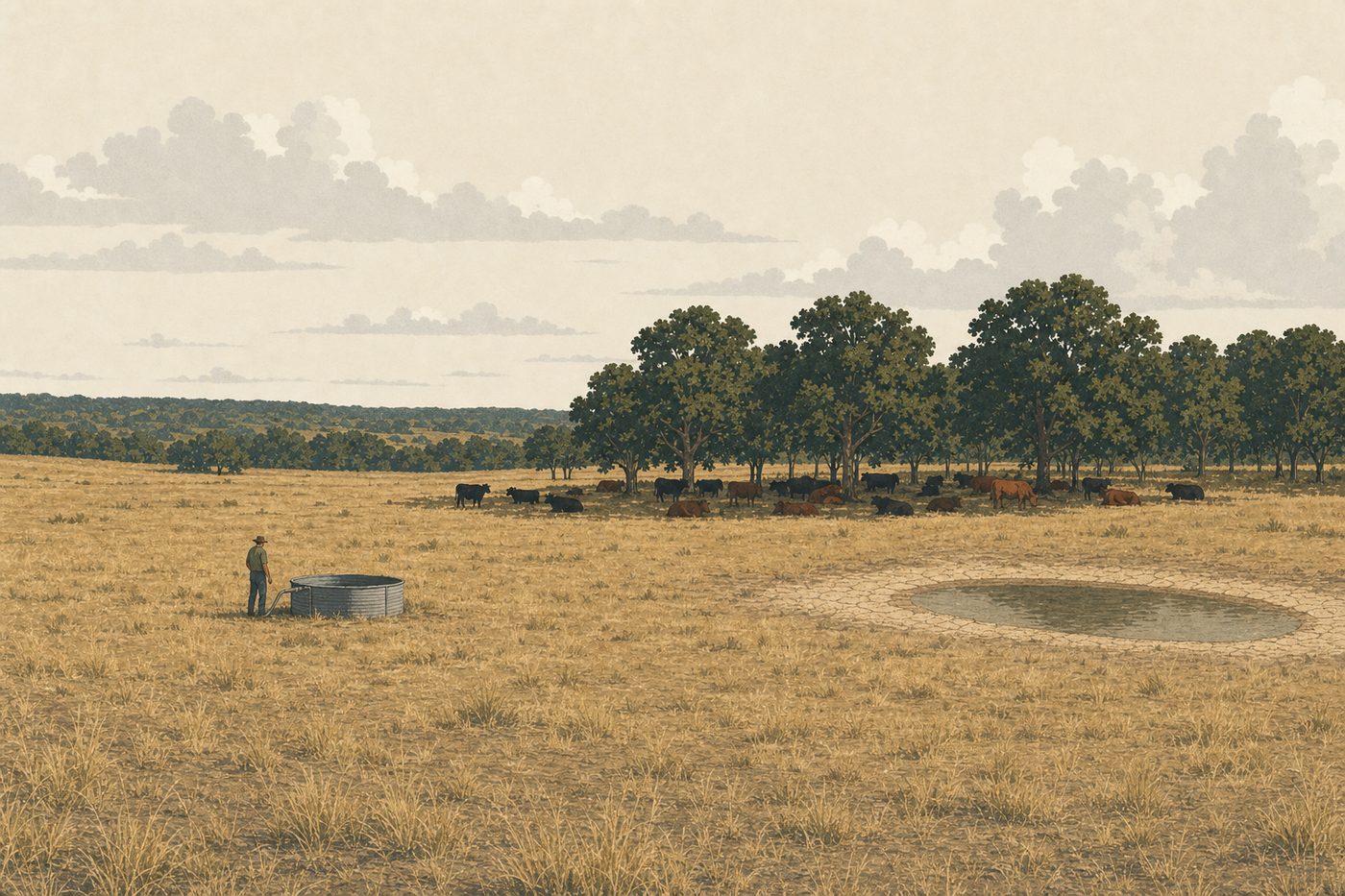
This book was written for a man with a laptop and a passport, and the first thing to say about reading it on a farm is that a farm cannot leave. Of all thirty-six ways to get out of trouble, the ground does not take the best one. The strategy at the end of the book, reside in one country, hold your passport from a second, keep your money in a third, is for someone whose assets are ideas. Cattle are not ideas. A pasture is the most stationary capital there is, and the third chapter says what that has always cost: farming made government pay, and the farmer has been the state's first customer since the first ledger. So the sovereignty a farm can have is not the flight the authors describe. It is the part of the estate that can leave when the ground cannot, and they named that part before it existed. From my book:
"Davidson and Rees-Mogg co-authored an increasingly prophetic book called The Sovereign Individual in 1997, predicting cryptographic bearer assets and the erosion of nation-state monetary control eleven years before Bitcoin existed. This book opened my eyes to how technological innovation disrupts nation-state power dynamics."
Read the year 1000 with a farm in mind and it stops being history. Two-thirds of the villagers held their land free. Three bad harvests in a row put them in debt, a plague took the hands they needed to work their way out, and a change in the price of a horse took away their means of defending what they had. They did not lose their fields to a conqueror. They handed them over, one family at a time, to whoever could carry them through the next bad year, and they never got them back. That is the standing risk of every small farm in every century, and the book's own line is the answer to it: higher savings allow self-insurance of riskier behaviour. A grazing operation carries a bad year on what it saved in the good ones, and the only question is what it saved in. Savings held in the money the fifth chapter describes are taxed every year by the people who issue it, without a vote, and the chart above is what that came to over a working lifetime. Savings held in the thing the seventh chapter predicted are not. The closed village gave up every chance of getting ahead in exchange for someone else carrying its risk. A farm with savings nobody can dilute carries its own, and keeps the fields.
The line about cows is the one I would have written differently. A farmer who kept his herd in a field to be milked and hobbled them when they tried to leave would not have a herd for long. On this ground the cattle walk to the next paddock because the grass there is better, and every gate opens toward something they want. The authors' hope for government, that it will have to treat people as customers rather than as the victims of a shakedown, is what a grazier already knows: what stays by choice is worth more than what is fenced, and you keep it by making the next paddock worth the walk. Their own case for a country with land per head, clean water, cheap food and renewable products describes a place like this one, and bulk goods shipped locally describes what a farm sells and to whom. The book is about where wealth goes when it can go anywhere, and one of its answers is somewhere with grass.
Where the book stops short is the money, and the miss is exact. They expected a receipt: ounces of gold in a vault, identified by molecular signature, issued by a mining company or a Swiss bank, redeemable at a fee of a percent a year. Everything they said about the receipt was right, unique, verifiable, divisible to a fraction, impossible to counterfeit, and none of it required the vault. What came in 2009 removed the issuer, and with the issuer went the bar, the bank, the fee and the one thing an exit tax can still reach, which is a custodian who can be told to hand it over. Twenty-one million units that no institution stands behind, held by whoever holds the key, was a step past the book's imagination, and it is the step that makes a farm's sovereignty possible at all, because a farm cannot keep its savings in Bermuda and does not need to. The other miss is the state. They thought it would starve as its revenue escaped. It did not; it takes a larger share of the national income now than in the year they wrote, and it got there by the route their own chapter names, inflating what it could not tax. My book takes the argument where the evidence went:
"Which is the whole argument from The Sovereign Individual arriving on schedule. Capital moves. Talent moves. A state that bans this does not delete it, it exports it, and it exports the people who understand it too. The countries paying attention worked that out and are now competing for the thing they were supposed to prohibit."
The authors would not sign all of this. They have no patience for people who stay where they were born, and a farm is a decision to stay. Their morality chapter, though, ends up where a farm starts: reputation as the only protection when no one can be forced, the low margin and the returning customer, the word kept because it is the whole business. A farm that sells to the people who eat from it lives on that or not at all. That, and the year 1000, is what this shelf takes from them.
What's happened since
The revised edition went to press with the millennium bug as the possible trigger for everything, and the year 2000 arrived with the lights on. Iridium, the satellite country with its own dialling code, filed for bankruptcy in August 1999, a few months after the book that praised it; the satellites were nearly deorbited and the network was bought out of the wreckage for a fraction of its cost. The Knights of Malta got their lease on the upper part of Fort St Angelo. Canada, Belgium and Italy are still countries, the United Nations has not been liquidated, and the cyberpoor are not those on less than two hundred thousand a year. The exit tax they called a Berlin Wall for capital was enacted in a harsher form in 2008, and the United States still taxes by nationality. William Rees-Mogg died in December 2012. Peter Thiel's preface to the 2020 edition, which is in the copy this was written from, names what they missed most: China, which built its own information age with the Communist Party intact and had, in his word, crushed the city they had called the model for the coming world.
On the thing that matters to this shelf they were right in a way that is uncomfortable for both sides. The money they described arrived on the third of January 2009, with no gold and no bank, and their book is now on the reading lists of people who hold it. Their governments, though, did not wither. The chart above carries their numbers to 2025: a dollar of 1949 buys about seven cents' worth, a mark of 1949, continued as the euro, about sixteen pfennigs' worth, and an ounce of 1949's gold buys more than seven times what it did. The state's share of the national income rose in the same years, and the states that could not tax the new asset began, as my book records, to buy it. Nobody called that the commercialisation of sovereignty, but it is jurisdictions competing for a customer, which is what the authors said would happen once the customer could leave. Read it for the third chapter and the seventh, the year 1000 and the money, and for the sit-down strike as an explanation of the century that followed it, and take the sneering as the price of a book by two men who had been laughed at for ten years and were about to be right.