

In short
Mircea Eliade was a Romanian who taught the history of religions in Bucharest in the 1930s, in Paris after the war, and at the University of Chicago from 1956 until he died there in April 1986. For most of that time he wanted to write one short book, four hundred pages, that a reader could finish in a few days and come out the other side having met the Stone Age hunters, the Vedic priests, the Greeks and the Buddha in one continuous story. He never managed it. What he wrote instead, in his late sixties, was this: three volumes, the first from the painted caves to the Mysteries of Eleusis, published in French in 1976 and in Willard Trask's English two years later. It is a survey, and it reads like one, but it is a survey by a man who had spent fifty years on a single conviction and wanted to show it in evidence rather than argue it.
The conviction is in the preface. The sacred is not a stage humans passed through on the way to being reasonable. It is part of how a mind works, the thing that lets a person tell what is real and full of meaning from what is random and dead, and it shows up wherever there are people: in a Neanderthal grave dusted with red ochre, in the way a Neolithic village laid out its houses, in a Babylonian king being slapped by a priest every New Year, in a Greek farmer's joy in the day. The book's method is to take each of these seriously as a decision somebody made about what the world is, and to follow the decisions in order. For a farm, the middle of the book is the important part, because Eliade thinks the discovery of agriculture was the largest religious event in human history, and he says why.
The thesis
"In short, the 'sacred' is an element in the structure of consciousness and not a stage in the history of consciousness. On the most archaic levels of culture, living, considered as being human, is in itself a religious act, for food-getting, sexual life, and work have a sacramental value." — Preface
The religion of the caves
The first chapter begins with a body standing up. Once a creature is upright, space arranges itself around it, front and back, left and right, above and below, and Eliade thinks everything that later became sacred geography, the centre of the world, the four directions, the pillar that holds up the sky, begins in that posture. Then there are the tools. Monkeys use objects; the early humans made tools to make tools, kept them for later, and shaped them to cut, which no part of the body does. And there is fire, kept and carried at Choukoutien near Peking six hundred thousand years ago. He does not sentimentalise any of it. The decisive fact about early humans, he says, is that they chose to kill in order to live, and for two million years they lived by hunting, which set up a relationship with the animals they killed that has never gone away. The blood was the same colour as theirs.
What survives of what they thought is almost nothing: bones, stone, red ochre, and from about thirty thousand years ago the painted caves. Eliade calls the evidence opaque and spends a chapter showing what that means. In 1966 an anthropologist watched the Kogi of the Colombian sierra bury a girl. The shaman named the grave a village of death and a womb, opened it with words, tried nine times to lift the body and could not until the ninth, laid her with her head to the east, put shells and green stones in with her, and closed the house. Two hours. A future archaeologist, Eliade points out, will find a skeleton facing east and some shells, and nothing else, and will have no way of knowing that the nine lifts were the nine months of pregnancy run backwards. That is the situation with every grave before writing. It does not mean the graves are empty of meaning. It means the meaning is not in the ground.
So he reasons from what did survive and from the hunting peoples still alive in the nineteenth century. Ochre on a corpse, from Choukoutien to Tierra del Fuego, is blood and therefore life. Bear skulls set in niches in Alpine caves look like the custom among Arctic hunters of keeping the skull and long bones of a kill so that the animal can grow new flesh, a belief that lived on in Thor's goats, eaten at night and standing again by morning, and in Ezekiel's valley of bones. The caves themselves are sanctuaries by their inaccessibility: hours through a labyrinth at Cabarets, and at Lascaux the lower gallery reached down a rope ladder through a shaft six metres deep. In it a wounded bison stands over a man with a bird's head lying on the ground, and Eliade allows the reading that he is not dead but in a trance, a hunter's shaman travelling. And from Alexander Marshak's work on notched bones he takes something exact: people were counting the moon's phases for twenty-five thousand years, which is fifteen thousand years before anyone planted a seed. The calendar is older than the field.
"Homo faber was at the same time Homo ludens, sapiens, and religiosus." — § 2
The longest revolution
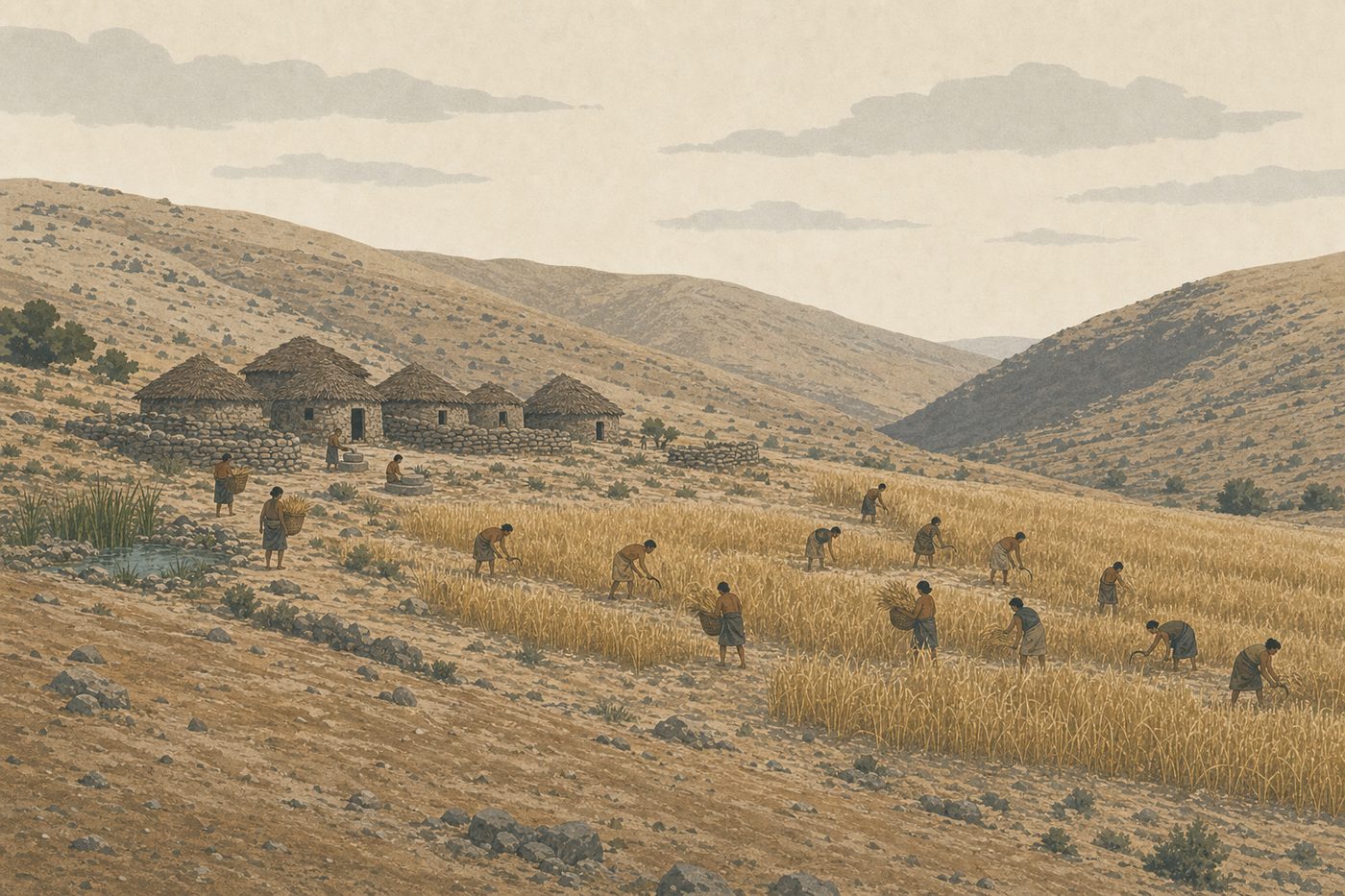
The ice went about 8000 BC and the reindeer went north with it, and in the silt of a pool at Stellmoor near Hamburg the hunters who followed them left twelve whole reindeer weighted with stones, and a pine post with a reindeer skull on top. In the Near East the same centuries went another way. The Natufians of Palestine settled down before they farmed: round huts at Einan, stone sickles, mortars and pestles, wild cereals cut and ground as food. The sheep was domesticated at Zawi Chemi about 8000 BC, the goat at Jericho about 7000, the pig about 6500, and, Eliade notes, the dog in England about 7500. Since 1960, he writes, it has been known that villages came before agriculture, and that grain and animals came before pottery. Gordon Childe's Neolithic Revolution took two thousand years and happened to people who already lived in one place. What it did to them was religious before it was anything else.
Eliade's account of why runs through the myths cultivators tell about where food comes from. On the island of Ceram a semi-divine girl, Hainuwele, is murdered and buried, and from the pieces of her body the tubers grow that people have eaten ever since. Every serious act in that society, initiation, sacrifice, the funeral, is a remembering of the murder. Among cereal growers the story is usually a theft instead, grain kept in the sky and stolen by a hero, but the two run together, and the point of both is the same. Meat was given in the world, an animal that was there. A crop is not given. It is the product of a death somebody caused, and eating it is eating a god.
"By feeding himself, man, in the last analysis, eats a divine being. The food plant is not 'given' in the world, as the animal is. It is the result of a primitive dramatic event; in this case it is the product of a murder." — § 11
With that, he says, the hunter's world tipped over. The sacred had lived in bone and blood; now it lived in seed and soil. Women had domesticated the plants and so owned the fields, and the earth was a woman who for a long time, in the myths, gave birth by herself. The seed had to die in the ground to come back multiplied, and human life was read off that: the flower of the field, the harvest, the return. Time went round in a circle, and the world itself was an organism that wore out in a year and had to be made again, so every New Year the story of creation was told over and the dead came back for the feast. Even the house was a small world. The Neolithic houses of Yang-shao in China were round with a central hearth and a smoke hole above it, the same shape as a Mongol yurt, whose tent pole is the pillar of the world and whose smoke hole is the North Star. Eliade calls what came out of all this a cosmic religion, and says its descendants ran the Near East for thousands of years and gave Europe, through Eleusis, its first idea of salvation.
What the archaeology gives back is fragments. Jericho, perhaps the oldest town on earth and still without pottery, buried its dead under the house floors and kept some of their skulls, the faces modelled over in plaster and the eyes set with shells, so that they read as portraits. Çatal Hüyük in Anatolia, about 7000 BC, had forty shrines out of the ground by 1965, no two alike, with a goddess in three ages on the walls and bulls' heads fixed beside her, and in one of them four men's skulls set under the bulls. But the fragments are not the measure of it, and Eliade reaches for the other kind of evidence. In twentieth-century Egypt the ritual sheaf was still tied exactly as it is on the monuments of the pharaohs. In Arabia Petraea the last sheaf was still buried under the name the pharaohs' Egypt gave it, the Old Man. The grain gruel Romanian peasants offer at funerals is the kollyba of ancient Greece and older. Some of what the peasants of eastern Europe were doing at the start of the century had already disappeared from Greece before Homer.
"We would only emphasize that such rites maintained themselves for a period of 4,000 to 5,000 years, of which the last 1,000 to 1,500 were under the vigilant scrutiny of two monotheisms famous for their vigor, Christianity and Islam." — § 14
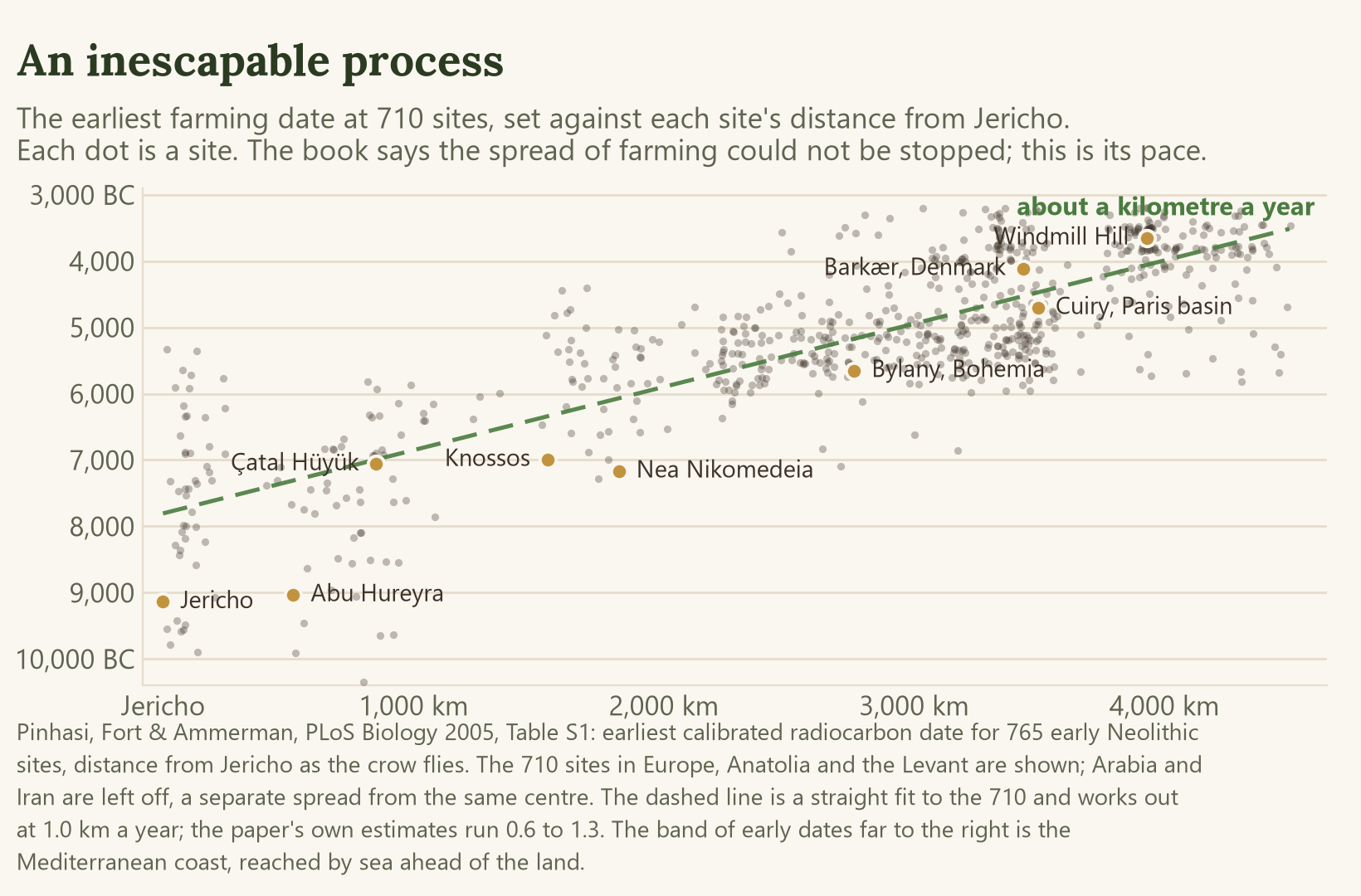
The rites travelled with the seed, and the seed travelled. From the Near East about 8000 BC, he says, the spread of farming proved to be an inescapable process, working its way up the rivers and along the forest edges of a colder, wetter continent, and still moving toward Australia and Patagonia when European ships arrived. The chart below is that sentence in numbers, and it was pulled from seven hundred radiocarbon dates he did not have.
Iron from the sky
When Cortés asked the Aztec chiefs where their knives came from, they pointed at the sky, and they were right: there is no smelted iron in the prehistoric New World, only meteorites. The Sumerian word for iron is written with the signs for sky and fire. The Hittite kings used the black iron of the sky, and for a long time so did the Egyptians. Iron was as rare as gold and used for ritual until someone learned to smelt ore, and Eliade says that discovery changed what the earth was. Ores grew in it, slowly, like embryos in a womb, and would in geological time have ripened into perfect metal; the miner who dug them out was performing a birth too early, which is why miners everywhere fasted and prayed before they went down. The smelter went further. His furnace was a second womb, artificial, in which the ore finished growing in weeks instead of ages. The smith was a master of fire, feared and kept apart with the shamans, and in half the mythologies of the Near East the divine smith forges the weapon that lets the young god kill the dragon.
"In assuming the responsibility for changing nature, man took the place of time; what would have required eons to ripen in the subterranean depths, the artisan believes he can obtain in a few weeks; for the furnace replaces the telluric womb." — § 15
He follows the thought straight to us. Ben Jonson's alchemist says lead would be gold if it had had time, and that our art doth further it. The struggle to take the place of time, Eliade writes, which is the mark of the modern technological society and will reach its height in synthetic chemistry, began in the Iron Age.
Stone and banana
The farmers of western Europe, who had polished stone and no metal, stood three-hundred-ton blocks on end at Carnac and lifted hundred-ton slabs onto uprights, and did it from the Spanish coast to Denmark and Sweden. Their houses have left almost no trace; their dead have the biggest buildings of their age. A covered passage at Soto near Seville is twenty-one metres long under a twenty-one-ton pediment. At Los Millares a hundred passage graves hold up to a hundred dead each, several generations of one family. On Malta, where seventeen temples have been found and very few houses, the Hypogeum at Hal Saflieni held the bones of seven thousand people in rock-cut chambers shaped, one scholar says, like a womb, so that the living who entered the temples entered the body of the goddess. And in France, into the twentieth century, young women who wanted children slid down certain stones and sat on others. Eliade's explanation of all of it is a myth from Indonesia.
"One day he sent them a stone, but the ancestors, surprised and indignant, refused it. Some days later God let the cord down again, this time with a banana, which was immediately accepted. Then the ancestors heard the creator's voice: 'Since you have chosen the banana, your life shall be like the life of that fruit. If you had chosen the stone, your life would have been like the existence of stone, unchangeable and immortal.'" — § 34
Agriculture had taught people that their lives were like the life of a plant, brief, and coming round again. The megaliths, he argues, are the answer to the banana. The dead went into Mother Earth with the seed's hope of coming back, and at the same time they were built into stone, which does not change, so that they became as durable as rock and could be asked for help. A menhir is a body for eternity with a soul in it. The peoples who did this, from Ireland to Malta, trusted their dead in a way the Mesopotamians and the Greeks never did, whose dead were pitiable shadows to be kept at a distance. The builders of Carnac, in Eliade's phrase, had succeeded in taking possession of both the stone and the banana. Radiocarbon dating, which arrived in his working lifetime, had just shown that they did it on their own: the Breton tombs are older than 4000 BC and Stonehenge was finished before Mycenae, so the old story of missionaries from the Aegean was dead.
The king struck in the face
History begins at Sumer, in Kramer's phrase, and Eliade's Mesopotamia is a place where the gods are frightening and the world is run on paperwork. The Sumerians had a word, me, for the decrees that fix the destiny of every thing and every enterprise, and every New Year the gods fixed the fates of the twelve months to come. The plans of temples and cities preexisted in the sky, where Nineveh was the Great Bear and Sippar was Cancer, and King Gudea saw his temple's plan in a dream. Kingship itself was lowered from heaven, and had to be lowered a second time after the flood, when one man, Zisudra, was carried through seven days of water and set down immortal in Dilmun, where no lion kills and no night watchman walks his post.
The myth he stops on is Inanna's. The goddess of love and war, queen of the Great Above, decided to take the underworld from her sister too. At each of the seven gates the keepers stripped a garment or a jewel from her until she arrived naked, which is to say powerless, and her sister's look of death left her a corpse hanging on a nail. Revived with the food and water of life, she was let go only on condition that she send someone in her place, and the demons who escorted her up found her husband Dumuzi, the shepherd king, sitting on his throne in fine clothes, not mourning at all. She fixed the eye of death on him, and they took him. That the Sumerian kings played Dumuzi in the sacred marriage every New Year tells you what the story is for: death, ritual and reversible, follows every act of creation, and the king accepted his share of it. On the eighteenth of the month of Tammuz the women wept for him, knowing he would be back in six months, and in the sixth century Ezekiel found them still weeping at the gates of the Temple. The Babylonians made the acceptance literal. On the first days of Nisan the high priest took the king's sceptre, ring, scimitar and crown, struck him in the face, and made him say on his knees that he had not sinned; the people searched for Marduk shut in the mountain; the king led the army of the gods out against Tiamat and lay with a priestess; and the year was made again. Beside this Eliade sets Gilgamesh, two-thirds a god, who walked twelve hours through the dark to the one man the gods had made immortal, was told to stay awake six days and seven nights as his test, fell asleep at once, and lost the plant of youth to a snake at a spring on the way home.
Egypt, isolated by its deserts, built the opposite temperament on the same ground. Everything that mattered had happened once, in the First Time, before anger or noise or disorder, and the whole business of civilisation was to keep it so. The pharaoh was a god whose work was maat, order, put in the place of chaos every morning as the sun drove off the serpent, and the same verb served for the sun rising and the king appearing at court. There was a harvest festival of Min in which the king, the queen and a white bull walked in procession and the king cut a sheaf of grain and offered it to the bull. And there was Osiris, the murdered king, whom his son woke and who came back not as a walking god but as the force in the ground that makes things grow:
"Whether I live or die, I am Osiris; I enter in and reappear through you, I decay in you, I grow in you…. The gods are living in me, for I live and grow in the corn that sustains the Honoured Ones. I cover the earth; whether I live or die I am Barley. I am not destroyed." — § 29
The order broke once, and Eliade reads the break closely because it is the first time in history a people wrote down what it felt like. About 2200 BC the state collapsed for a century and a half. Ipu-wer came before the king to report the tombs pillaged and the dead thrown in the river, and ended by blaming the king to his face. A king wrote for his son Meri-ka-Re that the country's misery had happened through what he had done and he knew it only afterward; do justice, quiet the weeper, and instead of a monument of stone make thy memorial to last through the love of thee. A man argued with his own soul for the right to kill himself, calling death the scent of fields after rain and a man's longing for his house after years of captivity. When order came back, the pharaoh's afterlife had been copied onto the coffins of the nobles and then of anyone, and the dead stood in the hall of the two truths with their heart on one pan of the scale and a feather on the other, saying I have not killed, I have not caused anyone suffering, I have not cut down on the food in the temples, I am pure.
The seven dry years
The Hittites, Indo-Europeans who took Anatolia and adopted nearly everyone's gods, kept a myth in which the god Telepinus gets angry and simply leaves. The fires go out, the ewe ignores her lamb and the cow her calf, grain and spelt stop growing, animals and people stop mating, the pastures dry and the springs fail. The eagle cannot find him. The storm god cannot. A bee sent by the Mother Goddess finds him asleep in a grove and stings him awake, which makes him furious and makes everything worse, and only rites of purification talk him down. Eliade calls it the first waste land in literature, and adds that Telepinus is not a dying god of vegetation at all; he is a fertility god wrecking his own creation for no reason anyone recorded, and the same terrible thing is later said of Śiva.
At Ugarit on the Syrian coast, in tablets dug up from 1929, Baal, son of Grain, takes the kingship from senile El, kills the sea-dragon Yam with two clubs made by the divine smith, builds himself a palace, and then goes down to Mot, who is Death, and dies. His sister Anath finds the body, buries it, and then finds Mot:
"with a blade she cuts him; with the winnowing basket she winnows him; with fire she roasts him; with the mill she crushes him; in the fields she sows him, and the birds eat him." — § 51
She has harvested Death like an ear of wheat, and Baal is alive; El dreams that fat rains from heaven and honey runs in the wadis and laughs out loud. After seven years Mot is back and they fight to a standstill, Baal on top, and Baal is king forever while Mot keeps the underworld. Eliade will not let this be a picture of summer and winter. Summer in Syria is the season of fruit; what a Canaanite farmer feared was a run of dry years, and the seven of Mot's absence are the seven lean years the Old Testament also remembers. What the myth does is stranger and better than a calendar. The god who guarantees life goes down into death and the god of death is sown as grain, and neither can destroy the other, so that death comes out of it, in Eliade's phrase, as the condition sine qua non of life.
That was the religion the Israelites walked into, and Eliade follows the collision from the far side. Cain, whose name means smith, kills Abel, whose name means shepherd, and the first murderer builds the first town; the herders' suspicion of everyone who works metal is in the second chapter of human history. Abraham, told to sacrifice his son, is the strangest case in the book, because Abraham had no idea what the act was for. The Canaanites who burned their firstborn knew exactly what they were buying. Abraham's obedience, Eliade says, is the sacred identified so completely with the profane that it becomes unrecognisable, an infanticide in every visible respect. Then the prophets. Amos was a herdsman who looked after sycamores. Hosea married a woman from the fertility rites and wrote God's complaint that Israel had gone to her lovers for bread and wool and oil and would not admit that I was the one who was giving her the corn, the wine, the oil. And between them, over three centuries, they did something no one had done before:
"The prophets finally succeeded in emptying nature of any divine presence. Whole sectors of the natural world—the 'high places,' stones, springs, trees, certain crops, certain flowers—will be denounced as unclean because they were polluted by the cult of the Canaanite divinities of fertility." — § 121
In its place they put history. Assyria at the gates was not weather; it was Yahweh. Events had a meaning because a will was behind them, and Eliade counts this the Hebrews' great discovery, taken up whole by Christianity, that history itself is where God appears. He also says, without comment, what it cost. The only clean place was the desert, and the sacred dimension of vegetation would not be found again in Judaism until the Middle Ages.
The year rebuilt in bricks
In India the Āryans made a new territory real by building a fire altar on it: one says one is settled when one has built a hearth for Agni, and until then the ground was chaos. Their gods were the sky and the storm and the fire and the drink, and the hymn to soma is the most honest account of intoxication in ancient literature, the drinker asking whether he has not dominated the sky with his stature and struck the earth great blows, have I not drunk soma. What the priests did with it in the next centuries is the part Eliade thinks matters. In the Brāhmaṇas the creator, Prajāpati, is the Year, and creating the world has exhausted him: his joints are the joins of day and night, the new and full moons, the turns of the seasons, and they have come loose, and he cannot stand. The priests rebuild him by building the altar, three hundred and sixty enclosing stones and three hundred and sixty bricks for the days and nights, and every sacrifice puts the worn-out year back together for another year. It is the Neolithic New Year with the workings shown. The sun, they said, would not rise if the priest at dawn did not make the offering. And then the rishis in the forest thought about it too long. If every rite has its effect, every other act has one too, and the effects do not end at death; they carry into the next life and the next, which is the law of transmigration, and the whole apparatus of sacrifice turned out to be a wheel. Their prayer, the earliest in the Upanishads, is the shortest statement in the book of what the whole book is about: from nonbeing lead me to being, from darkness lead me to light, from death lead me to immortality.
The joy of life
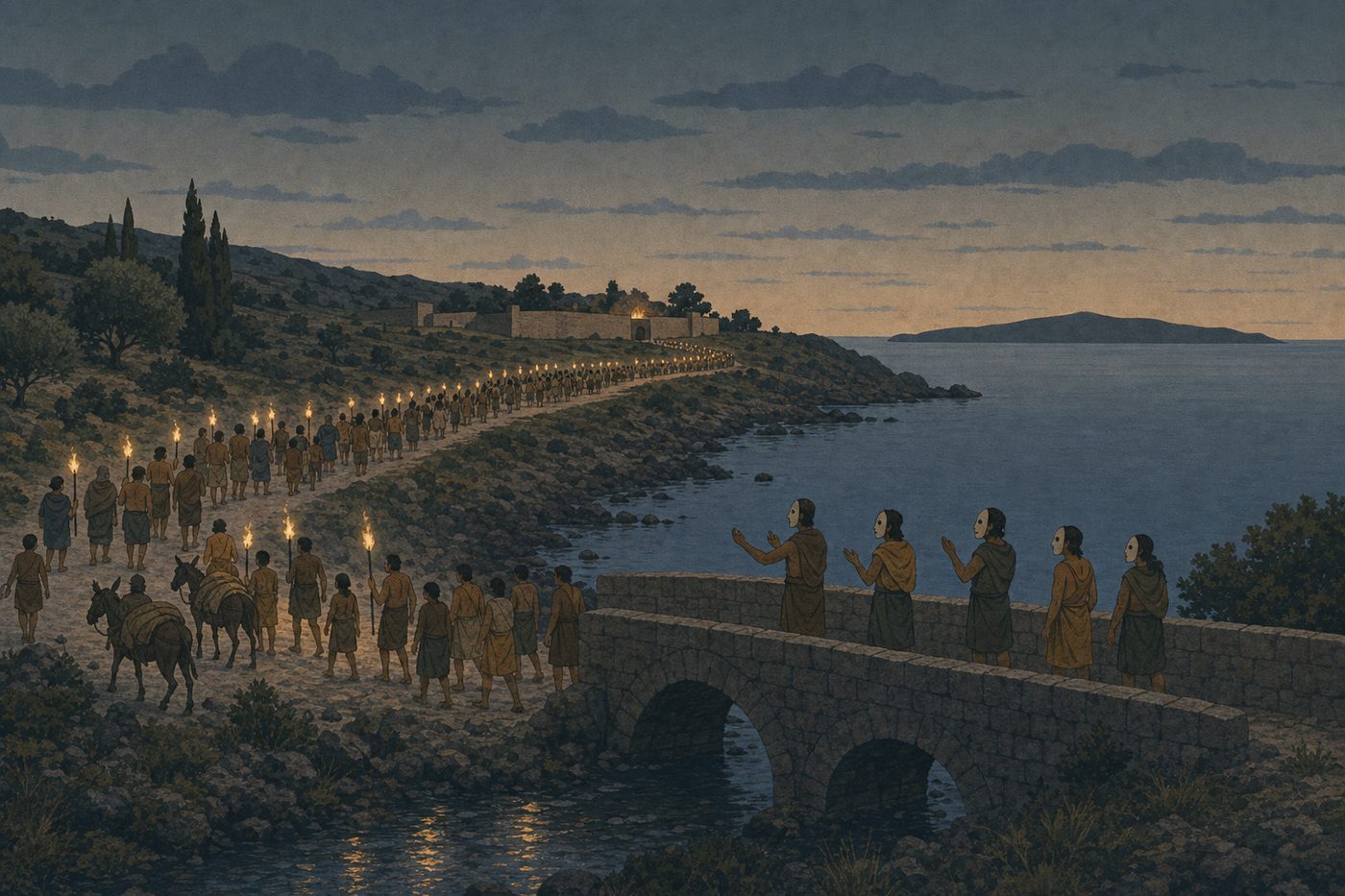
The Greeks separated from their gods on purpose. At Mekone, Hesiod says, men and gods met to settle their relations, and Prometheus killed an ox and divided it, bones under a layer of fat on one side, meat and entrails under the paunch on the other. Zeus chose the fat, and ever since men have burned the bones for the gods and eaten the meat, which is the whole of Greek sacrifice and the end of the vegetarian golden age under Kronos, when the earth gave everything and nobody worked. Eliade notes, with Karl Meuli, that bones and skull were exactly what Siberian hunters offered their sky god as the best portion, so the trick was an old rite that had become a crime once a Titan performed it. The punishment was fire withheld, then Pandora. What the Greeks made of the distance is his real subject. A man is not a god's creature and cannot pray his way close; his life is a lot, moira, measured out at birth; the best thing is not to be born, and the second best is to die young. Achilles's shade would rather be a poor man's slave on earth than king of the dead. And out of that, Eliade says, came a joy nobody else has managed, a religious sense of the body, of the games and the banquet and the present hour, because if the gods had fenced a man inside his limits then everything inside the fence was holy.
"This dimension is not always obvious, since sacrality is in a sense camouflaged in the immediate, in the 'natural' and the everyday. The joy of life discovered by the Greeks is not a profane type of enjoyment: it reveals the bliss of existing, of sharing—even fugitively—in the spontaneity of life and the majesty of the world." — § 87
His gods are portraits. Athena is intelligence in work, the goddess the smith learns the ploughshare from and the potters call to hold her hand over the kiln. Hermes is the god of roads because he does not get lost in the dark, which makes him the friend of herdsmen and of thieves and, later, the guide of the dead. The heroes are all monsters, too tall or too short, mad, torn to pieces, and buried inside the city walls against every rule because their bones protected it.
Eleusis is the book's last stop, and Eliade is scrupulous about how little is known. The story is the Hymn to Demeter. Persephone was taken to Hades while gathering flowers, and her mother, disguised as an old woman, came to Eleusis, nursed the queen's baby son and hid him in the fire each night to make him immortal, until the queen saw and screamed. Witless are you mortals, Demeter said, and dropped him. She demanded a temple, shut herself in it, and starved the earth with drought until Zeus gave her daughter back, four months of the year excepted for a pomegranate seed. Then she taught the kings of Eleusis rites which no one may in any way transgress or pry into or utter. Eliade reads the wheat into the myth by its absence: before Persephone went down, there was no wheat, and it was after that Demeter sent Triptolemus to teach the Greeks to farm. It is Hainuwele again, a death and then the crop. What the initiates saw in the hall he does not pretend to know. Two words shouted at the sky and the ground, Rain and Conceive, were carved on a well in Athens and cannot have been the secret. An ear of wheat shown in silence may belong to another cult. A great fire burned in the small building at the centre and could be seen from far off; the hierophant struck a gong and the kingdom of the dead opened; and every ancient writer who went says the same thing about it, that whoever has seen this goes down to Hades knowing the end of life and its beginning, and that for the rest there is only darkness.
Dionysus ends the volume, and he is a farmer's god before he is anything else: the jars of new wine opened at the Anthesteria, the queen of Athens taken to the old ox-stable to be married to him. On the last day of his festival the dead came back and were sent home at nightfall with a shout, and Eliade quotes a Hippocratic doctor on why the two go together: it is from the dead that food, growth and seeds come to us. Heraclitus had already said that Hades and Dionysus are one and the same.
The end of the wheel
Zarathustra is the one man in the book who tried to stop the year going round. A priest of the old Iranian religion, poor, with few flocks and few men by his own account, driven out by his tribe and refused shelter at the Bridge of Winter by a petty chief, he preached that the world had begun with a choice between good and evil that every person repeats, and that it would end once, in fire and molten metal, with the just sorted from the wicked on a bridge that widens under the feet of the good and turns to a razor's edge under the rest. Where every religion before him had renewed the world each New Year by telling creation over, he announced a renovation that would happen one time, by the will of God, and not again. Eliade calls that the first linear time. The priests who came after him folded it back into the New Year festival anyway, and the last ten days of every Iranian year are still the days the souls come home.
Through the Orenda lens
This farm is named for the thing the book is about. Orenda is an Iroquois word, and I found it a long way from any farm, on the way down the same hole this shelf is built from. My book gives it three sentences:
"Somewhere on the free fall down the Bitcoin rabbit hole I came across the idea of 'orenda'. An Iroquois word for the collective lifeforce present in all natural beings - and their ability to use that lifeforce to bend reality to their will. Bitcoin is orenda expressed as money. Healthy land is orenda expressed as ecology."
Eliade's preface says the same thing at the scale of the species: to be human is to be able to tell what is real, powerful and full of meaning from what is not, the name for that faculty is the sacred, and it has been running since the first person stood up and looked around. He is not saying everyone believes in gods. He is saying that a Kogi shaman lifting a girl nine times and a farmer who cannot walk past a calf without stopping are using the same part of the mind. Food-getting, sexual life and work have a sacramental value: that is a description of a working day here, and the book's first page is the first place I have seen it written as a fact about people rather than a feeling about one place.
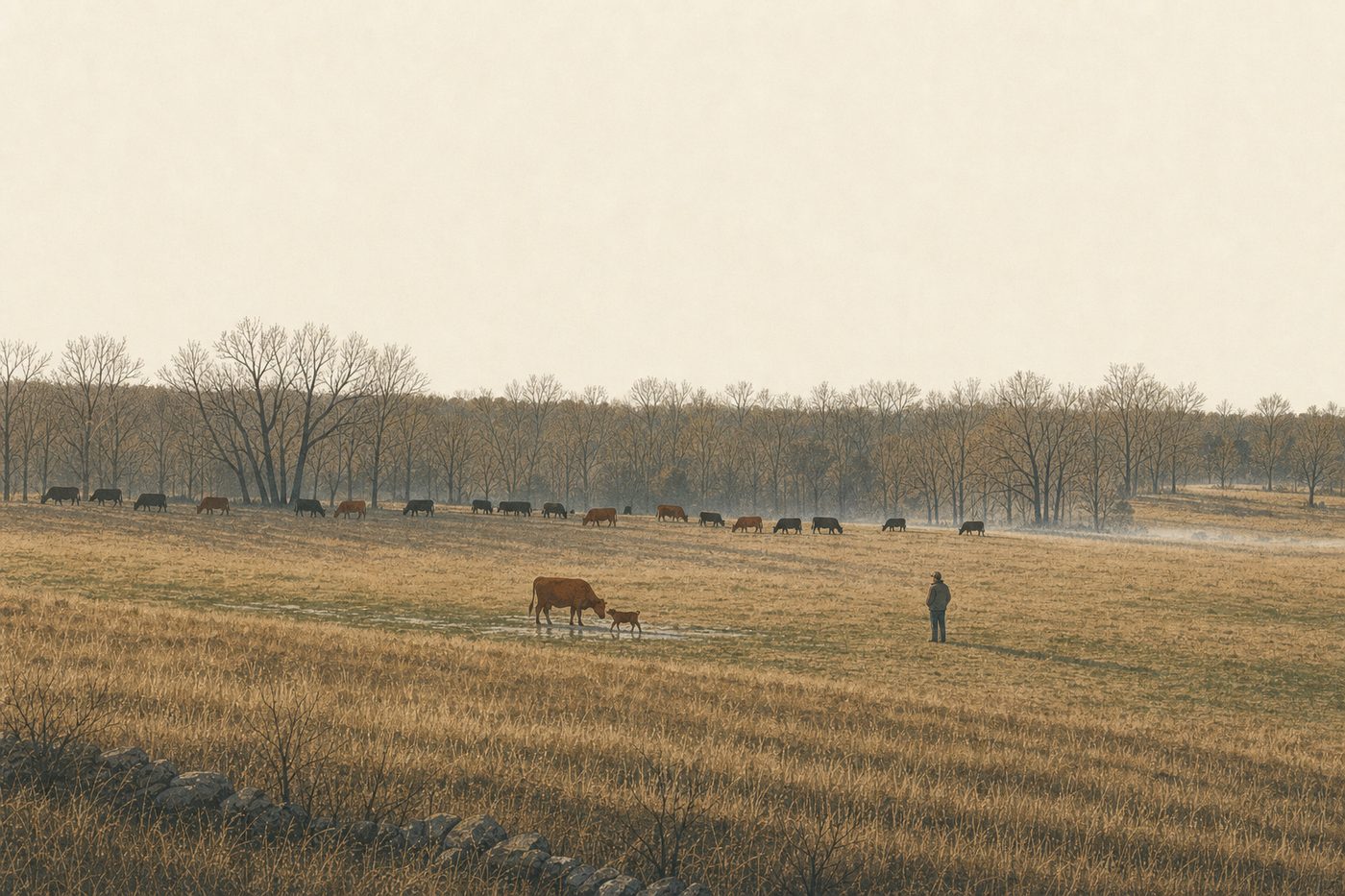
The middle of the book is a farm's own story told as history, and two things in it stop me. The first is that food is a death. Eliade's hunters made a pact with what they killed and his farmers told each other that the crop grew from a murdered girl, and both were saying, in the only language they had, that eating is not innocent. A grazing farm knows that with no mythology at all. There is a calf in the picture above and there is a steer that goes in the fall, and the second is why the first is worth keeping. The industrial version of eating is built to hide the death, and Eliade's whole first half is a record of people who thought hiding it was the one thing you must not do.
The second is the stone and the banana. Agriculture, he says, taught people that their lives were like the life of a plant, short and cyclical, and the megalith builders answered by putting their dead into something that does not rot, so that they would have both. A farm chooses the banana every day; the herd, the grass, the season and the person are all going to die and come round again, and the point of the work is to leave the ground better for the next turn. What it cannot do is keep what it earns in the banana. Savings that rot at the rate the money is issued are the closed village in Eliade's Neolithic, everyone giving up the chance to get ahead because nothing they kept would keep. The men at Carnac wanted a body for eternity. What this farm keeps its surplus in is a stone in their exact sense, a thing that does not change and that nobody can dilute, and it is the reason the banana is affordable. My book puts the two halves together without knowing it was quoting a Neolithic myth:
"Every era of sound money produced long-term building: cathedrals, infrastructure, institutions that outlasted the people who started them. Every era of debased money produced short-term extraction: speculation, consumption, structures that rotted within a generation."
The chapter on iron names the thing the farm refuses. The smelter's furnace was a womb that made in weeks what the earth makes in ages, and Eliade says our whole civilisation is the furnace, the struggle to take the place of time. He is right about the civilisation and wrong, in a way he would have liked, about at least one field. A pasture cannot be smelted. Soil forms at the speed soil forms, a calf takes what it takes, the grass is ready when it is ready, and the only way to have more next year is to do the work this year and wait. The money that runs the rest of the world is the alchemist's furnace exactly, claims on future work produced faster than the work, lead called gold because nobody had the patience. The money this farm saves in is issued on a schedule that no furnace can hurry, by work that has to be done and shown. My book calls that the same rule as the ground:
"Proof of work: nothing grows without real labor, real inputs, real energy. No shortcuts."
Where I part from the book is where it parts from itself. Eliade records, level-voiced, that the prophets emptied nature of the divine, that springs and trees and crops were made unclean and the desert was made the only holy ground, and that this cleared the way for the God of history. He also records, two hundred pages earlier, that the Egyptian sheaf was still being tied the pharaohs' way in his own century, under the eyes of Christianity and Islam, and that the peasant rites outlasted the theology by four thousand years. This shelf does not take a side between Baal and Yahweh. But it has a book on it about what happens to ground nobody holds sacred, and the two facts belong on one page: the moment the divine was ordered out of the soil is the moment the soil became something you could mine. The sheaf, meanwhile, went on being tied. That, more than any doctrine, is what I take from him. The sacred is not a stage that people grew out of. It is the farmer's ordinary day, camouflaged in the immediate, as he says of the Greeks, and it keeps being done by hand long after the people who explain things have moved on.
What's happened since
Eliade died in Chicago in April 1986, a year after the third volume; the chapter he promised in this preface, on the modern West as the sacred's last camouflage, was never written. The evidence has moved since, mostly in his favour. Chauvet, found in the Ardèche in December 1994, pushed the painted caves back from his thirty thousand years to thirty-six thousand, and in 2016 rings of broken stalagmites deep inside Bruniquel cave were dated to a hundred and seventy-six thousand years, built by Neanderthals more than three hundred metres from daylight: the religion of the caves before there were any of us to practise it. Göbekli Tepe in Turkey, excavated from 1995, is a hilltop of carved pillars weighing up to twenty tons, raised about 9500 BC by hunters with no farms and no pottery, and its excavator's phrase, first the temple, then the city, is a harder version of Eliade's line that villages came before agriculture. Çatal Hüyük was reopened in 1993 and the goddess has been argued down: most of the figurines turned out to be animals, found in rubbish and grain bins rather than shrines. Stonehenge has since given up the cremated remains of sixty-three people, men, women and children, buried around its first bluestone circle, so it began as he said, as a cemetery. And ancient DNA has settled the argument he left open about Greece: the first farmers of Europe were descended from farmers of Anatolia and the Aegean, who walked; the chart above is the movement of people, and the rites went with them because the people did. A second wave, herders off the steppe north of the Black Sea about 3000 BC, turned out to be the Indo-Europeans he described from their vocabulary. Linear A and the Indus script are still unread. The secret of Eleusis is still a secret, though since 1978 there has been a running argument, never settled, that the kykeon had ergot in it. Read the book for the middle: the Natufians, Hainuwele, the sheaf, the stone and the banana, Osiris as barley, Anath winnowing Death. It is the one place on this shelf where the farm's own history is told from the inside.