

In short
The first volume of this book ended at Eleusis, with the Greeks walking to the sea at nightfall to see a thing nobody wrote down. This one begins with a man leaving a palace by the south-east gate at night, and ends with a bus that will not start. In between it covers a thousand years, from the Buddha to Constantine, and the whole settled world, China to Ireland. Eliade wrote it in his seventies, in Chicago, in French, and had it Englished by Willard Trask, who died before it went to press. It is a survey and reads like one. But it has an argument, and the argument matters to anyone who works land.
The farmers of the first volume had made the whole world sacred: seed and soil, the year, the house, the dead under the floor. Then, in the sixth century before Christ, at nearly the same moment in India, China and Greece, the clever people stopped believing it. Life was suffering. The world was a wheel, or a prison, or a dream, and the soul was a stranger whose job was to get out. That is the Buddha, and the Orphics with their gold plates, and later the Gnostics and Mani, who taught that the earth itself was made by the enemy. Against them stand the people who took the world back: Confucius making a religion out of manners; Krishna telling a soldier to do his work; the Persians, who believed souls had volunteered to be born; the Church, which decided, against its most brilliant members, that God had made matter and meant it. Eliade does not pretend to be neutral. He thinks a Neolithic village had it basically right, and the book is his account of how nearly the world was talked out of it, and how it wasn't.
The thesis
"To accept the possibility of the Absolute becoming incarnate in a historical person is at the same time to recognize the validity of the universal dialectic of the sacred; in other words, it is to recognize that the countless pre-Christian generations were not victims of an illusion when they proclaimed the presence of the sacred, i.e., of the divine, in the objects and rhythms of the cosmos." — § 238
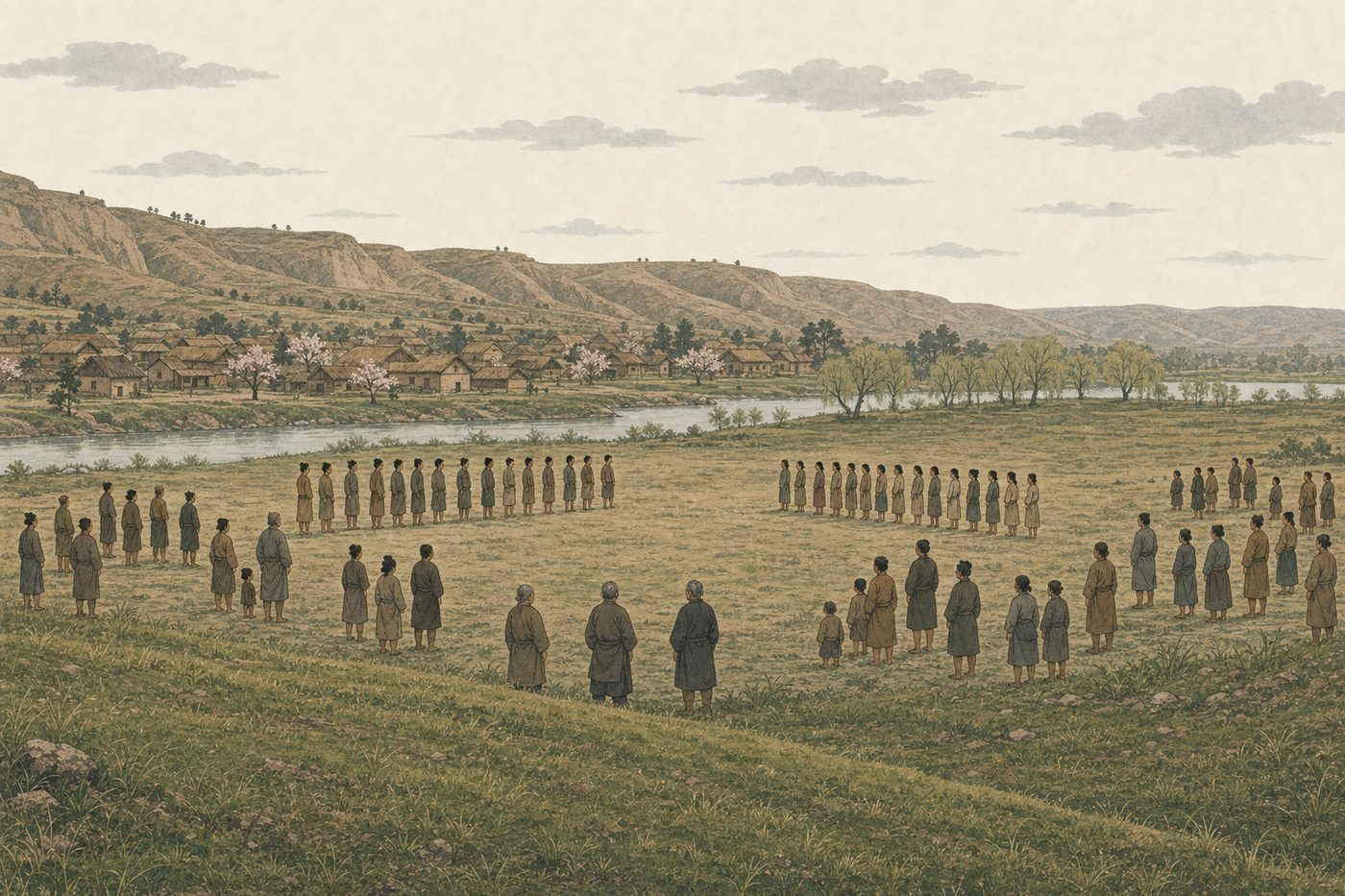
The yang calls, the yin replies
He starts in China because China is where the Neolithic never quite ended: much of what the villages of Yang Shao believed five thousand years before Christ, Eliade notes, was still being practised in Chinese villages within living memory. The whole of it ran on a pair of words. Yin was cold cloudy weather and the inside of things; yang was sun and heat. He takes from Granet the winter picture: the yang trapped under the frozen ground, tried and revived, and at the start of spring "striking the ground with its heel: it is then that the ice melts of itself and the streams awaken." The peasants acted it out. At the spring and autumn festivals two choruses lined up across a field, boys against girls, and sang at each other in turn, the field the whole of space and the singers everyone, and the festival ended, as he puts it with some delicacy, in a collective hierogamy. Then the philosophers made it the Tao.
Two men did, in opposite directions. Confucius, who lived through anarchy and thought the cure was good government, never got a post worth having and died believing he had failed, and two hundred and fifty years later the Han handed him the empire. He kept Heaven, kept the ancestors, kept the rites, and made the rites the point: a gesture done exactly right was not manners, it released power. His model was the sage-king Shun, who "simply stood there, gravely and reverently, with his face turned toward the South," and the kingdom ran. What Confucius did, in Eliade's phrase, was show the possibility of recovering the religious dimension of secular work.
Lao Tzu went the other way and vanished. Confucius went to ask him about the rites, was told to get rid of his arrogance and his zeal, and came away saying he knew birds and fish and beasts but "the dragon I cannot know; he rises into heaven on the clouds and the wind. Today I saw Lao Tzŭ, and he is like the dragon!" Lao Tzu wrote five thousand words for a border guard on his way west and was never seen again. His Tao cannot be named; it tells kings to do nothing and everything will get done; and it is, Eliade insists, shamanism with the workings shown: Chuang Tzu has Confucius find Lao Tzu stiff as dry wood, gone from the world, and Lao Tzu say when he comes round, "I went to frolic at the Origin of all things." The people who took him at his word wanted to live forever, and grew feathers doing it, and the alchemists among them, who took cinnabar because burned it gives mercury and so holds the secret of coming back from death, are the furnace again: the alchemist "contributes to the work of nature by accelerating the rhythm of time."
The man struck by a poisoned arrow
India's turn came from the other side. The Upanishads had found that the self was the same as the All, and the people after them drew the conclusion: then what is all this? The fable Eliade picks is from the Chāndogya. A man is taken blindfold far from his city and left, and shouts that he has been abandoned, until someone takes the blindfold off and points, and he asks his way from village to village until he is home. Śaṅkara explained it: the thieves are false ideas, the blindfold is illusion, the city is your own self, which you had never left. All the schools agree on the diagnosis, "All is suffering, all is transitory," and agree, he says twice, that this is not pessimism, because the way out exists. For Sāṃkhya the spirit is a spectator with nothing to do with the world, and matter puts on the whole show for its benefit and, once seen, withdraws "like a dancer who departs after satisfying her master's desire."
Then a prince did it. Eliade tells the Buddha's life as biography and myth at once. Siddhārtha was born in a garden while his mother held a tree and announced that this was his last birth; he was also a minor king's son who left the palace at twenty-nine soon after his son was born, because Indian custom would not let a man renounce the world before he had an heir. He rode out by the south-east gate, cut his hair with his sword, and sent the gods home, and they play no part after that. Six years of fasting took him to a millet seed a day and then to nothing; he understood it was useless, ate the rice a woman gave him, and his five disciples walked out in disgust. Under the pipal tree Death attacked him with an army and then with women, and when Death claimed the seat and Siddhārtha had no witness, he touched the ground with his right hand and the Earth rose to the waist and vouched for him. He died at eighty, of dysentery after a dish a blacksmith served him, lying on his right side between two trees, and Ānanda cried and was told how can you suppose that what is born does not die. His last words: "perishability is the law of things; do not slacken your efforts!"
What he taught he refused to make a system, and the refusal is the teaching. A monk complained that the Master would not say whether the world was eternal or the soul survived death, and the Buddha told him about a man shot with a poisoned arrow who would not let the surgeon touch it until he knew the archer's caste and village and the kind of feather on the shaft, and died. What he gave was a diagnosis and a method, which Eliade shows was Yoga: watch your breath, watch yourself walk and eat, and go through the meditations in order until you touch nirvāṇa with your body. The images he chose for what he had done are the ones that mattered to a Neolithic world. He had broken the egg. He had knocked the house down.
"To the archaic ideal of 'fixing one's abode in a stable dwelling place' (that is, assuming a certain existential situation in a perfect cosmos), the Buddha opposes the ideal of the spiritual elite with which he was contemporary: annihilation of the world and transcendence of every 'conditioned' situation." — § 160
He was not alone on the roads: Mahāvīra, whom he never met, went naked for thirteen years and founded the Jains, whose monks still sweep the path ahead of them so as not to kill anything, since everything, stones and drops of water included, has a soul.
Wolf's milk
Rome is the book's counterweight, and he plainly likes it. Its founding is a murder: Romulus drew a furrow round the Palatine with a plough, the turned earth for a wall and the furrow for a moat, and when Remus jumped over it to make fun of him Romulus killed him. Seven hundred years on Horace still thought the city was cursed for it, and at every crisis, Eliade quotes Grimal, Rome "will question herself in anguish, believing that she felt the burden of a curse upon her."
What made the Romans Roman was a total lack of interest in metaphysics and a passionate interest in what was in front of them. The norm was the year turning as it should; anything odd, a rain of stones, a monstrous birth, was the gods talking, and had to be read by professionals and cleaned up with rites. They also reserved the right not to listen: one consul, himself an augur, had himself carried about in a closed litter so that no sign could get in the way of his plans. They multiplied gods to fit the work. Augustine laughs at the list for a baby, one god to make it cry, one to make it speak, one to teach it to walk, and there was a like list for a field, one entity for breaking fallow and one each for ploughing, reaping, carting and storing. Eliade will not laugh. It is what it looks like when a rural people takes the immediate seriously.
The details are the best of it. The six Vestals, taken between six and ten, kept the city's fire for thirty years and were buried alive if they slept with anyone. The consul Decius, seeing his legions give, devoted himself and the whole enemy army to the Earth and the dead, and rode into them, and Rome won. At the siege of Veii Camillus stood outside the walls and formally invited the city's goddess to move to Rome, where a better temple was waiting; Livy says the people of Veii did not know their gods had already been asked to leave. And the city that buried two Greeks and two Gauls alive after Cannae panicked, in 186, on discovering seven thousand of its own people meeting at night in the rites of Bacchus, executed thousands, and passed a decree against secret associations that was still on the books three centuries later when it was needed for the Christians.
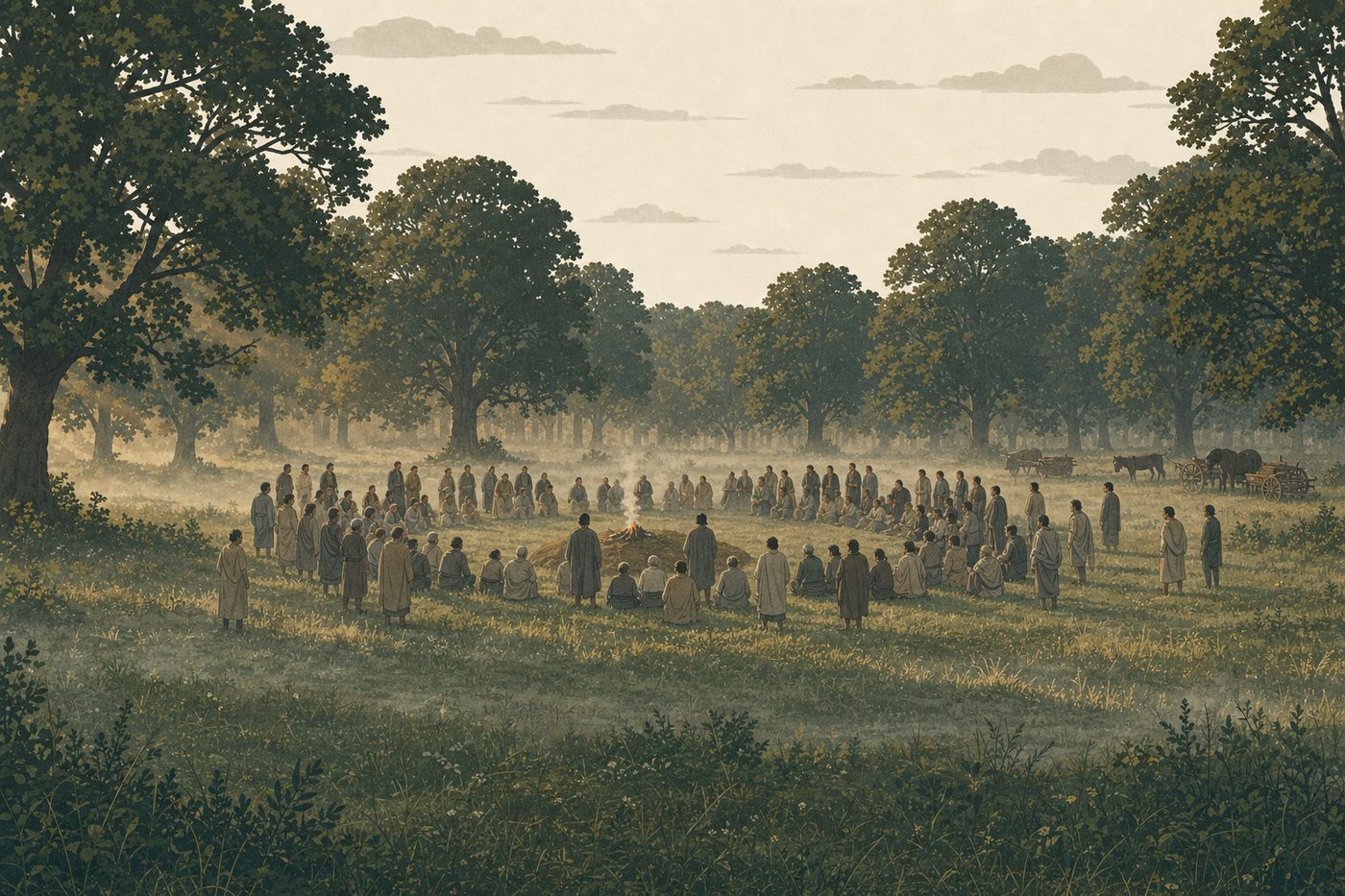
The tree that announces its own fall
The Celts' priests would not write. Caesar says the Druids spent twenty years learning verses by heart, judged every case in Gaul, met once a year at a spot reckoned the centre of the land, and taught that souls pass into other bodies, which he took for a trick to make soldiers brave. And Ireland kept, into the twelfth century, the rite by which a king was made: in front of his people he mated with a white mare, which was then killed and cooked and shared out. Sovereignty was a marriage with the land, and the land was a horse.
The Germans knew from the start that it would all end. Their world tree, Yggdrasill, was rotting from the day it was planted, an eagle in its leaves and a snake at its roots, and destiny lived in the well the roots went down into. Odin got his wisdom by hanging from that tree for nine nights, wounded with his own spear, "sacrificed to Óðinn, myself to myself." Baldr, the best of the gods, was killed by a blind brother with a sprig of mistletoe because his mother had not bothered to make the mistletoe promise, and every thing in the world wept for him except one witch, who was probably Loki. Then the winter that lasts three years, the wolf eating Odin, every god and every monster dying together, the earth going under the sea; and then, and Eliade thinks this is the old Indo-European myth and not a Christian afterthought, a new earth, green, and Baldr walking out of Hel with the brother who killed him, and a man and a woman who had hidden in the trunk of the tree.
The child of Earth and starry Heaven
Somewhere in the sixth century the Greeks, too, began to wonder whether they belonged here. Orpheus, whose head floated down the river to Lesbos still singing, is a shaman in Greek dress, and those who took his name lived without meat, which was a refusal of the sacrifice Prometheus had founded the Greek world on, and believed the body was a tomb and the soul a god in it. The people buried with them left instructions on gold leaf: keep left of the white cypress, go on to the lake of Memory, and say to the guards, "I am the child of Earth and starry Heaven; that you know; but I am parched with thirst, and I am dying." Lethe now worked the other way round: it made you forget heaven so you could be born again, and the Orphic meant to stop being born. Plato took the lot and made philosophy of it: to know is to remember, and the soul remembers because it saw the Ideas between one body and the next.
Then Alexander opened the world. When his Macedonians mutinied because he had made Persians their kin, he answered, "But I have made you all my relatives!" The city-state and its gods went; the Stoics told everyone he was a citizen of the cosmos, and the freed man found himself, in Eliade's phrase, alone in a universe terrifying by its mystery and vastness. Fortune ruled it: chance, necessity, the stars. Every religion that spread through that world promised to get one person out from under Fortune, and Isis said it plainly: "I have conquered Destiny, and Destiny obeys me."
Renouncing the fruits
Buddhism, meanwhile, was spreading, under Aśoka, who had killed a hundred thousand Kaliṅgas and then cut into rock the words "All men are my children," and its philosopher Nāgārjuna was showing that everything the tradition had said, nirvāṇa included, was empty, and that "There is nothing that differentiates saṃsāra from nirvāṇa." But what Hinduism did with the same crisis is the hinge of the book. The Mahābhārata is a war: two branches of one family, a rigged dice game, twelve years in the forest, and eighteen days of slaughter that leave the winners heartsick. Eliade reads it as the end of an age, the myth the Norse had, and inside it, on the morning of the battle, a soldier loses his nerve because the enemy are his cousins and his teachers. Krishna, who is his charioteer and is also God, does not tell him the war is fine. He tells him that nobody escapes acting, that "everyone is condemned to action," and that the way through is to do the duty your situation gives you and let go of what comes of it:
"Indifferent to the fruit of action, always satisfied, free from all ties, no matter how active he may be, in reality he does not act" — § 194, quoting the Gītā
Every act done that way becomes a sacrifice, and sacrifice holds the world up. And because the world, war included, is Krishna's own body, it is not a prison to escape from. Eliade puts the consequence in one sentence: the Gītā "had effected the resacralization of the cosmos, of universal life, and even of man's historical existence." The wise could still walk into the forest if they liked. Everyone else, the man with a family and a trade and a war to fight, had been handed a way to be holy where he stood.
Eat your bread with joy
The Jews were handed history instead, and the book follows what it cost. The unknown prophet who wrote the second half of Isaiah in Babylon was the first to say not just that Israel would be punished and forgiven but that a new age was about to begin: Babylon down, the exiles walking home through a wilderness where cypress grew instead of thorns, the nations converted. His servant, beaten and spat on, "pierced through for our faults," was the shape the Christians would recognise five centuries later. Then they went home and rebuilt the Temple and nothing happened. Haggai had promised an earthquake and the fall of kings on the day the work was finished; the day came, the end did not, and, as Eliade says has happened many times since, the hope was quietly rebuilt into something else: the Law.
Ecclesiastes shows the strain: he had watched the good die and the wicked prosper and decided that God had withdrawn and could not be understood, and drew the conclusion of Gilgamesh's barmaid: "Go, eat your bread with joy and drink your wine with a glad heart." Then Antiochus turned the Temple over to Zeus and forbade the Sabbath on pain of death, the pious rose, and out of the terror came the first apocalypses: Daniel's four kingdoms, gold to iron, smashed by a stone; a court, and the books opened; one like a son of man given a kingdom that would not pass. History now ran on God's plan to an end, and the worse it got the nearer the end must be. The dead would rise; Satan, who had been a member of the heavenly court, became the adversary of God. When the Temple fell a second time, in the year 70, the man who saved Judaism was carried out of the siege in a coffin and asked the Romans for a school. The answer given there was to give up the end of the world and keep the Law, which became, in the rabbis' teaching, the pattern the world was made from: two hundred and forty-eight commands for the body's members and three hundred and sixty-five prohibitions for its veins.
Born again for eternity
The religions that filled the Hellenistic world all worked the same way, and Eliade lays the pattern out before the cases. A god who had died and come back. An oath of silence; fasting; a washing; then a night in which the newcomer somehow died with the god and was born again and fed on milk like an infant; a meal; and a promise that Fortune no longer applied to him. Only Dionysus was Greek. The rest came from the east. Attis, whose mother conceived him by eating an almond and who cut himself under a pine tree and died, was carried into Rome each March as a felled pine wrapped like a body; two days later, on the day of blood, his priests slashed themselves and some of the new men cut off their sex and gave it to the goddess; and the next morning was joy, because he had risen. He was called "the ear harvested green," and Eliade thinks the whole terrible cult was the old farmers' mystery of vegetation gone to town and made to save people one at a time. Isis has the best witness. Apuleius, who was initiated, says he may not say what happened, and then says this much:
"Thou shalt understand that I approached near unto hell, even to the gates of Proserpine, and after that I was ravished throughout all the elements, I returned to my proper place: about midnight I saw the sun brightly shine, I saw likewise the gods celestial and the gods infernal, before whom I presented myself and worshipped them." — § 208, quoting Apuleius
And out of the same world came alchemy. It was not fraud, because the ancients could assay gold; and it was not science, because the alchemists mention sulphur hundreds of times without noticing anything about it. It was the Mysteries applied to matter: the stuff in the flask went black, and that was death, then white, then yellow, then red, and Zosimus dreamed of a man cut to pieces and burned so that he could change his body into spirit, and woke asking whether the man was Water. The alchemists projected onto matter the suffering that initiation had always put a person through, so that lead could be perfected the way a man was. They made a Mystery for the ore.
The doubt of the sacrificer
The Persians explained evil with a story Eliade traces back before Zarathustra. Zurvan, who is Time, sacrificed for a thousand years to get a son, and at the end of the thousand years he doubted for a moment whether it was any use. Two sons were conceived, Ohrmazd from the sacrifice and Ahriman from the doubt; Ahriman tore his way out first and claimed the kingship promised to the firstborn, and his father, who would not break an oath, gave it him for nine thousand years. Everything wrong with the world is a slip in a rite. The orthodox rejected the brothers and kept the timetable: the Evil One attacked, and God's answer was to make the world, and with it something no farmer's religion had ever needed, time that starts and stops. "By creating linear and limited time as the interval in which the battle against evil will take place, Ohrmazd gave it both a meaning (an eschatology) and a dramatic structure," Eliade writes: "he created limited time as sacred history."
He made the world twice, first as an idea and then in matter, and before the second he asked the souls waiting in heaven whether they would agree to be born into bodies and fight, and they said yes. Eliade stops on that.
"This testifies to the attachment for incarnate life, for work, and, in the last analysis, for matter—an attachment that is a specific characteristic of Zarathustra's message." — § 215
Ahriman got in anyway, tore the sky, fouled the water, killed the first bull and the first man, and the world since has been the mixture. At the end the mountains will run like metal and everyone will walk through the river of it, which the just will feel as warm milk, and be given back their bodies. Eliade calls the resurrection of the body "the most rigorous and the most daring religious valorization of matter that we know of before the Western chemist-philosophers of the seventeenth century." It came into Judaism from here, and into the Church.
So did a soldiers' religion. Mithra was born from a rock, killed a bull against his will, turning his face away, and from its marrow came wheat and from its blood the vine; then he ate with the Sun in a cave, and the cave was every chapel his men built afterwards, from Scotland to the Euphrates. A chapel held a hundred men and admitted no women, which, Eliade says, in a century when women were carrying every religion of salvation, is why Renan was wrong that the world would have been Mithraist had Christianity stumbled. The Christians feared it anyway: it had a baptism, a meal of bread and wine, and the same birthday for its god.
An obscure Jew
He opens on the road to Damascus, with a young Pharisee on the ground and blind for three days, and gives his reason: the earliest Christian documents are Paul's letters, and every one of them is written in the certainty that a man executed two or three years before Paul's own vision was alive. Then he goes back. A Galilean named Jesus came to be baptised in the Jordan with everyone else; the wilderness came next, and Satan offering him the kingdoms of the world, which, in that country and that decade, was an offer to overthrow Rome. When John was arrested Jesus began to preach the thing every Jew had been waiting a century for: the Kingdom is at hand. He was nearly made king: after the loaves and fishes, which Eliade reads as an old rite of a people eating together, five thousand people tried to take him by force, and he got into a boat.
In Jerusalem at Passover he entered like a king, cleared the Temple, and told the priests a story about tenants who killed the owner's son, and they understood him. What the tradition kept from the last night is two failures: Peter would deny him before the cock crew, and did, and was forgiven; and in the garden the disciples could not stay awake with him for an hour, and since Gilgamesh, Eliade says, staying awake has been the test. He was crucified between two men whom Josephus's word makes revolutionaries. Then the tomb was empty and they saw him, and whatever that was, it is the foundation, because it turned a handful of demoralised fugitives into men who thought they could not lose.
The Kingdom he preached was two things at once, and Eliade will not choose. It was coming soon, in this generation. It was also already here, arriving without any sign, compared in the parables "to the gradual maturing of the seed that is sprouting and growing," to a mustard seed, to yeast in dough. At the last supper he broke bread and said it was his body, and the first Christians did the same at every meeting, because a new life, as every farmer's religion had known, comes out of a death. Paul made the theology out of his own conversion: he had persecuted the Church and been saved regardless, so salvation was not earned, and everyone baptised was one body, "Jews as well as Greeks, slaves as well as citizens." The Christians left Jerusalem before the war rather than fight in it, and that was the moment they stopped being a Jewish sect. The Temple fell. The end did not come. And the answer that won, in John's gospel, was that it already had: the Kingdom was the Church, visible to those who could see it and not to the rest, which is exactly, Eliade observes, how the sacred has always worked.
The son of kings asleep in Egypt
Every religion of the age had a secret teaching, and the Church did too; Eliade thinks the historians who deny it are wrong. The trouble was what came in under cover of it. Valentinus, the greatest of the Gnostics, had a whole heaven of paired powers, and the last of them, Wisdom, wanting to know the Father, fell, and out of her grief and fear came matter and a blind maker who thought he was the only god. The Gnostic learned that he was a spark of light in a world made by mistake, that his birth was a fall and his body a prison, and that knowing this was the way out. Their best text is a poem. A prince is sent from the East into Egypt to fetch a pearl from beside a serpent, and the Egyptians feed him, and he forgets.
"I forgot that I was a son of kings,
And I served their king;
And I forgot the pearl for which my parents had sent me.
And by reason of the burden of their foods
I lay in a deep sleep." — § 230, the Hymn of the Pearl
His parents send a letter that flies to him as an eagle and speaks, and he remembers, and takes the pearl and goes home, where his robe of light comes to meet him and he sees that it is himself. Sleep, drunkenness, forgetting, homesickness: those are the Gnostic words for being alive.
Mani made it a world religion. Born in Babylonia in 216, he preached under one Persian king's protection and died under the next in seven chains weighing twenty kilos, and his church outlived him by a thousand years, from Spain to China. Its doctrine is the most complete despair anyone has organised. In the beginning light and darkness lay side by side; darkness saw light and wanted it; God sent a first man to fight, and he lost, and his soul, which was five kinds of light, was eaten. Everything since, sky and earth, sun and moon, is machinery built to get that light back out. Adam and Eve were made by two demons who ate all the others so as to lock the most light in one body, and every child born since keeps a spark of God in prison a generation longer. The suffering Jesus hangs from every tree. Eliade writes it out and then says what it means:
"One cannot, one must not, religiously valorize what belongs to the adversary of God: nature, life, human existence. The 'true religion' consists in escaping from the prison built by the demonic forces and in contributing to the definitive annihilation of the world, of life, and of man." — § 234
He adds, without pressing it, that a system in which the world, life and man are all the result of an accident has a certain likeness to modern materialism.
The bus that stops at Eleusis
The Church became itself by fighting that. Its first theology was written against the Gnostics, and what it defended was the Old Testament: God made matter first and man last, in his own image, with a body and a sex and a will, and history is the time a man is given to learn to be what he was made for. Eliade, who has just spent two chapters on people who wanted out, notices the temper of the thing.
"Paradoxically, despite the delay of the parousia and the increase in persecutions, Christianity appears as an optimistic religion. The theology elaborated against the Gnostics glorifies the Creation, blesses life, accepts history—even when history becomes nothing but terror." — § 235
What came in was everything the farmers had ever believed, rebaptised. The Cross was the Tree of Life, planted at the centre of the world where Adam was buried, so that Christ's blood ran onto Adam's skull and washed him; and from the blood grew wheat, the vine and the healing herbs, as they had grown from every dying god. Romanian peasants sang it into the twentieth century: where my blood dripped, good wine flowed. Every dragon-killer from Portugal to the Urals became Saint George. Eliade calls it cosmic Christianity, the faith of the countryside, in which the drama of Christ is spread over the whole of nature and the historical part is quietly dropped. He gives the causes of the victory plainly. The Christians did not break under torture. They fed widows and orphans, in a plague they alone nursed the sick and buried the dead, and there was no barrier of class or race or learning to joining them: an emperor's chamberlain knelt before a bishop who had been his slave. Under Theodosius the persecuted became the persecutors, and the monks came out of the desert: in 391 they pulled down the temple of Serapis in Alexandria and in 415 they lynched Hypatia in the street.
In 396 Alaric's Goths came through Thermopylae with men in black behind them and burned the sanctuary at Eleusis, and the initiations that had run since the Bronze Age stopped. Demeter did not leave. The village kept a statue of her and heaped it with flowers every year for the fields until 1820, when an Englishman took it away to Cambridge against the armed resistance of the inhabitants. In 1860 a priest told a French archaeologist the story of Saint Demetra, an old woman from Athens whose daughter had been carried off by a Turk. And in February 1940 the Athenian papers reported that an old woman with very big eyes had got on the bus to Corinth without money for the fare, been put off at the next stop, which was Eleusis, and been let back on when the driver could not start the engine and the passengers paid for her. She told them they ought to have done it sooner, and that they would be punished for how they lived, "you will be deprived even of plants and water!", and vanished, and the passengers counted the tickets. Eliade ends the volume there, with the Homeric hymn, in which the goddess, disguised as an old woman, said much the same to the people of Eleusis about three thousand years before.
Through the Orenda lens
The book is a thousand years of clever people saying the world is not worth being in, and I run a farm, so I read it as an argument about my job. The Buddha knocked the house down. The Orphics said the body was a tomb, the Gnostics said the earth was made by a blind god by mistake, and Mani said plainly that one must not honour nature, life or human existence because they belong to the enemy. Against all of that Eliade lines up the Persians, whose souls were asked whether they would consent to be born into bodies and fight, and said yes; and Krishna, for whom the world is God's own body; and the Church, which decided that God had made matter on purpose. I did not have a side in this argument before I had a farm. Now I have one, and the word for it is the word the farm is named for. My book says where I found it:
"It's not a philosophy I adopted. It's a word I found for something I was already observing. The farm, the bitcoin, the reading, the teaching. All one current. All the same signal."
That is the Gnostic's awakening the other way round. The prince in the poem wakes, remembers he is a stranger in Egypt, and goes home. What I woke up to was that I was already home. Orenda is lifeforce present in all natural beings, and there is no version of that in which the grass is a prison. Eliade's own position, on the last pages, is the one I would have come to on my own: the people who saw the sacred in the objects and rhythms of the world for the whole of prehistory were not fooling themselves, and a religion which says God went into a body and meant it has, whether it likes it or not, taken their side.
The second thing is Krishna's word for the discipline. Everyone is condemned to action; the way through is to do the work your situation gives you and let go of the fruit. I would not have put it that way, because I do want the fruit, later. But a farm makes you do it whether you like the language or not. My book has the plain version:
"You plant cover crops that don't produce revenue but hold the ground together. You rotate animals across pasture in patterns that mimic natural grazing, building fertility instead of depleting it. That is low time preference applied to the land."
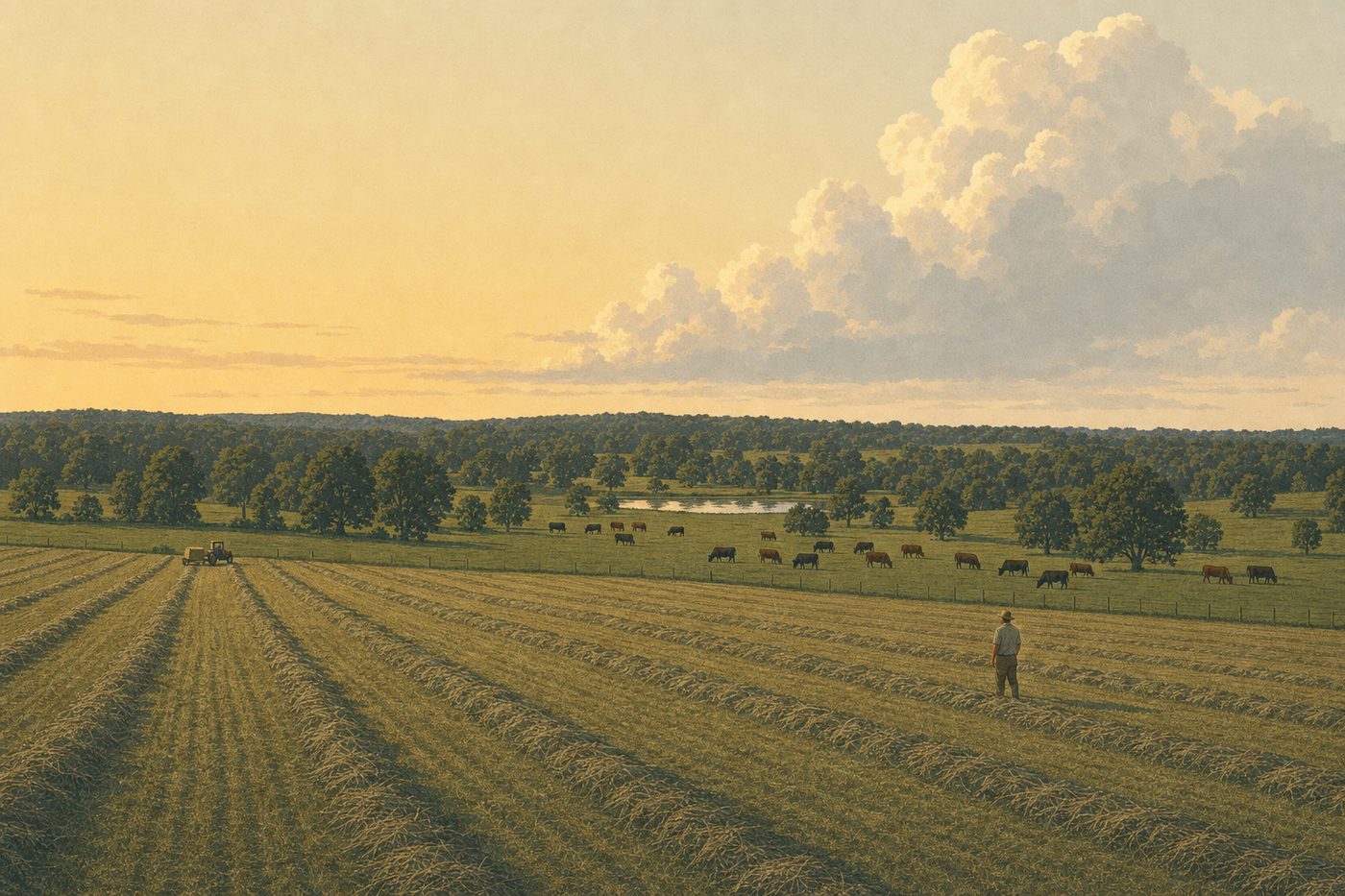
A cover crop that produces no revenue is an act with the fruit renounced. So is hay cut with weather coming, which is the picture above: you do the work this week because the grass is ready this week, and the sky decides the rest. Eliade says the Gītā made ordinary life holy again for the people who could not walk off into the forest. A farm is those people.
The third thing is time, and this is where the money comes in, because the book is really a history of time. The farmers of the first volume lived on a wheel. The Buddha's answer was to break the wheel and get off. The Persians' answer, which Eliade thinks the great invention of the volume, was to give time a beginning and an end and make the interval the place where the work is done: "he created limited time as sacred history." A farm lives on both. The year comes round, calving to hay to weaning to winter, and that is the wheel. But the soil is on a line, building or going, an inch a century formed and ten to a hundred times that lost under industrial farming, and using the wheel to move the line up is what regenerative means. And the money I keep the farm's surplus in is the Persian kind: a schedule with a beginning, a fixed end written in on the first day, and no priest who can renew it.
"The reward keeps halving until it rounds to zero, somewhere around the year 2140. At that point, all 21 million bitcoin will have been issued. No more will ever be created. The supply schedule was written into the code on day one and has never been altered."
Every other money in the book, and every other money since, has been Zurvan's: time that goes on forever and produces its evil by a slip in the rite, which in a treasury is a decision on a Tuesday afternoon. Limited time is what makes a plan possible.
Where I part from Eliade is where he draws the line. He puts the Gnostics and Manichees on one side and the Church on the other, and he is right about the theology, but his own pages show the line running through the middle of every religion in the book: the Church that blessed matter sent thousands of monks into the desert, and those monks burned the Serapeum and murdered a woman in the street. The line is between people who think this field is where the work is and people who think it is where the spirit is held prisoner, and both kinds turn up in every century and every trade, including mine. The industrial view of a pasture, as a dead surface you apply inputs to, is Mani with the light taken out: matter made by no one, worth nothing in itself, to be got through. Eliade noticed the resemblance and let it go in a sentence. I would not.
And the last thing is the bus. The first volume ended for me on the Egyptian sheaf still tied the pharaohs' way, and this one ends with Demeter's statue under flowers at Eleusis until 1820 and an old woman on a bus in 1940 telling the passengers they would lose even plants and water for the way they lived. That is a story about the countryside, which kept the farmers' religion under whatever name was on offer for sixteen centuries after the philosophers had declared the world a prison and the theologians had settled the question the other way. Eliade calls it cosmic Christianity and says the historians have not paid attention to it. I would call it what this shelf is about.
What's happened since
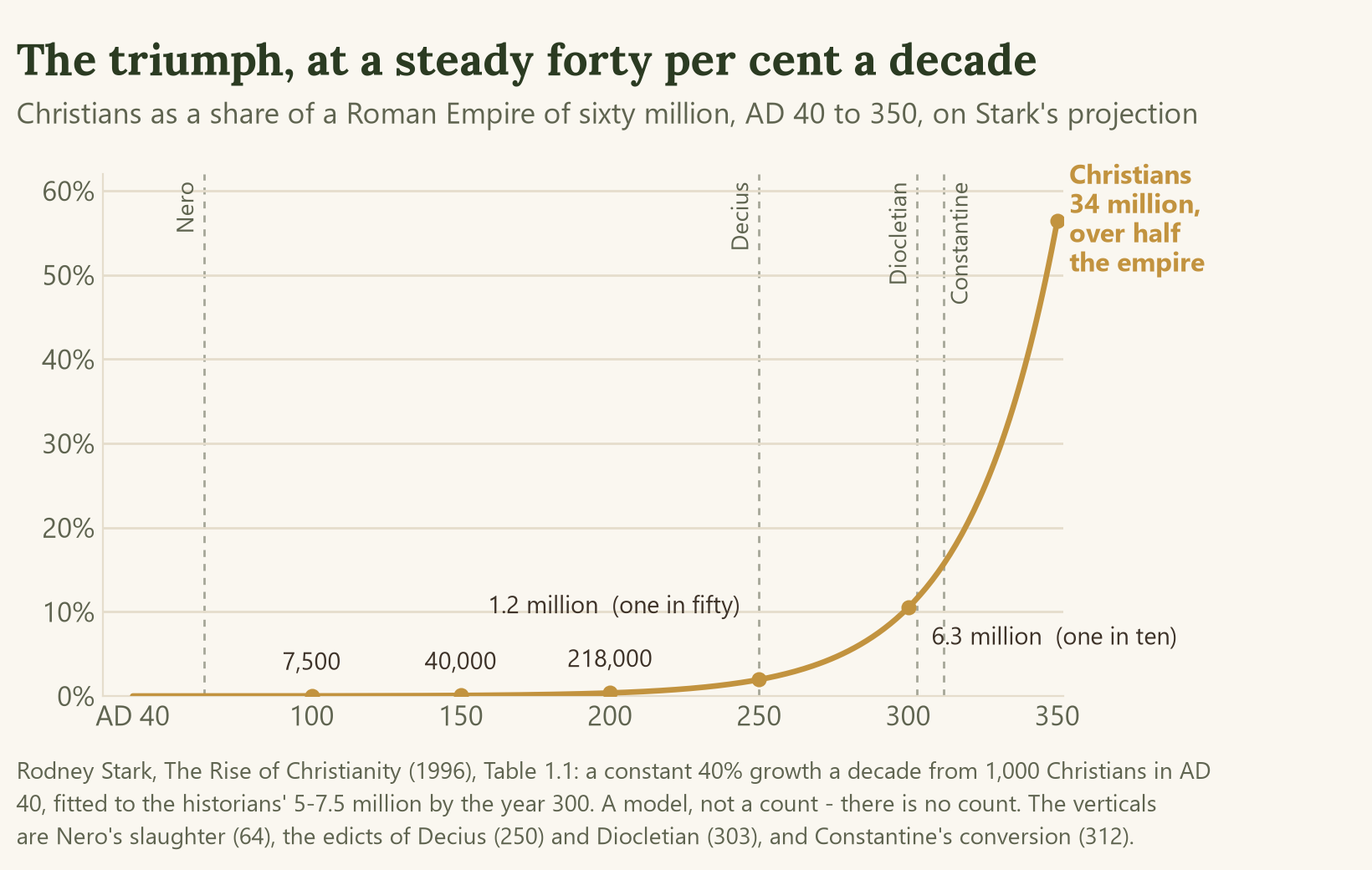
Eliade finished the third volume in 1983 and died in Chicago in April 1986; the English of this one came out in 1982, its translator having died two years before it did. The ground under it has moved in a few places. The Buddha has been moved a century: his death, which Eliade puts at 478 or 487, is now placed by most scholars within twenty years of 400 BC, after a conference at Göttingen in 1988 gave up the old consensus. The oldest text of Lao Tzu, on bamboo slips from a tomb at Guodian dated about 300 BC, came out of the ground in 1993, consistent with his guess at the book's date, and the Derveni papyrus, the burnt Orphic roll he cites in fragments, was published whole in 2006. The Jains, whom he counts at a million and a half, were four and a half million at the Indian census of 2011. And the sixty million and the forty per cent on the chart above are Rodney Stark's arithmetic from 1996, which fitted a constant rate of growth to the historians' guess of five to seven and a half million Christians by the year 300 and found that it also matched what the sources say at every century between; the point of the chart is that a steady rate looks like nothing for two hundred years and then like everything, which is what Eliade's sources, and Constantine, saw. Read the book for the middle: the Buddha's last meal, the consul in his litter, Odin on the tree, the gold plates, Krishna in the chariot, the souls who agreed to be born, the sleeping disciples, the son of kings asleep in Egypt, and the old woman on the bus.