

In short
The second volume of this book ended with an old woman on a bus at Eleusis in 1940. This one opens on the steppe, with Genghis Khan asking the imam of Bukhara why anyone would go to Mecca when the whole universe is the house of God, and closes with Isaac Newton at his furnace and a lama reading aloud to a dead man. Between them three religions of the Book built the biggest institutions the world had seen, and Eliade, who was going blind by now and could barely hold a pen, chose not to write about the institutions. His preface says so. Aquinas gets one section and Luther three, and the rest goes to what the manuals leave out: the heresies, the mystics, the sorcerers, the alchemists, and the farmers who went on keeping the year under whatever name the bishop allowed.
The book has a shape, and it repeats. A god makes the world and goes quiet, and the people below him make their own arrangements. A prophet reads the Book aloud and an institution grows up to keep it; then someone inside says they have seen God for themselves, and the institution kills them, or condemns them after death, or, in the one case where it could not, makes them a saint. And underneath, on every side of every schism, the countryside keeps a religion nobody wrote down, in which the harvest is what the fight is about. Eliade thinks that religion deserves equal treatment with the theologies, and this is the volume where he says so.
The thesis
"But I have concentrated less on the familiar creations of Occidental thought (e.g., Scholasticism, Reformation) than on certain phenomena which have largely passed into silence or been minimized in the manuals: heterodoxies, heresies, mythologies, and popular practices such as sorcery, alchemy, and esotericism. Interpreted in their proper spiritual horizon, these religious creations have their own special interest and occasionally their grandeur." — Preface
The tent with a hole in it
He begins with the horsemen and their god going quiet. Tängri is sky and god in one word, and the Mongols swore by saying "May Heaven know it!" But the god is only as strong as the empire. When there is no sovereign, Eliade says, the celestial god is slowly forgotten and the popular cult takes his place. The Mongols ended with ninety-nine Tengris.
What the herdsmen kept was a world that fitted in a tent. Heaven is a felt tent, the Milky Way its seam, the stars the holes the light comes through, the polestar the post; the smoke hole in the roof of every yurt is the same hole on a smaller scale, the way up. Under the sky the world was made by a dive. In the Altai version God and "man" swim on the first water as two black geese, God sends the man down for mud, the man keeps a little in his mouth, it swells as the Earth swells, he spits it out, and that is the marsh. God tells him he has sinned and that he will be Erlik, king of the dead. Every mountain and every death is a slip at the creation by an assistant who could not be trusted, and the story ran west into the Balkans, where the assistant became the Devil.
The shaman is chosen by sickness. He dreams that the spirits cut off his head and set it aside so he can watch while they take him to pieces and clean his bones; he lies as good as dead in the yurt for three days or nine, and gets up a shaman. At the Altai horse sacrifice he climbs a notched birch through nine heavens, thanks Bai Ülgän for the herds, and comes down with the weather and next year's harvest; when he goes the other way he gets the king of the dead drunk and rides home on a goose.
The Balts had a farmer's heaven, with Dievs on his farm in the sky coming down to help with the work, and in the seventeenth century an old Lithuanian confessed that he was a werewolf: three nights a year he and his companions went as wolves to the end of the sea, which is Hell, and fought the Devil and the sorcerers to get back the cattle and the wheat they had stolen. Werewolves, he said, were the dogs of God. Eliade will come back to him.
Take and read
In August 410 Alaric's Goths sacked Rome, and the pagans said it was the Christians' fault. Augustine, bishop of Hippo, spent fourteen years answering, and the City of God is not really about Rome: history has two events in it, Adam's sin and the Incarnation, and the just are pilgrims through a city of men that has been mortal since Cain built it. In a sermon he gave the sentence that carried the West through the centuries in which the Empire disappeared: Rome will not perish if the Romans do not perish. An institution lasts as long as the quality of the people in it, not the other way round. The Vandals were at Hippo when he died, on 28 August 430; a year later the town was burned and Roman Africa was over.
His life is in the theology. Nine years a Manichee, a concubine and a son, and then one summer day in 386 a child's voice in a nearby garden saying "Take and read!" His doctrine of grace came out of his own failure to master his own body: original sin passes through the act that makes children, the will is not free to do good, and God chose before the world who would be saved and who damned, unbaptised infants among the damned. He admitted this was incomprehensible. Eliade lets a Catholic theologian of his own day give the verdict: the Church has carried the greatness and the weakness of Augustine for sixteen hundred years. Origen had gone the other way, teaching that at the end everything would be restored, the Devil included; the Church anathematised him in 553, three centuries dead, and lost, Eliade thinks, its one chance to speak to India.
Augustine disliked the cult of relics until Saint Stephen's arrived in Hippo in 425 and began curing people, after which he kept a register of the miracles. A martyr's grave was where Heaven and Earth touched, and a body could be divided without limit; bishops became, in Peter Brown's word, the impresarios of the dead, and Jerome said it in three words: the city changed its address. The East went further and built the cosmos into the church itself, the altar as Paradise in the east and the west end as the country of the dead, and held that a man in a body could become God by grace; when an emperor banned the icons in 726, the defence was John of Damascus's: "How do you, as someone who is visible, worship the things that are invisible?" God had taken a body, so a body could be painted, and after a century the icons won.
Read!
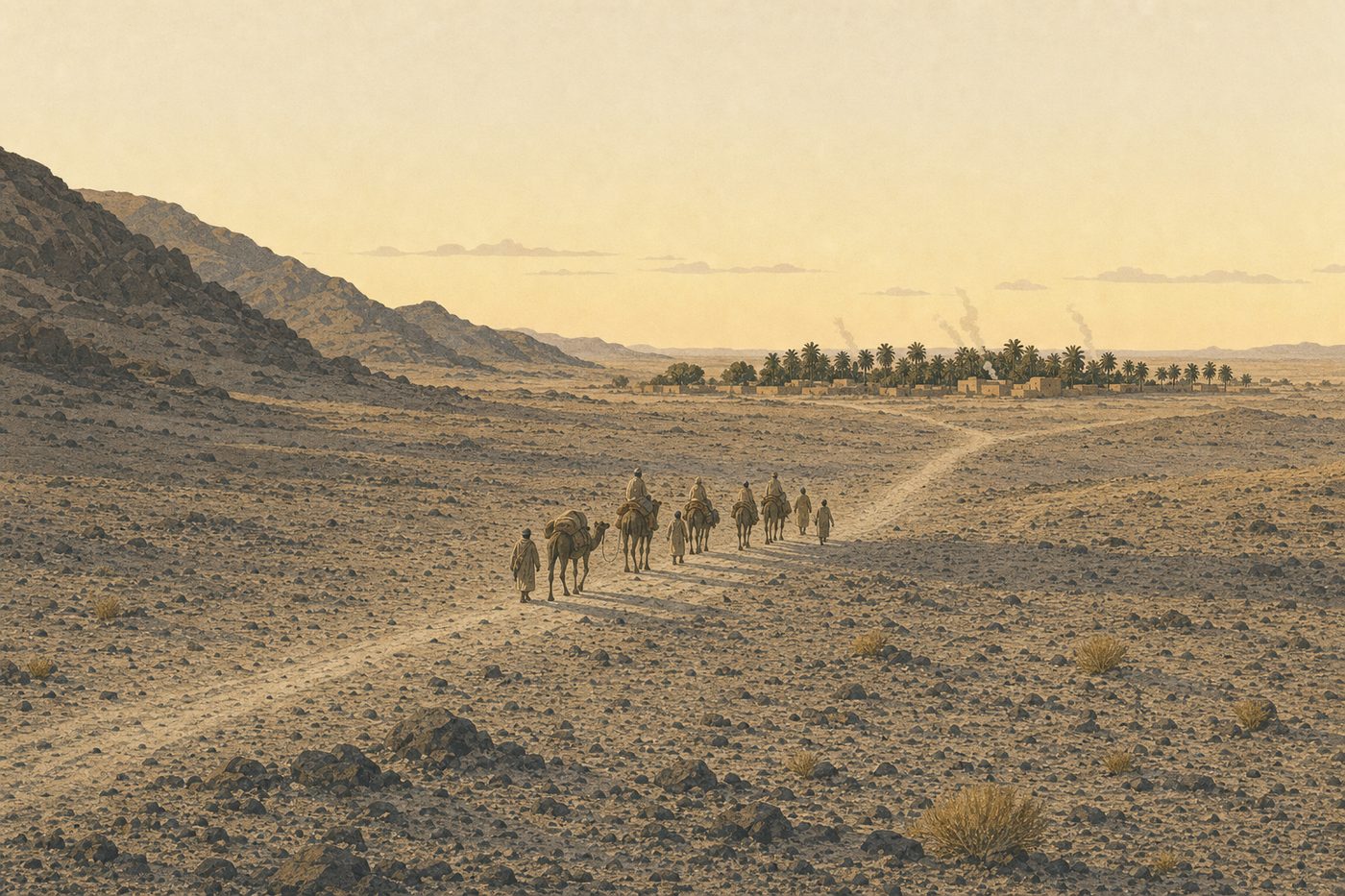
Muhammad, Eliade says, is the one founder of a world religion whose life we actually know. Mecca was a sanctuary before it was a town, a cube with a black stone in its corner; its lord was Allah, who had gone the way of Tängri, taking a few first-fruits while his three daughters took the prayers. Muhammad was an orphan who married the rich widow he worked for and took no other wife while she lived. Around 610 he began going up to a cave alone, a thing no Arab did, and there, in the story Ibn Ishâq kept, an angel came holding a book and said "Read!", and pressed the book on his mouth and nose until he nearly choked, four times, until he read. He woke, he said, with a message written on his heart, and going out on the mountain he saw the angel sitting cross-legged on the horizon and could not turn his head without seeing him. Eliade takes this as real, and notes that he resisted, as shamans and prophets do.
The Meccans objected that his god damned their ancestors, that he ate food and walked in the market like anyone, and that the end of the world kept not coming. He tried a concession, a verse allowing the three goddesses to intercede, and then withdrew it as the Devil's dictation, which makes the Quran, Eliade says, the only holy book with the power to cancel its own lines.
In 622 he moved. Seventy-five men and two women from Yathrib swore to fight for him, and on 24 September he rode in and let his camel choose the site of his house. At Medina he became a statesman. He had prayed toward Jerusalem and expected the Jews of the oasis to recognise him; they pointed out his mistakes in the scriptures instead, and on 11 February 624 a revelation turned the prayer round to face Mecca, whose sanctuary, he now announced, Abraham and Ishmael had built. The war was raids, a defeat, and a siege; after it he had the last Jewish tribe in the town killed. In 630 he walked into Mecca with ten thousand men and no fighting, smashed the idols, executed six enemies, forgave the rest, and went home. In 632 he made the pilgrimage one last time, fixed every step of it as it is still done, and asked the crowd whether he had fulfilled his mission; they shouted that he had. He died in June in his favourite wife's arms. Some would not believe it, and Abû Bakr told them:
"If one venerates Muhammad, Muhammad is dead; but if one venerates God, Muhammad is living and does not die!" — § 263
The house of God
What he had made has, Eliade says, no parallel in history: a monotheism purer than either of the others, a state and a nation, in twenty years. Man is weak because he is a creature, not because of a Fall, and the religion is simple on purpose: no church, no priests, worship anywhere, five duties, four wives, eat and drink but not to excess. It was meant for everyone, not for saints, and it was meant to spread by war, which was preferable to apostasy and to anarchy.
He named no successor, and the split began at his grave. 'Alî, the son-in-law everyone knew he had loved, stood aside for unity; under 'Umar the armies took Syria, Persia and Egypt in eight years; then 'Umar was stabbed, 'Uthmân was killed by his own garrisons, 'Alî was murdered in 661, and his son Husayn was cut down with his family at Karbala in 680, which the Shî'a have not forgiven. Thirty years after the Prophet the community was three parties, and still is. The caliphs built Baghdad in 762 as a circle divided by a cross, with a gate to each direction, and retired into their palaces, leaving religion to the lawyers.
Heaven began to laugh
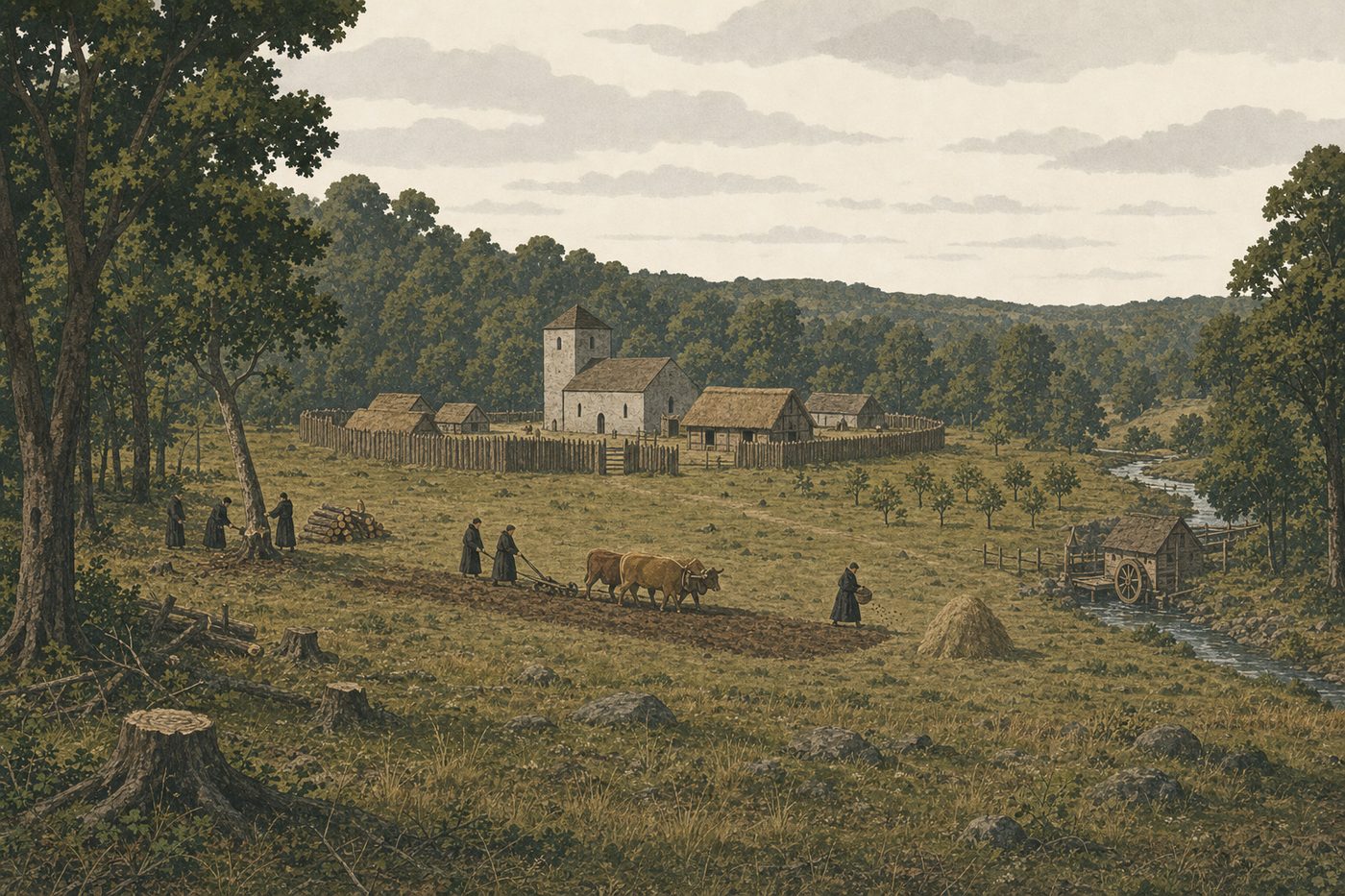
The West went dark, and what survived the dark was farms. The new society, Eliade says, grew from two seeds that could survive any catastrophe, the Benedictine monastery and the fief. Benedict's houses were small, scattered and self-feeding, so the burning of one did nothing to the rest. The kings came from Wodan, so the Church made Wodan a son of Noah born in the ark, and buried the kings in church so nobody could worship their mounds.
Then the year 1000 came near and everyone waited for the end. Comets, famines, the Devil felt everywhere; the abbots gathered the people round the relics and made the knights swear on them not to attack churches or monks, not to take ox, cow, pig or lamb, not to seize peasants or peasant women. When 1033, the millennium of the Passion, had passed and nothing had happened, the monk Raoul Glaber wrote that Heaven began to laugh, the earth covered itself with green and fruit, and the crowds held up their hands and shouted "Peace! Peace! Peace!"
The Crusades came out of the same expectation, and Eliade reads them as the end of the world attempted by force. The first took Jerusalem and lost it in a generation, and each failure taught the poor that the rich could not be the instrument, and in 1212 the children went. Nobody incited them, a witness insists; they were little shepherds, mostly, thirty thousand of them, and asked where they were going they said "to God!" The French ones took seven ships at Marseilles: two went down off Sardinia and the other five were sailed to Alexandria by two ship-owners who sold the children in the slave market. The German ones, led by a boy who had promised them the sea would part, walked over the Alps to Rome, were told to go home, and, in the words of a chronicle, returned barefoot and famished, one by one and in silence. Many died of hunger in the villages and no one buried them.
One prays, one fights, one labours
In about 1027 a bishop told his king that the house of God was three houses: one that prays, one that fights, and one that labours. The Romanesque cathedral was the whole of it in stone, the year's work and the zodiac and the monsters and Christ in glory, and Eliade's point is not that it taught the illiterate but that it took a farmer into a second world for an hour.
And a Calabrian abbot rewrote the calendar. Joachim of Fiore, who talked with three popes and told Richard the Lionheart when the Antichrist would be born, read history as three ages: the Father's, ruled by fear and married men; the Son's, ruled by faith and the clergy; and, after forty-two generations of thirty years, that is in 1260, the Age of the Spirit, ruled by monks, in which love and freedom would be the whole religion and the sacraments would not be needed. Perfection lay ahead in history, which no orthodox theology can allow. He was condemned twice, Dante put him in Paradise, and Eliade follows the third age down through the Franciscans to Lessing, to Comte, and to Hegel.
I am the Truth
The Sunni mainstream made the Law the whole of religion and settled, with al-Ash'arî, that faith and reason face each other with nothing in between. The Shî'a did the opposite. 'Alî had said that every verse of the Quran has four senses, the plain, the hidden, the limit and the divine intention, and the hidden one needs a guide; the guide is the Imâm, 'Alî's descendant, a particle of divine light in a man. The line produced, in the fortress of Alamût, the most reckless idea in the book. On 8 April 1164 the Imâm there proclaimed the Great Resurrection: the Law was over, Islam was now purely spiritual, and he was its face. Whoever dies without knowing his Imâm, says an Ismaili text, dies the death of the unconscious.
The Sufis, named for the wool they wore, came up among people sickened by the caliphs. Râbi'a, a freed slave, taught that God should be loved for nothing, neither for Paradise nor against Hell. Junayd of Baghdad taught sobriety: after the self is annihilated you come back, what remains is a new life in God, and you do not talk about it in front of people who have not been there. He expelled the disciple who did. Al-Hallâj took off the Sufi habit to walk among ordinary people in Baghdad, and said in ecstasy "I am the Truth." Then he asked to be killed:
"God, you have made lawful my blood. Kill me…. There is no more urgent duty on earth for the Muslims than my execution." — § 277
Nine years in prison, then the gallows in 922. Eliade, following Massignon, reads him as no pantheist but a man who had found that suffering was the way into love and wanted the scandal ended. His sanctity spread through the whole Muslim world after they killed him.
The wine of the Light
It was a theologian who made the mystics safe. Al-Ghazzâlî, professor at Baghdad, broke down, walked away, spent two years as a Sufi in Syria, and wrote the Revivification of the Religious Sciences to put what he had found inside the Law rather than against it, remarking on the way that the men so learned about rare forms of divorce could tell you nothing about trusting God. After him the orders spread from Morocco to Indonesia and became Islam's best missionaries, and the lawyers answered with the madrasa, so that by the fourteenth century the theologians owned the schools. Sohrawardî, who revived the light of the old Persians, was executed at Aleppo at thirty-six for saying that God could still, even now, raise a prophet.
Rûmî, whom Eliade thinks perhaps the most gifted religious poet of Islam, was a professor of law in Konya until a wandering dervish of sixty walked into the town. When Shams was murdered Rûmî did not stop dancing, day or night; his son wrote that he had been a scholar and became a poet, an ascetic and became drunk on love. He dictated forty-five thousand verses walking in the street and sitting in his bath. The dance his order still does is a funeral turned inside out, the white robe a shroud, the black cloak a grave, the felt hat a headstone, the room the universe, the sheikh stepping into the centre as the sun. In the music, Rûmî said, was a secret that would overturn the world if he told it.
Water, water
The Jews built their institution in a coffin. Yohanan ben Zakkai was carried out of the siege of Jerusalem in one and asked the Romans for a school, and sixty years later Hadrian made studying the Torah a capital crime and Akiba died under torture. What came out of Jabneh was the Mishnah, a code in six divisions, farming, feasts, family, civil law, sacrifice and purity, that ignores history so completely it still rules on tithes to be carried to a Temple that no longer existed. Eliade calls it the sanctification of ordinary life in place of a Messiah, and quotes Neusner's summary of what a man can do: man, like God, makes the world work. The Talmud that grew on it runs to 8,744 pages and taught the Jews how to live under anyone: the law of the land is the law.
The mystics had been going up to the Throne since before Christ, through seven palaces guarded by doormen who needed a password; Akiba's warning to three colleagues about to try it is the strangest sentence in the book, that when they reached the shining marble they must not say "water, water." The Kabbalah surfaced in Provence in the twelfth century, in the Cathar country, and a little after 1275 the Zohar appeared in Spain, a thousand pages of the second-century Rabbi Simeon talking with his friends, written, Scholem showed, by Moses de Leon. It gave the Jews the hidden God, the Infinite, unfolding into ten lights that are also a tree and also a man, and a God whose marriage was broken by Adam's sin, so that his Presence has been in exile since.
God made room
In 1492 the Jews were driven out of Spain, and forty years later the Kabbalah was reborn in Safed with catastrophe built into it. Isaac Luria died there at thirty-eight in 1572, having written nothing; his pupils kept his teaching. It starts with a question a child could ask: if God is everywhere, where could a world go?
"Thus, God was compelled to make room for the world by, as it were, abandoning a region within Himself, a kind of mystical primordial space from which He withdrew in order to return to it in the act of creation and revelation." — § 290, quoting Scholem
The first act of creation was a withdrawal. Then the light came back into the emptied space, the vessels made to hold it broke, sparks fell among the shells of evil, and the work of every soul since is to gather them, the repair Luria called Tikkun, which ends in the Messiah. Scholem calls it a myth of God giving birth to himself, and it was the last idea to take hold of every Jewish community on earth.
It also loaded the gun. In 1665 at Smyrna a man given to fits of sadness and joy was told by a visionary that he was the Messiah, and the whole Jewish world believed it; six months later the Turks arrested him, and to escape death Sabbatai Zvi turned Muslim. His prophet explained that the Torah, like a seed in the ground, must rot to bear fruit. Out of the same provinces, fifty years later, came the Baal Shem Tov and the Hasidim, who kept the Kabbalah and dropped the Messiah, made the saint rather than the scholar the model, and prayed with singing and dancing. One of them said he did not go to his master to learn Torah but to watch him tie his boot-laces.
The first fires
Around 930 a Bulgarian village priest called Bogomil taught that this world was made by Satan, that the Cross was an instrument of torture and should be hated, and that peasants owed their landlords nothing. In the Balkan folk version God is so tired after the Devil helps him make the world that he falls asleep, and cannot get the Earth to fit under the sky until a hedgehog tells him to press it a little, which makes the mountains. In the West the believers were called Cathars. On 28 December 1022 a counsellor of the king of France and the queen's confessor were burned at Orléans, the first heretics burned in the West, and it did not stop them; the weavers carried it into Languedoc, where the Perfect received the Spirit by a laying on of hands and some starved themselves rather than sin again. Eliade is clear that this was not Christianity but an eastern religion of escape from matter, whose ideal was that the human race should stop having children and end.
He is also clear about what the Church was: priests kept taverns and charged for every sacrament, and the Bible could not be read in any language a layman spoke. When Innocent III's legate asked to give up the mission against the heretics for a monastery, the pope wrote back that action ranks higher than contemplation, and in 1207 he preached a crusade against the south of France, offering the barons of the north the heretics' lands. It was the only crusade that won. It finished the civilisation of the troubadours, founded the Inquisition at Toulouse, and in 1229 a synod there forbade the laity to own a Bible in Latin or in French. Eliade calls it one of the blackest pages in the Church's history and, in the same paragraph, says the Church was right about the doctrine.
A little soup
Francis of Assisi is the one who could not be condemned. A rich merchant's son who spent a day as a beggar on the steps of Saint Peter's, he heard Matthew read in 1209, take no gold or silver, and did exactly that. The friars worked with their hands and begged when the work was not paid, and when Francis came back from preaching to the Sultan to find his vicars had changed the Rule, he lost the argument. His Testament forbids the friars to own a house or to ask Rome for a letter about anything, and tells them to live always as guests, strangers and pilgrims. He died in 1226 and his friend the cardinal, now pope, canonised him inside two years, which Eliade says was the surest way to keep the order inside the Church.
Eckhart said the rest out loud, in German, to nuns and townspeople. God is not good; I am good. God acts, and the Godhead beneath him does nothing. The soul has a ground that is the ground the Father begets the Son in, so the Son is born in anyone who is just, and in that ground I had no God and was the cause of myself. And yet he praised the person who breaks off contemplation to bring a sick man a little soup, and said God was as easy to find in the street as in church. Twenty-eight of his propositions were condemned two years after he died. Marguerite Porete, with less protection, was burned in Paris in 1310 for a book that was then copied all over Europe for six centuries under other names, because nobody could find the heresy in it. Then the plague came and the dead were painted rotting on their own tombs, and out of the wreck came Nicholas of Cusa, who wrote a book on the peace of faiths, in which the pagans had worshipped God in all their gods, while the Turks took Constantinople. It was forgotten until Lessing found it.
Push it down into your heart
The East had left the West in stages, a word added to the Creed, a bull laid on the altar of Hagia Sophia in 1054, and 1204, when the Fourth Crusade broke the icons, threw the relics in the filth, and set a prostitute singing on the patriarch's throne; a Greek chronicler wrote that the Muslims had never treated them so.
What it kept was the body. The monks of Sinai had prayed one sentence without stopping since the sixth century, and by the thirteenth a monk of Athos was teaching them to breathe it: sit, gather your mind, send it in through the nostrils with the breath and push it down into your heart, and when it gets there you will see the joy, like a man coming home to his wife and children. The Hesychasts said they saw God as light. A Calabrian named Barlaam called that heresy, and Gregory Palamas, twenty years a monk on Athos, answered with a distinction the councils of the 1340s made law: God's essence is beyond reach, but his energies are God too, and they can be seen. The saint becomes light without ceasing to be matter, and leads the whole creation to God through himself, which is why, Eliade says, the East had no Renaissance and needed no Reformation. The last great theologian after him was a layman, Cabasilas, who held the layman higher than the monk, because the monk imitates an angel and the layman is a whole man.
Born with the shirt
Then he goes home to Romania. Every Christmas Eve the young men of a village go out in new clothes hung with flowers and bells, make a din to drive off the spirits, sing under every window and are let in, bless the house and its master as if he were a king, and are paid in cakes and meat and drink. The carols are named for the Roman New Year and were banned by a council in 692, and some are Christian on top: God comes down a ladder of wax in a coat of stars, or is a shepherd with a flute whose flock Saint Peter drives. Underneath is an older world with an island in the sea and a tree with girls dancing round it. At Pentecost the same young men are sworn into the horse-dancers, who cure the fairies' victims by dancing the fairies' dance while one of them falls down dead in the patient's place and gets up again.
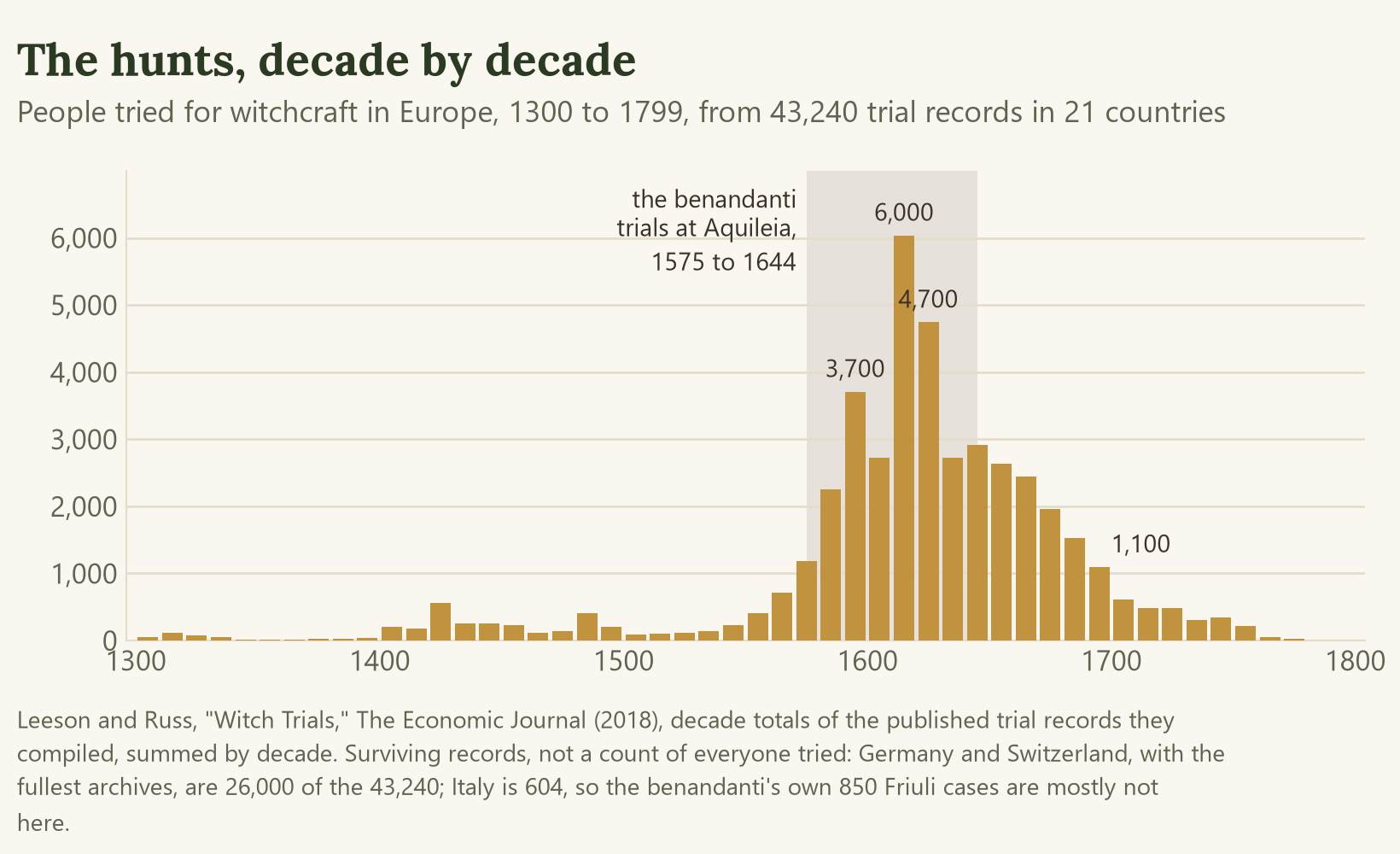
That is the religion the witch hunts were about. Eliade's evidence is Ginzburg's: the trials at Aquileia, in Friuli, that began on 31 March 1575 when the inquisitors heard of villagers who called themselves benandanti, good walkers. All had been born with the caul. Four nights a year, in the Ember weeks that mark the turns of the season, they went out in spirit while their bodies lay as if dead, riding hares and cats, to fight the witches, fennel stalks against brooms of rushes, and if they won the harvest was good and if they lost there was famine. An angel had called them, a captain summoned them with a tambourine, and the witches did the dancing and feasting, they said, and they did not. The Inquisition had a script, and for fifty years it read them the script. By 1600 they admitted only to healing, which the court took as proof of witchcraft; by 1634, after eight hundred and fifty cases, they were saying that they and the witches made common cause. The last great trial was in 1644: a man described the Devil in detail and confessed to four dead children; then, alone with the vicar in his cell, he said none of it was true, the judges wrote that he confessed whatever was suggested to him, and he hanged himself before they could decide. Eliade sets the Lithuanian werewolf beside him, and the Romanian strigoi born with the same caul who fight each other all night and go home in tears, reconciled, and says what the hunts were for:
"In the last analysis, the witch hunts pursued the liquidation of the last survivals of 'paganism': that is, essentially, fertility cults and initiation scenarios. What resulted was the impoverishment of popular religiosity and, in certain regions, the decadence of the rural societies." — § 306
The child of printing
The century before the hunts got worst was, Eliade says, one of the most creative in the West, and every discovery in it read as a religious one. Printing was the one that mattered: Lutheranism, he quotes, was from its beginning the child of book printing. Luther believed in witches and alchemy like everyone else; what was his own was a life. A lightning bolt in 1505 made him a monk; a visit to Rome in 1510 sickened him; and in 1513 or 1514, lecturing on Romans at Wittenberg, he understood that the justice of God was not the thing that condemned him but the thing that made him just, given for nothing, received by faith alone, and felt he had walked into Paradise through open gates. On 31 October 1517 he nailed up ninety-five theses against indulgences. He burned the bull that gave him six months, and in the autumn of 1520 wrote the four books that did the rest: every baptised Christian is a priest, the clergy have no monopoly on scripture, and there are three sacraments, later two. He hid in the Wartburg, told the princes to slaughter the rebel peasants, married a nun, had six children, wrote hymns, and stiffened into a church.
The argument that mattered was with Erasmus, who said he had taught nearly everything Luther taught but not so harshly, and who held that if the will were not free then sin could not be sin. Luther answered that free choice was a fiction and a name without reality, that he would see the whole world torn to pieces before he yielded, and that the peacemaker filled him with disgust, anger and contempt. Eliade calls the exchange significant, dispiriting and exemplary. The Catholic answer that worked was Ignatius, whose Exercises teach a man to see Bethlehem with his own eyes, and whose purpose was not union with God but spiritual athletes, sent out into the world.
Gold, if it had time
When Cosimo de' Medici got a Greek manuscript of Hermes Trismegistus around 1460, he told Ficino to put Plato down and translate it first. For two centuries after that the cleverest people in Europe believed in a primal religion older than Moses that would reconcile the churches and give man his place as a small god on earth. Alchemy came with it, through the Arabs, and Eliade reads the recipes as he read the Chinese and Greek ones: the black stage is the alchemist's own death, the Stone is everywhere and despised, thrown in the street by servant girls and played with by children, and the work is to do quickly what nature does slowly. Ben Jonson's alchemist says lead would be gold if it had time, and his partner adds that their art furthers it. The alchemist substitutes himself for Time.
The Renaissance gave that an ending it had not had. If Christ redeemed man, the alchemists said, the Work would redeem Nature; the Stone was Christ. And Isaac Newton, whose alchemical papers nobody looked at until 1940, worked at the furnace from 1669 to 1696, believing that God had given the secrets to a few in the beginning and hidden them in fables, and that he was recovering them. He never found the force between corpuscles, but when he turned to the planets he brought the alchemist's attraction with him. Modern science, Westfall concluded, is the marriage of the Hermetic tradition with the mechanical philosophy; Eliade adds that it then annihilated its own ideal, since the point had been the redemption of Nature, and calls it the last attempt of Christian Europe at a total knowledge.
The rope of light
The last chapter is Tibet, and it starts with the same tent. Before the Bon and before the Buddha there was a religion the Tibetans just called custom, with gods who were mountains, a smoke hole for the gate of Heaven and a hearth for the gate of the Earth, and kings who did not die. Each had a rope of light fastened to the crown of his head; at the end he dissolved from the feet upward, like a rainbow, into the rope, and the rope into the sky. Then a proud king called Digun cut his rope in a duel, and there have been royal tombs since.
Eliade's Tibet is the shaman's dismemberment turned into a science of the mind. Marpa beat and humiliated Milarepa for years and wept in secret at how he took it, and the monks, in the rite called cutting, offer their own flesh to the demons and watch a goddess take their head off. Behind it is a myth that men were once made of light and reproduced by it, and fell into touching. So at death the lama opens a hole at the crown of the head, where the rope was, and reads to the corpse for days from the Book of the Dead, which tells him that the blinding light he is about to meet is himself:
"Be not daunted thereby, nor terrified, nor awed. That is the radiance of thine own true nature. Recognize it." — § 317, quoting the Bardo Thödol
Most cannot, the book says, and follow the duller lights back down into a womb. Eliade ends with the lamas scattered across the world since the Chinese came, and wonders whether they will do for the West what the Greek scholars did for Italy after Constantinople fell.
Through the Orenda lens
The book's first pattern is the god who goes quiet. Tängri is forgotten when the empire breaks; Allah is a rumour behind three daughters by the time Muhammad goes up the mountain; the Balkan God falls asleep once the Devil has helped him make the world. Eliade files each as a loss, and then gives the version that is not a loss: Luria's God, who withdraws to make room, and whose first act of creation is his own absence. My book has a version of that too, and it is the reason the money in it works:
"Satoshi contributed to the code, corresponded with early developers, and refined the software for roughly two years. Then, in 2011, Satoshi handed the project over to other contributors and disappeared. No press conference. No book deal. No IPO."
Every other money in this volume has a sovereign who can be lobbied and a treasury that can be told. The one that has none is the one whose maker left. It is also how a pasture works. The grazier's art, as my book puts it, is to move the animals in patterns that mimic natural grazing, and the rest of it is getting out of the way; the fertility comes from the withdrawal. Eliade would have called Satoshi a deus otiosus. Luria would have said he made room.
The second pattern is the Book, and who is allowed to read it. It is the spine of the volume: the Imâm who holds the key to the hidden sense; the Synod of Toulouse forbidding a farmer to own the scriptures in any language he could read, in the same decade the Inquisition burned his neighbours for reading them; and then a printing press and a monk who said every baptised Christian was a priest, which was the end of Latin's monopoly and of the one Church. The institutions in this book were built to stand between a person and the text, and every reformer in it wanted the text. So does my book:
"A node doesn't trust. It verifies. Every block, every transaction, every time."
You cannot read the Federal Reserve's ledger, any more than a weaver of Toulouse could read Latin; you can read what it publishes and take its word. The price of checking bitcoin's whole supply is a few hundred dollars once, and that was the design. Luther's press put the Book in the vernacular. The node puts the ledger in the kitchen. I do not think the second is smaller than the first.
The third is the alchemist who wanted to take Time's place, and here the book ends somewhere I did not expect. The first volume had the furnace; this one has Newton at the fire for twenty-seven years, and then Eliade's flat sentence that modern science came out of that marriage and killed its own ideal. The alchemists never made gold. Their heirs did: a money that comes into being without work or time, out of an entry in a ledger, is the transmutation finally achieved. My book gives the mechanism as I see it from the field:
"On a conventional farm, you spray synthetic fertilizer, get a big yield this year, and degrade the soil for next year. Then you need more fertilizer, more chemicals, more intervention, just to maintain the same output. It's the same pattern as debt-fueled growth. More stimulus, more printing, more intervention, diminishing returns. The extractive loop."
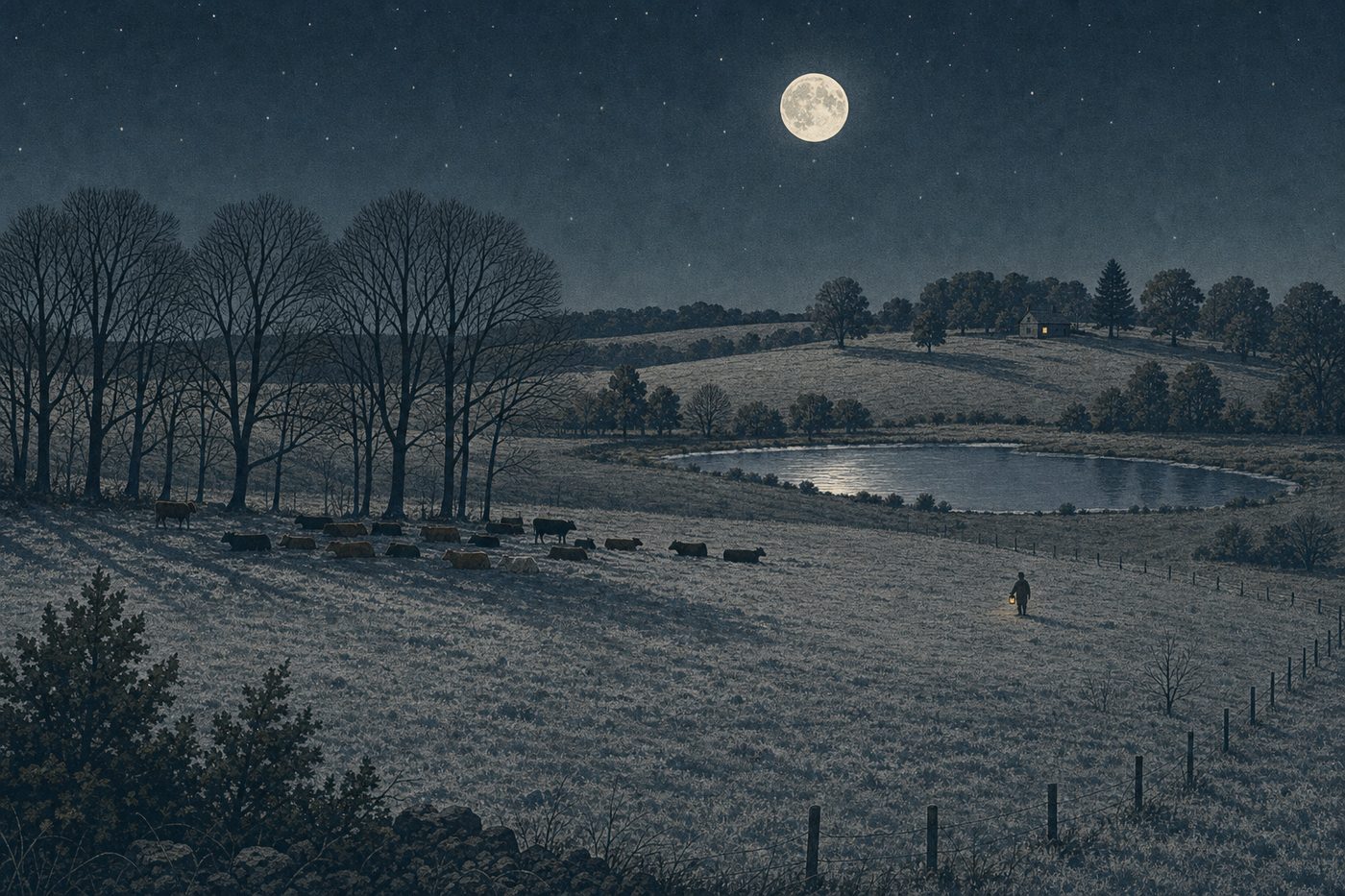
Lead is gold if it has time, and a pasture is fertile if it has time, and the one thing no art furthers is the inch of soil a century. The money I keep the farm's surplus in is the one that gave the alchemy up: nothing is issued without work, and the schedule cannot be hurried by anyone. It is the least Hermetic invention in history, and the picture above is what it is for.
The last is where I part from Eliade, and it is by a hair. He wants the countryside's religion given equal treatment in a total history of Christianity, and he gives it. But he still writes about it as a survival, an archaic thing that outlasted its time under a Christian coat. A farm reads those pages differently. The benandanti went out on the Ember nights, which are the four turns of the year, because the harvest was the whole question. That is not a survival. It is the working religion of people who ate what they grew, and it outlasted the theologies because the theologies never had to feed anyone. Eliade says the countryside grew poorer when the hunts had done with it; that is the plainest sentence in the book about what happens when an institution wins an argument with the people who do the work. A December night check is the benandanti's errand without the fennel. You go out in the dark because the herd is out there, and the year turns whether the bishop allows it or not.
What's happened since
Eliade died in Chicago in April 1986, three years after this volume and a year after its English; the fourth volume, which was to have carried Hinduism, China, Japan, the Americas, Africa and the religions of modern societies, was never written by him; what appeared under his plan after his death was other scholars' work. The ground under this one has moved where you would expect. Ginzburg's benandanti, whom Eliade read in the 1966 Italian, reached English in 1983; the witch-hunt numbers on the chart above, which nobody had when he wrote, are a 2018 compilation of 43,240 trials across twenty-one countries, and they put the peak in the four decades either side of 1600, where he put it and where the Friuli trials sit. Newton's alchemy has gone from a scandal to a field: the papers Dobbs read in 1975, about a million words of them, are transcribed and online at Indiana. And the Zohar he took, on Scholem's word, for the work of one man is now read by many scholars as the work of a circle, with Moses de Leon the chief hand. Read the book for the middle: the shaman on his goose, the angel with the book, the children walking to the sea, the man on the gallows in Baghdad, the God who made room, the hedgehog, the soup, the boys with bells on Christmas Eve, the farmer in his cell, and the rope of light.