

In short
In 2009, at a farmers' market in California, a student at a Greenpeace booth asked Alex Epstein whether he wanted to help end our addiction to dirty fossil fuels. He said he studied energy for a living and thought the world would be better if people used a lot more of them. She looked at him and said, "Wow, you must make a lot of money." The book opens there because that is the argument as he sees it: the case against fossil fuels is so settled that the only imaginable reason to make the other one is that someone paid you.
The Moral Case for Fossil Fuels makes the other one anyway. Epstein trained as a philosopher, and the book is built like a brief: first the track record of the people who told us the fuel would ruin us, then the question nobody in the debate answers, which is what standard you are using to call an outcome good. Measured against human life, he argues, the fuel that turned a dangerous climate into a survivable one is a moral good, and the industry's habit of calling it a necessary evil gave the argument away before it started. It is the one book here that argues against this farm, and it is here on purpose.
The thesis
"Ultimately, the moral case for fossil fuels is not about fossil fuels; it's the moral case for using cheap, plentiful, reliable energy to amplify our abilities to make the world a better place—a better place for human beings." — Ch. 1
His son will ride a camel
The book's first move is to go back and check. In 1972 the Club of Rome's computer models said the world would run out of oil by 1992. In 1977 Jimmy Carter told the nation on television that it could use up every proven reserve on earth by the end of the next decade, and a Saudi proverb of the day put it better than he did: "My father rode a camel. I drive a car. My son flies a jet airplane. His son will ride a camel." Paul Ehrlich, the most celebrated ecologist alive, said in 1971 that by 2000 Britain would be "a small group of impoverished islands, inhabited by some 70 million hungry people," and offered even money that England would not exist by then. Life magazine reported in 1970 that city dwellers would need gas masks within a decade.
What people did instead of following the advice was double their use of the fuel. Nobody in the oil business is riding a camel; proven reserves rose as consumption rose, because a reserve is a measure of what technology can reach, and technology kept reaching. Over the same years infant mortality in China fell by 70 percent, global malnutrition fell by more than a third, and the six pollutants the American government tracks fell while fuel use climbed. "Ours," Epstein writes, "is a world that was not supposed to be possible."
He draws a method from the wreckage, and the method is the best thing in the book. Experts are advisers, not authorities: a specialist owes you a clear account of what he knows and where his knowledge stops, and the moment he asks to be obeyed instead of understood he has stopped being useful. Count both sides, because every failed prediction came from someone who counted one. And name your standard.
Ninety-three servants
Epstein makes energy physical before he argues about it. A human body runs on about two thousand calories a day, roughly a hundred-watt bulb, and is a tenth as strong as a horse. Convert the machine energy an average American uses into the people it replaces and it comes to ninety-three of them, working full time, for one person. Before machines, the way past the limits of one body was to use somebody else's, which is why he borrows Milton Friedman's line for what changed: running servants were replaced by running water.
Then he takes the abstraction out of it entirely, with a story from a hospital in The Gambia in 2006. The lights came on unexpectedly one Saturday afternoon, and an emergency caesarean went ahead. The baby had already suffocated in the womb. The problem was detectable, the machine that would have detected it existed, and the machine needed power the hospital did not have. The whole book is in that ward.
And the hazelnut. A magazine reported that cars might one day run on hazelnut oil, and the comedian Jimmy Fallon pointed out on television that a jar of hazelnuts costs nine dollars: "I've got an idea for a car that runs on bald eagle heads and Fabergé eggs." Epstein turns the joke into his test for any energy source. For a thing to be cheap and plentiful, every input to it has to be cheap and plentiful, and hazelnuts need rare land and give one crop a year. Sunlight is free; the land, metal and machinery that turn it into power on demand are not, and the sun goes down. He prints Germany's own generation data, solar and wind supplying half the load in some quarter-hours and almost nothing in others, with coal running underneath the whole time, and his verdict is unkind.
"Which is why, in the entire world, there is not one real or proposed independent, freestanding solar or wind power plant. All of them require backup—except that 'backup' implies that solar and wind work most of the time. It's more accurate to say that solar and wind are parasites that require a host." — Ch. 2
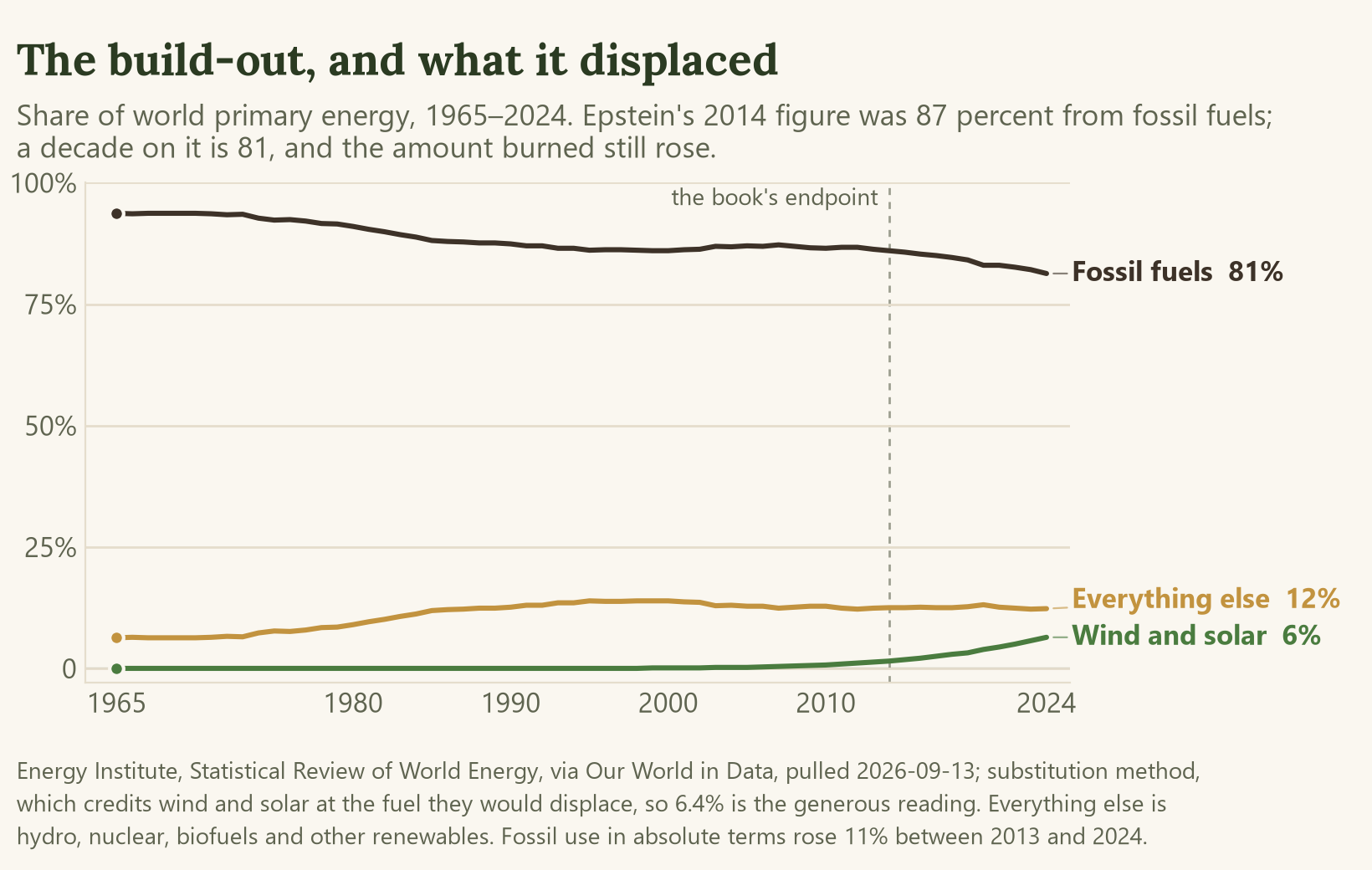
Coal, oil and gas pass his test for one reason: nature already did the concentrating and the storing. They are ancient sunlight, cooked for a hundred million years, lying around in quantities we have barely touched. That is the entire practical case, and it is why, after the fastest renewable build-out in history, they still supply most of the world's energy.
The food of food
The chapter that cuts closest to this farm is the one about eating. In 1898 the chemist William Crookes warned that with the guano beds exhausting, "all civilisations stand in deadly peril of not having enough to eat." Fritz Haber and Carl Bosch answered by pulling nitrogen out of the air using natural gas, and diesel put one man on a combine that reaps half a million loaves a day. Ehrlich announced in 1968 that the battle to feed humanity was over and lost; the population has doubled since and the average person eats better. Epstein's phrase for it is that fossil fuel energy is the food of food, and by his count synthetic nitrogen alone feeds about half the people alive.
He is right about all of that, and this farm uses none of it. He even writes the sentence I would have written against him, and means it as praise:
"The amount of crops we can grow today is an utterly 'unnatural' phenomenon—that is, it is way beyond the natural capacity of the nutrients in land to nourish crops in one season, let alone season after season." — Ch. 3
He counts what came out of the field: people fed, a famine that never arrived. I count what the field can still do in a century. Both of us are describing the same acre, and the argument between us is about the clock.
By what standard?
Everything after the first chapter rests on one reversal. Two people can hold the same numbers and reach opposite conclusions because they are grading against different standards, and the standard almost never gets stated. So Epstein states the one he is arguing against, in its own words, from a National Park Service biologist reviewing the most influential climate book of the 1980s: species and rivers have intrinsic value, "more value—to me—than another human body, or a billion of them." On that standard, cheap abundant energy is a threat by definition, because it lets people transform more of the world, faster.
The exhibit that proves the standard is doing the work is fusion. In the late 1980s, when cheap, clean, limitless power briefly looked close, reporters asked the leading environmental thinkers whether they wanted it. Jeremy Rifkin said it was the worst thing that could happen to the planet. Ehrlich said it would be like giving a machine gun to an idiot child. Amory Lovins was already on the record: "It would be little short of disastrous for us to discover a source of clean, cheap, abundant energy, because of what we might do with it." If a source with no emissions and no scarcity is still opposed, then emissions were never the objection.
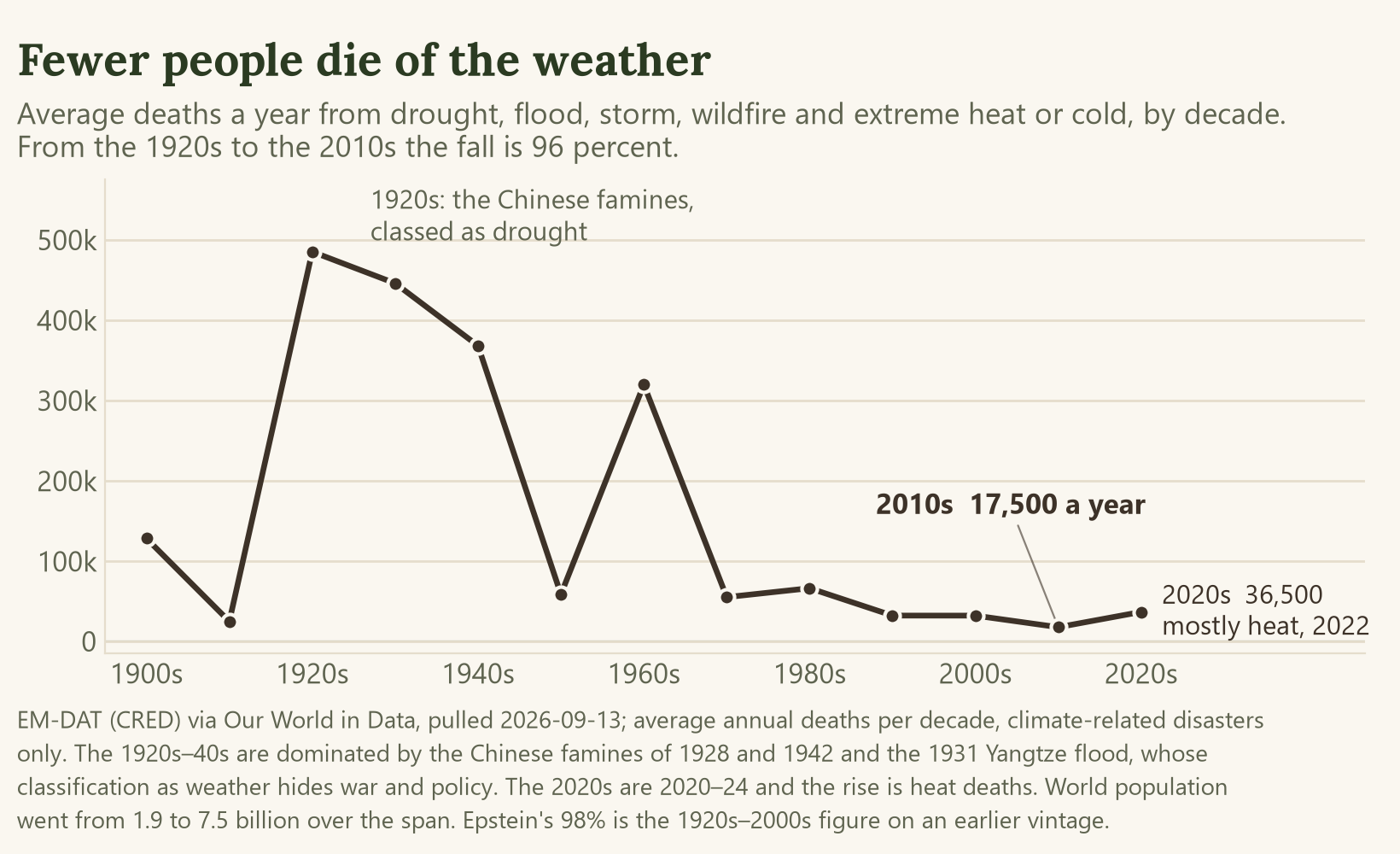
Epstein's standard is human life, and his sharpest number is the one that follows from it. Deaths from drought, flood, storm and extreme temperature fell by about 98 percent over the eighty years in which emissions rose fastest, and drought, historically the biggest killer, fell furthest. Relief convoys, irrigation, food grown somewhere else and moved. "We don't take a safe climate and make it dangerous," he writes. "We take a dangerous climate and make it safe." He ends by turning the question on the fossil fuel industry itself, which he says conceded the argument years ago by putting windmills on its annual reports and apologising for its footprint. A tobacco company that promised jobs, growth and lower tar would convince nobody, and an industry that calls its own product a necessary evil is only negotiating an expiration date.
Through the Orenda lens
The "season after season" sentence is the one I keep, because it is the whole disagreement in eleven words. Synthetic nitrogen substituted for the soil's own biology while that biology was worked to death underneath the yield, so the harvest holds while the thing that produces it thins, and the bill arrives on a timescale no election or loan reaches. The inference is uncomfortable for both sides. Epstein is right by his measure and winning by it, and the regenerative case cannot beat him on his clock. It can only insist there is a second clock, and that every civilisation that read only the first one made this mistake and did not see it coming either.
He and the sound-money writers agree on the thing they would least expect to. Both hold that raw materials are effectively without limit and that human time is the one resource that runs out; Epstein's version is that fossil fuels buy time, the bitcoin version is that a hard money stores it. Both rest on energy making a claim real, a hospital with a generator and a ledger that cannot be cheaply rewritten. Where they part is the price. Epstein needs energy cheap without limit; the ledger needs its energy dear. A farm lives inside both. It runs on cheap diesel and keeps its savings in something that was costly to write down, and I have stopped seeing a contradiction in that.
The thing his lens cannot see is the thing that beat him at the Greenpeace booth. Epstein reads the opposition as a standard of value, which is right, and then treats it as an error to be corrected with data, which is where he loses people. The environmentalists who turned down free fusion understood the numbers and had nothing material to gain; they were arguing against their own comfort on a conviction. A case built entirely on human flourishing has no slot for an opponent who means it, and an argument that cannot see the strongest version of the other side keeps losing to it in rooms full of twenty-year-olds. Which is why the most useful thing in the book is the method: name your standard, count both sides, treat the expert as an adviser. Applied honestly, it does not always return his answer.
What's happened since
The claim that broke is the pause. Epstein rested part of his climate chapter on the observation that temperatures had stopped rising in the late 1990s; 2024 was the warmest year in the instrumental record and the ten warmest since 1850 are the last ten, so the prop under that section is gone, though his narrower point that each added unit of CO2 warms less than the last is a laboratory result and stands. The claim that held is the one the practical case rests on: his 2014 figure was 87 percent of world energy from fossil fuels, and a decade later it was 81. The share fell for the first time on record, and fossil use itself still rose by a tenth, because the new sources went on top of rising demand. The 98 percent figure is real and carries more than it can hold, since the baseline is a handful of famines in the 1920s to 40s whose classification as drought hides as much war and policy as weather, and the book credits the whole fall to the fuel when medicine, warning systems and trade improved over the same years. His 2022 sequel concedes a few degrees of warming and argues they are manageable, which is the argument this book should have made and the one still worth having.