

In short
In the spring of 1933 an Austrian economist who had been teaching in London for two years wrote a memo to the director of his school. William Beveridge, who would go on to write the report that built the British welfare state, was telling people that Hitler's movement was capitalism's last stand against socialism. Friedrich Hayek had watched it form from Vienna and thought the director had it exactly backwards. The memo became a magazine article in 1938, the article became a pamphlet, and when the war came and every economist he respected was absorbed into the ministries, he expanded it in his spare time into a book, which appeared in March 1944 with a dedication that is still the best one-line summary of it: "To the socialists of all parties."
The argument is not that his friends were wicked. It is that they were about to keep, for the purposes of peace, the machinery they had built to fight a war, and that the machinery has a logic of its own. Once a government undertakes to direct the whole economy toward a chosen goal, it needs an agreement on ends that no free people has ever had, and it will get the agreement one way or another. He says at the start that this is a political book, that nothing in it is original except the patience of the examination, and that he had every personal reason not to write it. It is short. He tried many times to revise it and found he could never again say as much in as little.
The thesis
"Economic control is not merely control of a sector of human life which can be separated from the rest; it is the control of the means for all our ends. And whoever has sole control of the means must also determine which ends are to be served, which values are to be rated higher and which lower—in short, what men should believe and strive for." — Ch. 7
The abandoned road
The first two chapters are a history of how a word changed its meaning. The civilisation Hayek is defending grew, he says, out of the commercial towns of northern Italy and spread north and west with trade, and its one principle was that a man's own views and tastes are supreme in his own sphere, however small that sphere is. Everything that followed, the science, the growth, the workman of 1900 living in a comfort his great-grandfather could not have imagined, came from letting people try things at their own risk. Then the success made people impatient with the slowness of it, and by the turn of the century the principles that had produced the progress came to be seen as the obstacles to more of it. He is careful to say liberalism was never a creed of doing nothing. His own picture of it is the one line in the book a farmer will underline:
"The attitude of the liberal toward society is like that of the gardener who tends a plant and, in order to create the conditions most favorable to its growth, must know as much as possible about its structure and the way it functions." — Ch. 1
Socialism, he reminds his readers, began as an openly authoritarian project; Saint-Simon proposed that those who disobeyed his planning boards be treated as cattle. It won the democratic parties only by promising a "new freedom," and the second chapter is about the trick inside that phrase. To the people who fought for political liberty, freedom meant freedom from the arbitrary will of other men. The new freedom was freedom from necessity, from the limits circumstances put on everyone, which is another name for power or wealth. Tocqueville had seen the two part company in 1848: democracy and socialism have nothing in common but the word equality, one seeking it in liberty, the other in restraint. Hayek's evidence that the road ends where Tocqueville said is the roll of people who walked it and came back: Max Eastman, Lenin's friend, calling Stalinism "superfascist"; Mussolini, Laval and Quisling, socialists before they were anything else. In Germany a young communist could be turned into a Nazi in an afternoon, and both parties knew it; the one person neither could convert was the old-fashioned liberal.
Planning against competition
The third and fourth chapters clear the ground. Everybody plans, he says, and an economist is the last person who could object to foresight. What the planners of his day meant was something narrower: the central direction of all economic activity according to a single blueprint, in place of competition. He is for creating conditions in which competition works, for a legal framework that stops fraud and monopoly, for regulating what cannot be priced, and he names farming when he does it: the effects of deforestation and of some methods of farming fall on people who never agreed to bear them, and there the price mechanism needs a substitute. What he is against is the middle way everyone believes in. Competition and central direction are alternative ways of solving the same problem, and a mixture of the two means that neither works.
The claim that planning had become inevitable, that technology had killed competition and only the choice between private monopoly and state monopoly remained, gets the chapter's hardest look. Monopoly grew first in the young industrial countries, Germany and the United States, and in Germany it was built by policy from 1878 on, with protection and then compulsion. Britain stayed competitive until 1931 and then imported the German result inside a dozen years, which is not what a law of technology looks like. Then he turns the complexity argument around. It is precisely because nobody can hold the whole of a modern economy in one head that the coordination has to be done by something other than a head.
"It enables entrepreneurs, by watching the movement of comparatively few prices, as an engineer watches the hands of a few dials, to adjust their activities to those of their fellows." — Ch. 4
The rest of the chapter is about why the specialist is so often found in the front rank of the planners, and it is written with some sympathy. Every expert can see that his own ideal could be realised in a few years if it were made the sole aim of the country, and cannot bear to see it left undone. The magnificent German motor roads with no traffic on them are his example: a technical triumph out of line with everything around it is evidence of misdirected resources. He does not doubt the value of single-minded people in a free society. He says they would be the most dangerous people in it if they were ever allowed to run it, and the most intolerant of each other's plans.
A journey with no destination agreed
Every collectivist system organises the labour of society for a definite social goal, and the fifth chapter asks what the goal is. The common good, the general welfare, the general interest: none of these names a course of action, because the welfare of millions cannot be measured on one scale. To direct everything by a single plan you need a complete ethical code in which every need of every person has its rank, and no such code exists, because in a free society there has never been any occasion to write one. The limits of one mind are the whole foundation of his individualism. It does not assume people are selfish. It assumes that nobody can take in more than a sliver of the needs of everyone else.
So a people can vote for planning without agreeing on what to plan for, and he says what that is like:
"The effect of the people's agreeing that there must be central planning, without agreeing on the ends, will be rather as if a group of people were to commit themselves to take a journey together without agreeing where they want to go: with the result that they may all have to make a journey which most of them do not want at all." — Ch. 5
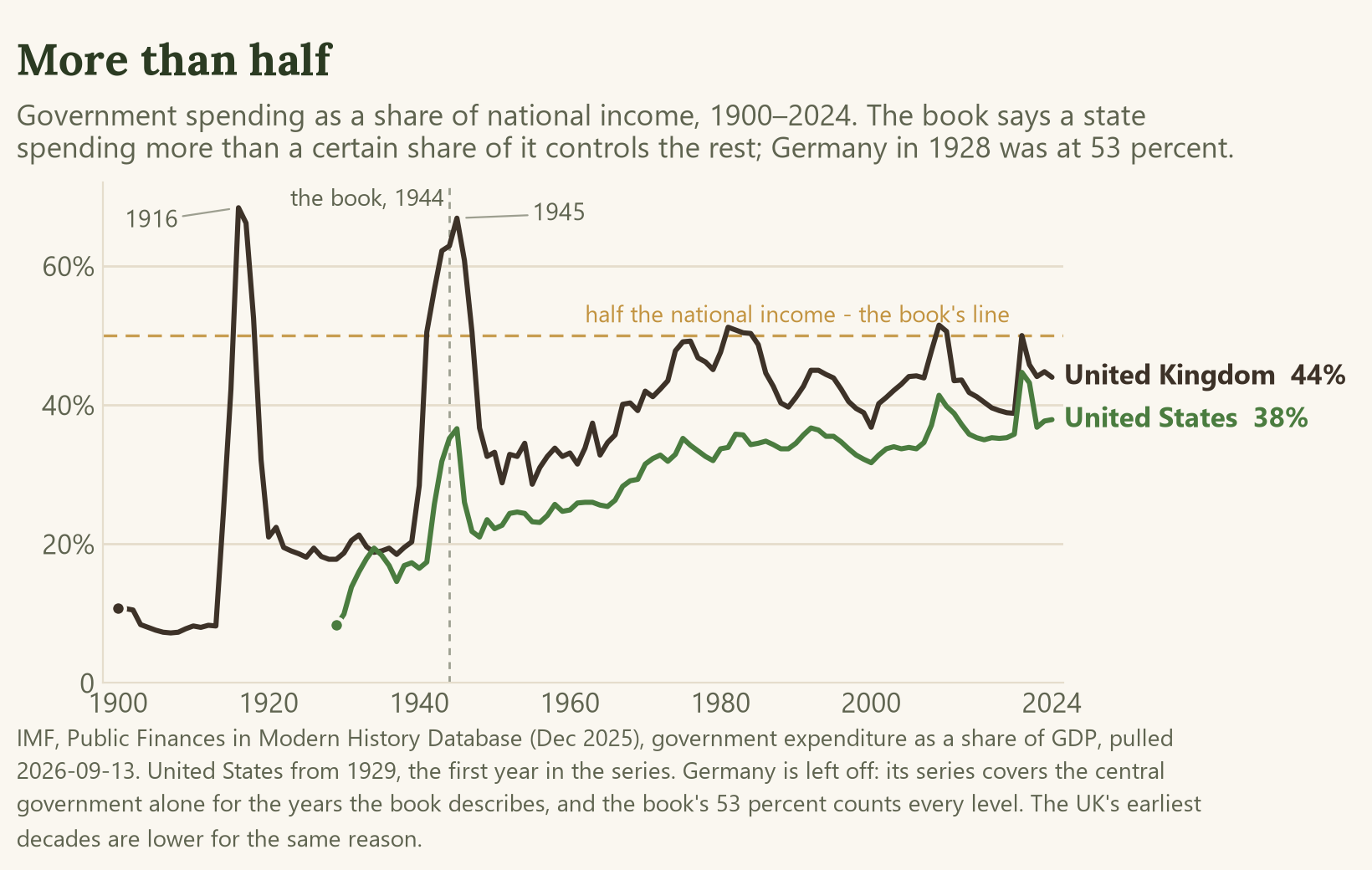
Parliaments cannot produce a plan by majority, because there is no majority for any one of a thousand possible plans, and they cannot vote one through clause by clause, because a plan is a whole. They become talking shops, and the demand grows that the work be taken out of politics and given to experts. He quotes Harold Laski, his colleague at the London School of Economics, proposing that a Labour government confine the House of Commons to airing grievances while wide powers go to the departments, and wondering aloud whether such a government could risk losing an election in the middle of the transition. Germany, he reminds his readers, had reached the point of being governed by decree before Hitler arrived; Hitler did not have to destroy democracy, only to take advantage of its decay. And here he says the thing the book is most quoted for, though usually without the second half. It is not the source of power that keeps it from being arbitrary. It is the limitation. The chart above is the point where the argument touches a number. Once a state spends more than a certain share of the national income, its decisions govern the rest, and he notes that in Germany in 1928 the figure was already fifty-three percent. Britain and America were nowhere near it when he wrote. They have spent most of the years since a good deal closer.
Signposts, not orders
The sixth chapter is the one he called the central one, and it is about the Rule of Law, stripped of technicalities: government bound by rules fixed and announced beforehand, so that a person can know how the coercive power will be used and plan around it. The distinction he draws is between two kinds of rule. Formal rules are the Highway Code. They tell everyone in advance what the state will do in a type of situation, without knowing who will be helped or hurt, which is the only sense in which a legislator can be impartial at all. The planner cannot work that way. When the government has to decide how many pigs are to be raised, how many buses run, which mines operate and at what price shoes sell, it is choosing between particular people's needs, on the circumstances of the moment, and its choices become the law.
"The difference between the two kinds of rules is the same as that between laying down a Rule of the Road, as in the Highway Code, and ordering people where to go; or, better still, between providing signposts and commanding people which road to take." — Ch. 6
From this he draws the conclusion socialists have always hated, that formal equality before the law cannot be reconciled with any attempt to make people materially equal, because to produce the same result for different people you have to treat them differently. He is scrupulous about what the principle does not say. It does not say the state should be idle; a state enforcing weights and measures is acting, and a state that lets pickets use force is not. It does not say that whatever is legal is lawful, either. If Hitler obtained his unlimited powers in a strictly constitutional manner, everything he did was legal, and who would say the Rule of Law still prevailed in Germany? Thirty years later he admitted he had meant that as a rhetorical question, and had since learned that two eminent professors of law had maintained precisely that it did. The chapter closes on H. G. Wells, a planner who also drafted a Declaration of the Rights of Man, every right in it qualified by "compatible with the common welfare" until nothing is left.
The means for all our ends
The consolation the planners offer is that the dictatorship would be economic only, and the seventh chapter is his answer to it. There is no separate economic motive. What we call one is the desire for general opportunity, the power to pursue ends we have not yet named, and money is what carries it.
"It would be much truer to say that money is one of the greatest instruments of freedom ever invented by man. It is money which in existing society opens an astounding range of choice to the poor man—a range greater than that which not many generations ago was open to the wealthy." — Ch. 7
Economic losses feel minor only because, in a free society, we get to decide which of our wants they fall on. Take away that choice and nothing is minor. The planner who controls production controls what everyone consumes, with or without rationing, and controls even more the work people do, which for most of us is most of our lives. His example of what discretion does is small and exact: a plain girl who badly wants to be a saleswoman, a weakly boy set on a job his weakness handicaps him in. Under competition they can buy their chance with a sacrifice and make good on qualities that show later. Under an authority fixing pay for the category and selecting by objective test, the strength of their wanting counts for nothing, and there is nowhere else to go.
The eighth chapter takes its title from Lenin's question, who, whom: who plans whom, who assigns to whom their station in life. Competition is blind, and he points out that the ancients thought blindness an attribute of justice. Whoever controls all the means of production decides all incomes, and this is a power nobody in a competitive society holds, not the richest man in it. Then the sentence that has outlived the rest of the chapter:
"What our generation has forgotten is that the system of private property is the most important guaranty of freedom, not only for those who own property, but scarcely less for those who do not." — Ch. 8
A member of a small minority with no property is freer while others in his community own property and can employ him than he would be as the nominal owner of a share in everything. The smallest functionary wielding the coercive power of the state has more power over a man than the millionaire next door. And "greater equality," unlike absolute equality, tells a planner nothing about how to divide the spoils; it only says to take from the rich as much as possible, and leaves every question of merit to be settled by someone. He quotes Mill on what people will bear: a fixed rule, or chance, or necessity, but not a handful of men weighing everybody in the balance at their sole pleasure.
The security of the barracks
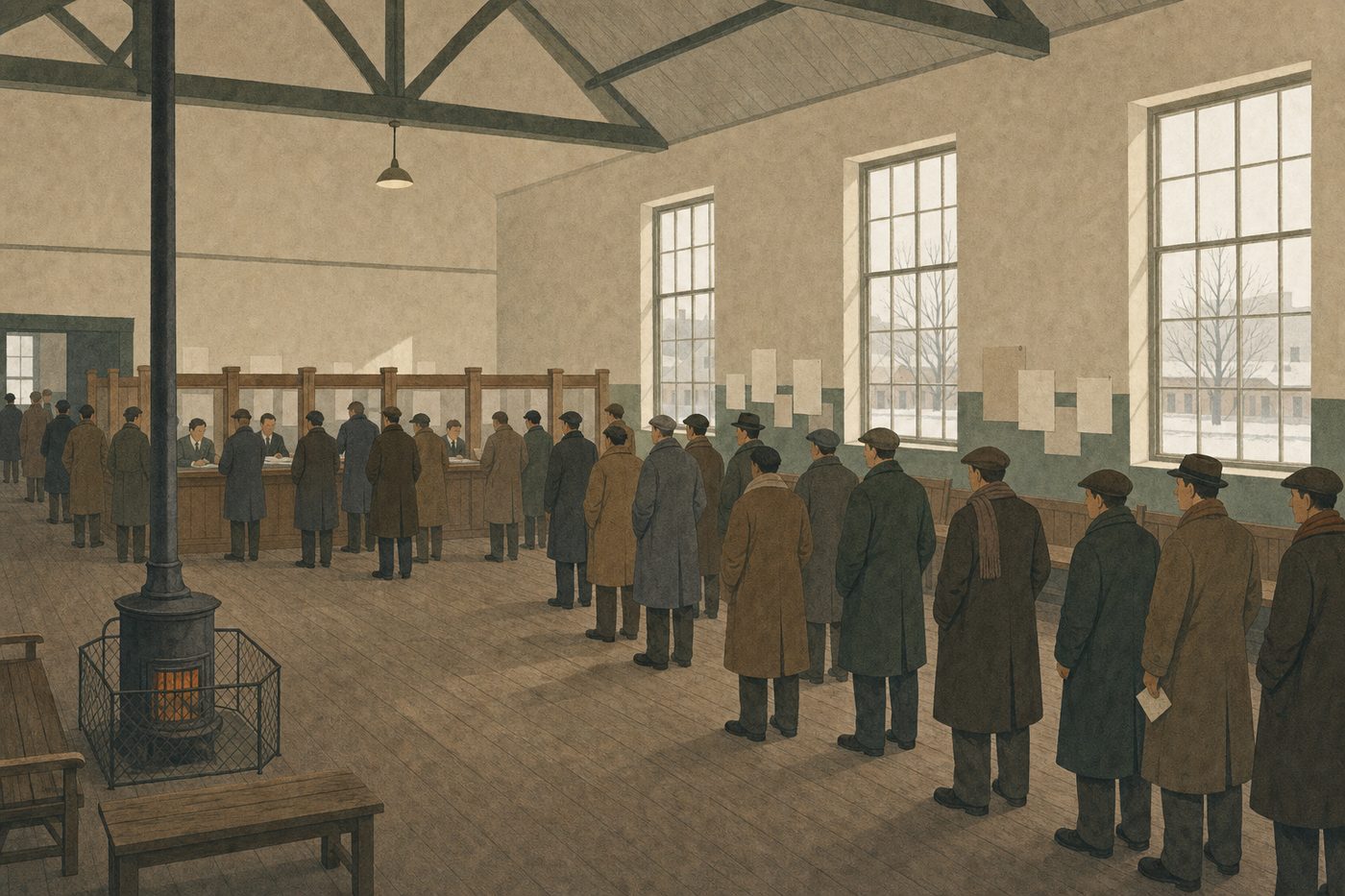
The ninth chapter separates two things the same word covers. There is the security against severe want, a minimum of food, shelter and clothing, which a country as rich as Britain can guarantee to everyone without endangering anyone's freedom, and he says plainly it should. Insurance against sickness and accident, help after floods and earthquakes, even the fight against slumps, none of these requires the kind of planning he is against. The dangerous kind is the security of a particular income, of the position a person or a trade has come to expect, which can be given to some only by taking opportunity from the rest. Every trade that shuts its door to newcomers to protect its standard reduces the security of everyone outside it, and as the sheltered grow the unsheltered have nowhere to go, until insecurity is the dreaded state of the pariah and a pension is what makes a young man fit to marry.
He knows what the alternative looks like because the army is the closest thing to it. Work and worker alike allotted by authority, everyone on short commons together when the means are scanty: the one system that can give complete security to everybody, and it is the security of the barracks. An American engineer with long experience of government planning is quoted on why, in a planned economy, discipline cannot be kept without a free reservoir of unplanned labour to hire from and fire into, and without it, "as with slave labor," without corporal punishment.
"It has been well said that, while the last resort of a competitive economy is the bailiff, the ultimate sanction of a planned economy is the hangman." — Ch. 9
The chapter ends with Germany, which had been a Beamtenstaat, a state of appointed functionaries, for two generations before Hitler, a country where rank was earned by becoming a salaried servant of the state and independent risk was faintly disreputable. He does not think any people would withstand that slow smothering, and he closes with Franklin on those who would give up essential liberty for a little temporary safety.
Why the worst get on top
Many people who thought totalitarianism inevitable consoled themselves that its horrors were an accident of who ran it, and that decent people could run the same machine for good ends. The tenth chapter is why they cannot. A planned society needs a large group that agrees on a ranking of values, and three things make that group the worst rather than the best. The more educated people are, the more their tastes differ, so the largest group that agrees is found lower down. The docile and the gullible can be added to it by repetition. And nothing binds a mass so well as a negative programme, hatred of an enemy, the "we" against the "they," which is why the Jew in Germany and the kulak in Russia were not incidental. Then there is the work itself. A totalitarian state has jobs that need doing which everyone knows to be bad, and the readiness to do them becomes the road to promotion. He quotes an American economist on the odds of the power being held by people who dislike holding it: about the same as the odds "that an extremely tender-hearted person would get the job of whipping-master in a slave plantation."
The eleventh chapter follows the machine into people's heads. A plan cannot survive doubt, so the facts on which it rests become official doctrine, and the schools, the press and the radio spread only what supports the belief in the decisions taken. The word "truth" stops meaning something to be found and starts meaning something laid down. His warning about language is the part that reads as if written this year:
"wherever liberty as we understand it has been destroyed, this has almost always been done in the name of some new freedom promised to the people." — Ch. 11
The old words are kept and their meanings changed, until two brothers, one of whom has taken the new faith, can no longer talk. The control reaches subjects with no politics in them. The theory of relativity was condemned in one country as Semitic and in the other as contrary to dialectical materialism, and chess players were exhorted to finish once and for all with chess for the sake of chess. He leaves the reader to guess which country. The chapter ends on the paradox that a movement setting out to make reason supreme ends by destroying it, because the growth of reason is a social process among people who disagree, and to plan it is to stop it.
The safety razors in the trenches
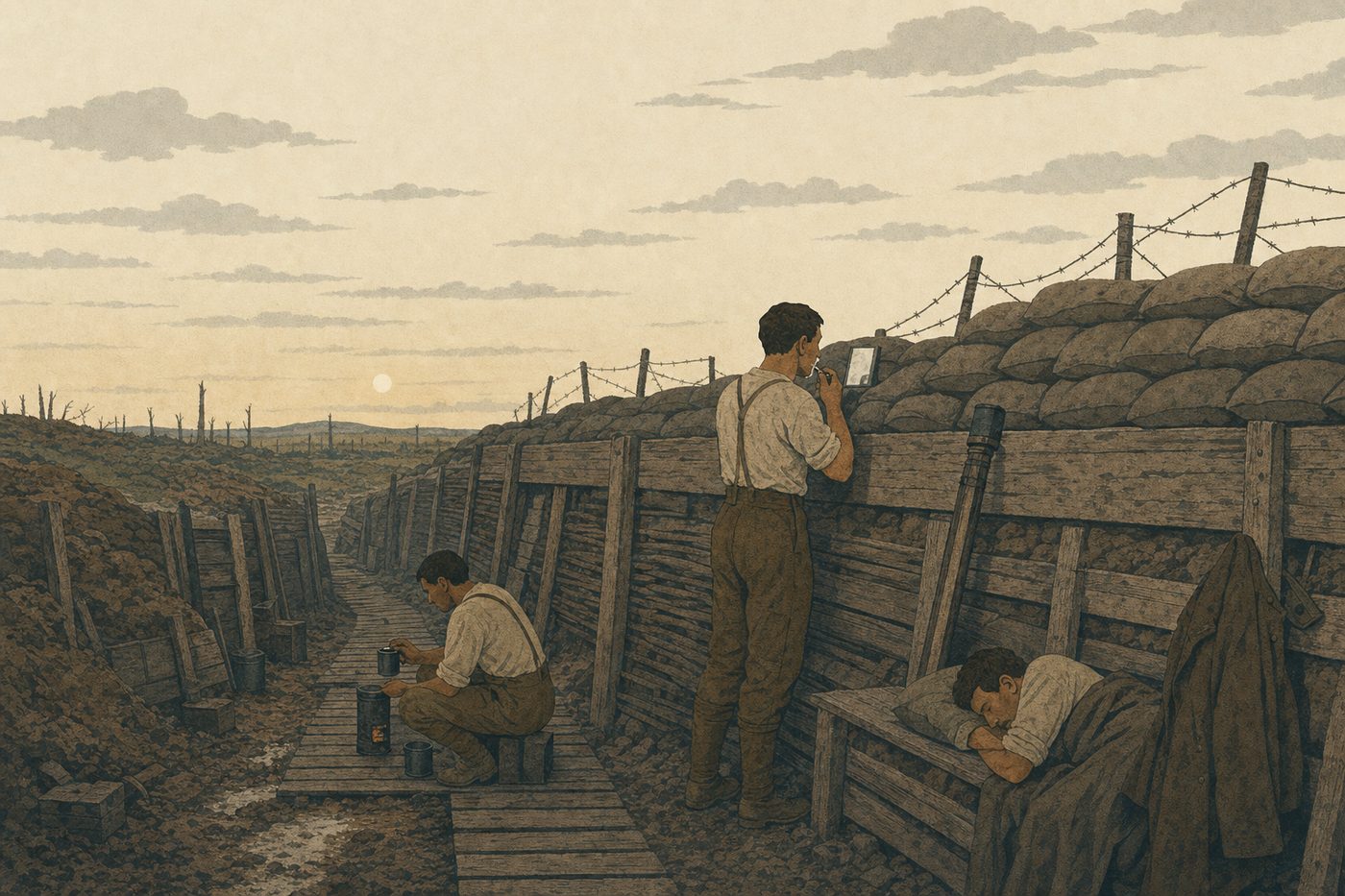
The twelfth chapter is the one that made his friends angriest, because it traces National Socialism to socialists. Fichte, Rodbertus and Lassalle, the acknowledged ancestors of the German state idea, are also acknowledged fathers of socialism. From 1914 one Marxist teacher after another led the idealist young toward the national kind. Werner Sombart, who had given the better part of his life to Marx's ideas, published Merchants and Heroes in 1915, welcoming the war as the struggle between England's commercial civilisation and Germany's heroic one, and found the English spirit at its most contemptible in the safety razors found in their trenches. Johann Plenge set the ideas of 1789, which were liberty, against the ideas of 1914, which were organisation, and by 1918 was writing that socialism must be power politics. Oswald Spengler wrote in 1920 that old Prussian spirit and socialist conviction were one and the same and that the liberals were the invisible English army Napoleon had left behind. Moeller van den Bruck, who gave the Third Reich its name, wrote that German youth turned from liberalism with nausea. Hayek's point is not that these men were Nazis before Hitler. It is that once you accept the premises, organisation over freedom and the whole over the person, there is no escape from the logic, and the men who supplied it were socialists who had simply followed it further than their comrades.
The thirteenth chapter brings it home to England, and it is the book's most uncomfortable one because he names people. E. H. Carr, a historian who called himself a realist of the German school, had written that morality is a function of politics, that the rule that treaties must be kept is not a moral principle, and that the peace could be won only by "a deliberate reorganization of European life such as Hitler has undertaken." A biologist, C. H. Waddington, had published The Scientific Attitude, arguing that science can pass ethical judgment and that the freedom to be odd and unlike one's neighbour is not a scientific value. Hayek's reading of both is that the scientists agitating for a scientific society were repeating the German political professors of a generation earlier. Then he says where the real push comes from, and it is not the intellectuals. It is organised capital and organised labour acting together, the monopolist sharing his gains with the union so both can keep the newcomer out, and the great democratic movement supporting a policy that must end its own freedom.
A world fit for small states
The last three chapters turn from the road to what waits at the end of it and what might be built instead. The fourteenth begins by refusing a compliment the age paid itself. Our generation did not care less about material things than its parents; it had come to hate the impersonal forces of the market it did not understand, and would rather submit to men it could see. But a civilisation as complex as ours runs on everyone adjusting to changes whose causes no single mind can follow, and the only alternative to that submission is submission to the arbitrary power of other men. Then he says what collectivism does to morals, and the passage is the heart of the book's second half.
"Responsibility, not to a superior, but to one's conscience, the awareness of a duty not exacted by compulsion, the necessity to decide which of the things one values are to be sacrificed to others, and to bear the consequences of one's own decision, are the very essence of any morals which deserve the name." — Ch. 14
There is no virtue in being unselfish where you have no choice. The virtues that had become rare, independence, self-reliance, the willingness to bear risk and to back one's own conviction against a majority, were exactly the ones the English and the Americans used to be known for, and he says, as a foreigner who must always remain one, that it was the most disheartening spectacle of his time to watch England hold in contempt what England had given the world.
The fifteenth chapter is about the peace, and it argues against the fashionable answer to national planning, which was international planning. Planning grows harder as the people under it share fewer values, and there is no scale of justice on which a Norwegian fisherman will forgo his improvement to help a Portuguese one, or the needs of a Slovak mountain shepherd can be ranked against a Slovene's. To plan a continent is to rule it by force, and the Germans' brutality toward smaller peoples was the nature of the task rather than a national vice. What is needed is the opposite: a power above the nations that can say no to what each does to the others, bound by rules and with none of the powers to direct. That is federation, and his hopes for it are modest and regional. Then the passage that follows:
"We shall not rebuild civilization on the large scale. It is no accident that on the whole there was more beauty and decency to be found in the life of the small peoples, and that among the large ones there was more happiness and content in proportion as they had avoided the deadly blight of centralization." — Ch. 15
Democracy has never worked without local self-government, where responsibility can be learned in affairs people know. We shall all be the gainers, he says, if we can create a world fit for small states to live in. The conclusion is two pages. He offers no blueprint and says nobody is competent to furnish one. What is needed first is to clear away what human folly has piled on the road, and to admit that much of what the twentieth century had done was very foolish. If the first attempt to create a world of free men failed, we must try again.
Through the Orenda lens
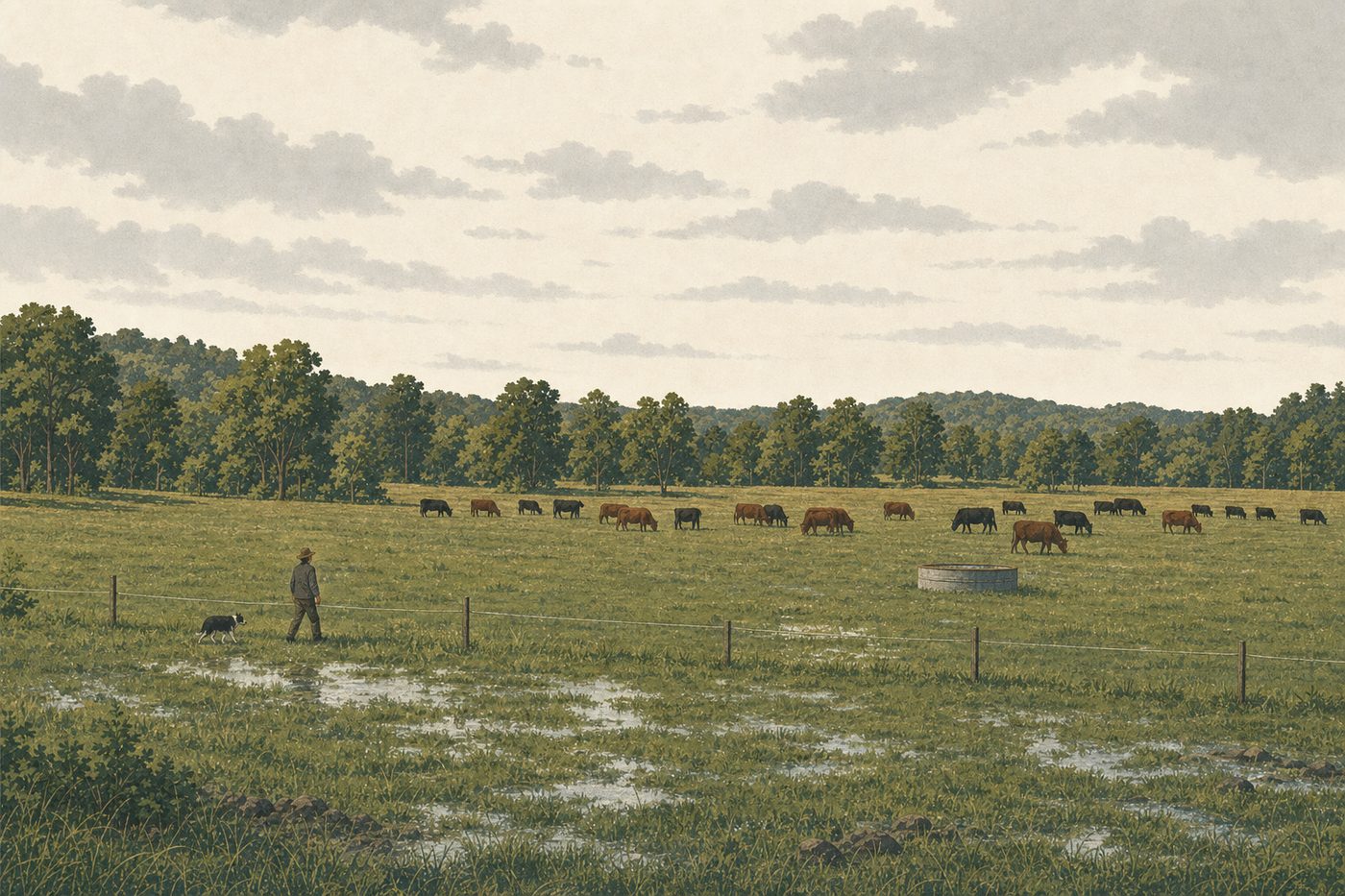
There is no farm in this book. The nearest he comes is a line about how many pigs are to be raised, and a concession that some methods of farming put their costs on other people and need a rule. But when he needs a picture of what a liberal actually does, he reaches for a gardener, and I do not think that was an accident. Everything I do on this ground is his distinction between planning for competition and planning against it. I set the fence, the water and the day the herd moves. What the cattle do inside the paddock, what the grass does after they leave, what the roots and the dung beetles and the rain do underneath, is a coordination nobody could direct and that fails the moment anybody tries. The industrial farm is the blueprint kind of planning applied to a field: decide the yield in advance, then force the biology to it with inputs. His dials are the case for reading the grass instead of the calendar. The knowledge is in the circumstances of time and place, and the circumstances are in the pasture.
My own book took the same argument in the one direction he does not, in 1944, take it himself:
"Friedrich Hayek, the Nobel laureate economist, identified the core problem decades ago: no person or committee is wise enough to manage the money of hundreds of millions of people. Not because they're corrupt (though some certainly are). Because the task is impossible."
Read the fifth chapter with that in mind and the committee at the Federal Reserve is his party of travellers who agreed to a journey without agreeing where to go. Read the sixth and you have the case for the money this farm runs on, made by a man who never heard of it. Bitcoin is a Highway Code. Its rules were fixed and announced beforehand, twenty-one million and a block every ten minutes or so, and they apply to everyone in exactly the way he says a formal rule must: nobody knew in advance whom they would help, and nobody can judge a case on its merits. The dollar is the other kind of rule. Every six weeks its terms are set on the circumstances of the moment by people balancing one group's interest against another's, which is his definition of discretion, and of the thing the Rule of Law exists to prevent.
Where the book stops short is the money itself. In 1944 he could still write that the remedy for slumps might lie in monetary policy, with nothing in that incompatible with nineteenth-century liberalism. He gave Keynes no line to draw, and Keynes, who otherwise found himself in deeply moved agreement, wrote to tell him so. Thirty years on he came round. By 1984 he was saying we would never have good money again until it was taken out of the hands of government, and that since it could not be taken violently, the only way was "by some sly roundabout way introduce something that they can't stop." This farm keeps its savings in the thing he was describing. From the book:
"Hayek's Road to Serfdom is a sobering campaign in favour of the preservation of personal and economic freedoms. And in it he perfectly articulates the knowledge problem: no committee is wise enough to centrally manage the money of hundreds of millions of people. That insight is the intellectual ancestor of Bitcoin's decentralized architecture."
The ninth chapter is where he meets a farm most directly, though he did not know it. He allows two kinds of security and forbids one, and the one he forbids is the guarantee of a particular income to a particular trade. Farming has spent a century asking for exactly that, and getting it, and paying for it the way he says: every guaranteed price is a door shut on someone outside, and the sheltered trade ends up unable to bear any change at all. The security he allows is the kind held outside the market. Savings that nobody can dilute are that. They are what let a small farm take the risk he says freedom requires, sell when the animal is ready rather than when the note is due, and never ask an authority for the certainty of its income.
He would not sign all of this. He would regulate the runoff, and he would be right to, and the honest answer is that a method which keeps its water and its soil on its own ground never gives an inspector a reason to come. He is a gradualist, and Britain answered his book in the way he conceded in 1956: six years of a socialist government produced nothing resembling a totalitarian state, and what he claimed instead was a change in the character of the people, slower and harder to see. The reading that has held up is the small one. Morals grow only where a person is free to decide and bears the consequences, and there is no place where that is truer than a piece of ground you are responsible for. A farm cannot be unselfish at somebody else's expense. The grass answers. That, and the world fit for small states, is what this shelf takes from him.
What's happened since
The book came out in Britain on the tenth of March 1944 in a run of two thousand copies, sold out in a month, and then waited on the paper ration. Three American publishers turned it down before the University of Chicago Press took it, expecting to sell nine hundred. Then Max Eastman, the old communist Hayek had quoted, condensed it for the Reader's Digest in April 1945, in front of a circulation of nearly nine million, and the Book-of-the-Month Club printed more than a million reprints at a nickel each. Look magazine ran it as a cartoon. Hayek was embarrassed by both, and by the company the book began to keep, and spent the rest of his life insisting in one preface after another that it did not say what its admirers and its enemies both said it said: that any move toward socialism ends in a camp. It says that unless the principles of policy are mended, consequences will follow that nobody advocating the policy wants.
In Britain it landed in an election. Labour won by a landslide in July 1945, its leaders having accused Churchill of taking his ideas from "Friedrich August von Hayek," with the emphasis on the von. Two years later that government, which had written into its own economic survey that a democracy would never direct labour in peacetime, put the direction of labour back on the statute book. It was never used, and Hayek observed that when the power to coerce is known to exist, few wait to be coerced. Nothing resembling a totalitarian state followed, and he said so in 1956; what he claimed instead was a slower change in the temper of a people, and that argument has never been settled either way. Chicago had sold about three hundred and fifty thousand copies by 2005, with uncounted more in translation and in samizdat behind the Iron Curtain, where the book had readers who did not need convincing. He won the Nobel prize in 1974, for work he regarded as more important than this, lived to see the Berlin Wall come down, and died in 1992 at ninety-two. The chart above is the one line in the book that can be carried forward: Britain's government spends about forty-four pence of every pound of national income in 2024 and America's about thirty-eight cents of every dollar, roughly twice the peacetime shares of the world he wrote in, and nobody calls it planning. On the money he moved further than the book did. In 1976 he proposed taking the currency away from governments altogether, and in 1984 said the only route was something they could not stop; the something arrived in 2009. The book keeps being rediscovered the way it was first discovered, by people who had not read it. In June 2010 a television host devoted an hour to it and it went, for a few days, to the top of Amazon's list, sixty-six years after publication. Read it for the sixth chapter and the fourteenth, for the journey with no destination and the security of the barracks, and take the England-becomes-Germany argument as a warning written during the bombing by a man who had watched it happen once and was not going to be polite about it a second time.