

In short
Nobody builds a factory to make drinking water. The chemistry is easy, and a city could do it tomorrow; instead every city on earth pipes water in from far away or cleans what it finds nearby. Ask why and most people will say the idea is absurd. Ludwig von Mises says the only thing that makes it absurd is a number: worked out in money, the factory costs more than the pipe. Take the number away and you have no way of knowing which is the foolish plan. Everything that looks like common sense about how to do things is, underneath, a price.
Human Action is nine hundred pages built on that kind of observation, and it starts further back than any economics book you have read. It begins with the plain fact that people act, that they act because something about the present bothers them, and that everything they do is a bet on a future nobody can see. From there Mises reasons outward to prices, money, interest, the boom and the bust, and the impossibility of running a society from an office. It was published in 1949 by a man who had watched the Austrian and German currencies die and had left Vienna before the Germans arrived, and it is not a modest book. It claims that economics is not a subject but the logic of every choice anyone makes.
The thesis
"Economics must not be relegated to classrooms and statistical offices and must not be left to esoteric circles. It is the philosophy of human life and action and concerns everybody and everything." — XXXVIII, §6
The fishermen's nets
The first move is small and it decides everything after it. A man acts because he is uneasy, and because he can picture something better, and because he believes what he does can close the gap. Take away any of the three and he sits still. What he acts for is his own business: Mises refuses, flatly and repeatedly, to say what ought to make anyone happier, and the whole book runs on that refusal. Value is not in things. It is in us. Which means a trade is never a swap of equals; both sides walk away holding what they wanted more, or they would not have traded. The oldest complaint about commerce, that one party must be losing, falls over on page one.
Everything reaches into the future, and the future is unknown, so every act is a speculation. The businessman is not a special breed of gambler. He is what all of us are, with a ledger. And because a man would always rather have a thing now than the same thing later, anything that takes time has to be paid for in waiting. Mises calls this time preference and treats it as a fact about action itself, not a character flaw or a cultural mood. Capital is what waiting buys. His image for it is the first fishermen who took hours away from catching fish to knot a net and hollow a canoe, and ate less that week to do it.
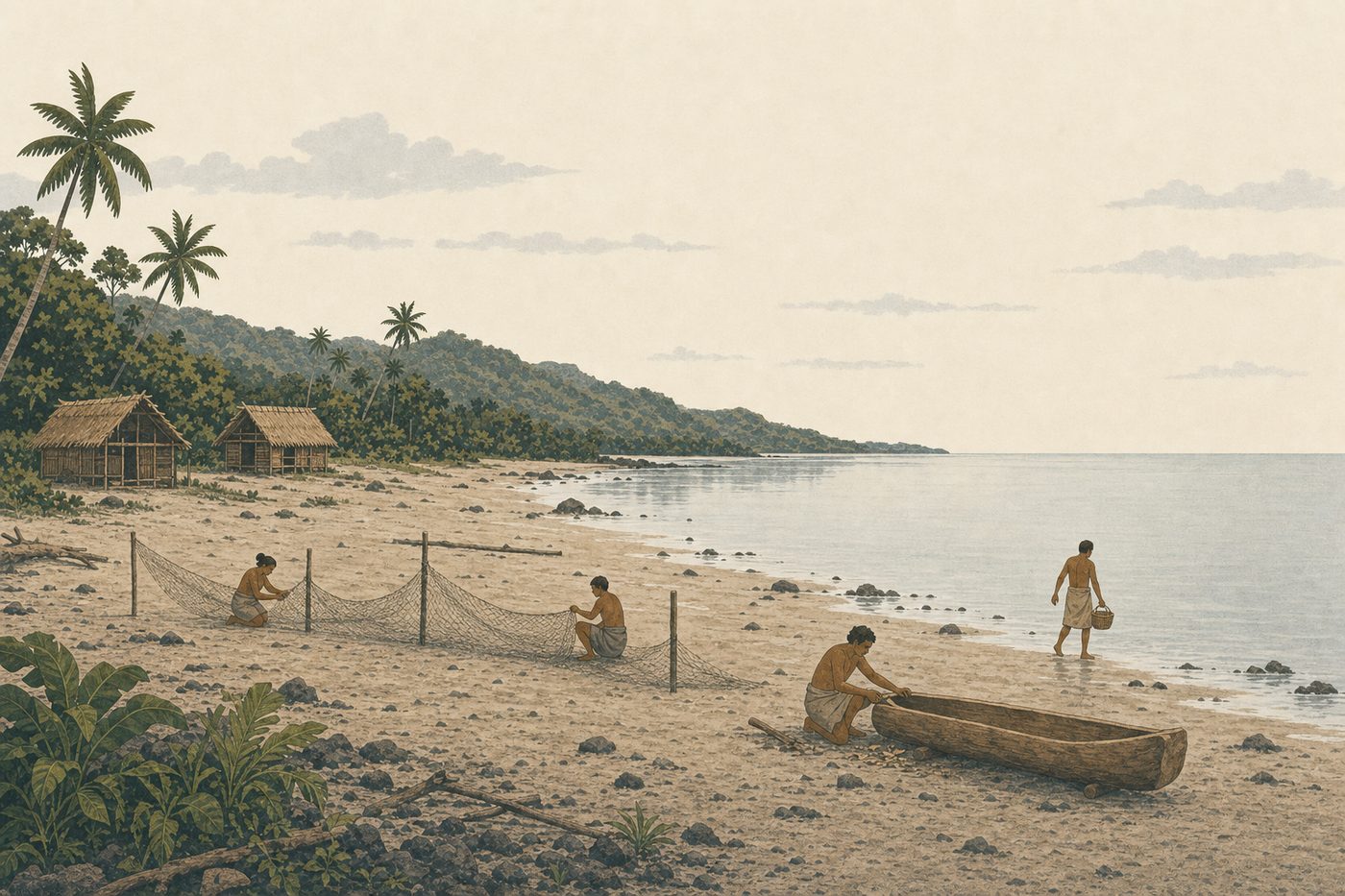
"We are the lucky heirs of our fathers and forefathers whose saving has accumulated the capital goods with the aid of which we are working today." — XVIII, §3
If the fishermen's sons had worn out the nets without making new ones, the whole business of getting richer would have started again from zero. That is the book's account of civilisation in one picture: a stock of postponed consumption, handed down, added to or eaten. Interest is not the lender's fee for lending. It is the price of now over later, showing up wherever people trade across time, and the loan market only reads it off. Saving is the first step toward every improvement anyone has ever made, and what restricts saving is how much people are willing to wait.
The chocolate king
Businessmen are called kings and their firms empires, and Mises thinks the metaphor is doing quiet damage. A government can compel. A chocolate king cannot. He keeps his kingdom only as long as people keep choosing his chocolate, and he loses it the day they spend their pennies elsewhere. He does not rule his workers either; he pays them what the customers are prepared to give him back for the product, and not a penny more, because there is no more. Every order in the shop is visible and every order from the public is invisible, and it takes a little more brains to notice which one is the boss.
"The market is not a place, a thing, or a collective entity. The market is a process, actuated by the interplay of the actions of the various individuals cooperating under the division of labor." — XV, §1
The comparison he reaches for is an election held every day, in which every penny is a ballot and no vote is wasted: the bakery bakes for the sick as well as the healthy, the publisher prints poetry alongside detective stories, because a minority with money to spend gets served in a market and gets nothing at the polls. The rich have more votes, and Mises does not pretend otherwise. But in a market that is not hampered by favours from the state, being rich is the result of a previous round of voting, and it is kept the same way. The owners of factories and farms are, in his phrase, trustees of the consumers, revocably appointed. Which is why he can say something that sounds strange until you have run a business: ownership of the means of production is not a privilege but a social liability. You hold it on condition, and the condition is that you keep serving people better than the next man would.
The master-builder
Chapter twenty is where the book earns its reputation, and its centre is a man on a building site. A master-builder has a fixed pile of bricks and timber and has to raise a building from it. If he believes the pile is bigger than it is, he draws a plan the materials cannot finish. He lays wide foundations and runs up the ground floor, and only some way into the work does he find he is short. Nothing about his skill was at fault. He was misinformed about what he had to work with.
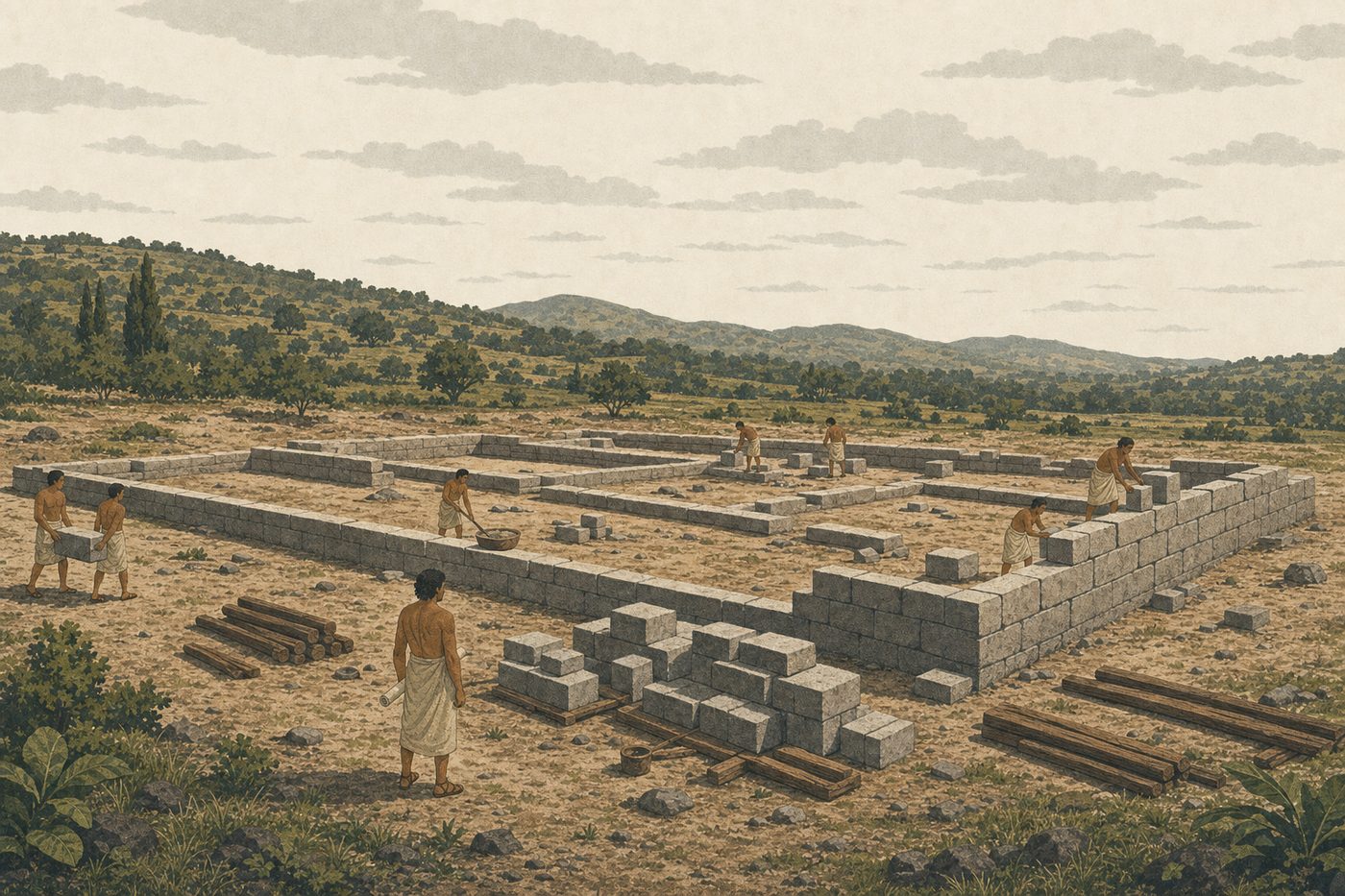
That is Mises's account of every boom. Interest is the price that tells the economy how much saving exists, how many bricks are in the pile. When banks create credit that no one saved, the rate falls and every builder in the country reads the same false number. They start projects that would only have paid if the savings behind the lower rate were real. The boom is not too much investment; it is investment in the wrong lines, malinvestment, and the tell is that it always begins in the industries furthest from the dinner table, steel and copper and construction, because that is where you start when you think you have material for something big.
"The boom is built on the sands of banknotes and deposits. It must collapse." — XX, §6
The banks think they have cooled things when they raise their rates a little. They have not, because the boom runs on the quantity of new credit, not the arithmetic of the interest rate, and as long as they keep issuing they are feeding it. When they finally stop, they get the blame, and Mises is exact about why that is wrong: the tightening does not cause the crisis. It makes visible the mistakes the boom already made. Then comes the sentence that has followed the book around since 1949. There is no way to avoid the final collapse of a boom brought about by credit expansion. The only choice is whether it comes sooner, by giving the expansion up, or later, as the total destruction of the currency. He does not expect anyone to learn. People are slow to give up a prosperity they can feel, and "the worst is that people are incorrigible. After a few years they embark anew upon credit expansion, and the old story repeats itself."
Groping in the dark
The most famous argument in the book is short. Suppose the director of a socialist economy is wise, honest and knows everything a man can know. He still cannot decide whether to build the hydroelectric dam or the coal plant, because the question is which uses less of what is scarce, and the only way to add up steel and copper and labour and land in one column is in money prices, and prices come from people trading things they own. Abolish the owners and the prices go with them. The director has the engineering; what he lacks is the arithmetic. He is a sailor on the high seas who has never learned navigation. For a while he can steer by the prices of the market he replaced, but Mises asks what use the prices of 1900 are to the director of 1949, and what the director of 1980 will do with the prices of 1949.
"The paradox of 'planning' is that it cannot plan, because of the absence of economic calculation. What is called a planned economy is no economy at all. It is just a system of groping about in the dark." — XXVI, §1
The escape people reach for, a socialism that keeps the market, he calls a triangular square. And the middle road most countries actually walk, a market with the state correcting it here and there, he treats as a slope rather than a resting place: each intervention produces the effects that call for the next, and the whole philosophy assumes a fund that can be squeezed forever. When the fund runs dry, "the Santa Claus principle liquidates itself." What he asks in return is not faith in businessmen. It is the admission that the alternative was never plan or no plan. It is whose plan, yours or the director's.
Ruritania
Money is where the book becomes political, and Mises gets there by denying the thing everyone wants from money. There is no such thing as stable purchasing power. Money's value moves because everything moves, and any scheme to hold it steady is a scheme to put the lever in someone's hand. Nor does an economy need more of it: whatever quantity exists will do everything money can do, because prices adjust to the amount there is. A country whose money grew scarcer would simply live with falling prices and would learn to read its progress in the cost of living rather than the size of its wages. He is asking for one thing only, that the supply be outside anyone's reach, and he says why gold did that job in the plainest sentence in the chapter.
"The gold standard makes the determination of money's purchasing power independent of the changing ambitions and doctrines of political parties and pressure groups. This is not a defect of the gold standard; it is its main excellence." — XVII, §19
Then the thought experiment. Imagine one world money, run by one authority, and imagine it issues a fresh sum and hands all of it to one country, Ruritania. Prices will rise everywhere eventually. But while they are rising the Ruritanians have the new money in their pockets and no one else does, so they outbid the world for its goods and the rest of the world quietly eats less. When it is over, the Ruritanians are richer at everyone else's expense, and no line item anywhere records the transfer. That is what he means by saying money is never neutral: it enters at a point, and it enriches whoever stands nearest the point. Run it inside one country and the first receivers are the government, the banks and their borrowers, and the last are people on wages and savings. He wrote the Ruritania passage about a proposal on the table at Bretton Woods. He did not know he was describing the next eighty years.
His verdict on what happened to gold is the one line of his that reads angrier than the rest. The gold standard did not fail. The governments were eager to destroy it, because it stood between them and cheap credit, and "the abhorrence of the gold standard is inspired by the superstition that omnipotent governments can create wealth out of little scraps of paper." And then, in 1949, a sentence that reads differently now: it may happen one day that technology finds a way to produce gold so cheaply that it becomes useless as money, and people will have to replace it with another standard.
Rome, from the ledger
Near the end he turns the whole apparatus on one historical event, and it is worth reading beside every other account of why Rome fell. In the second century the empire was a web of specialised regions feeding each other across the sea; no province fed itself. What broke it, he says, was not the barbarians, who were no stronger than the tribes the legions had brushed aside before. It was that asking more than the customary price for grain and oil was held to be immoral, so the cities capped prices and the wholesale trade never grew up, and then the emperors of the third century debased the coin. Price ceilings on top of a shrinking currency did what they always do. The grain trade vanished, the townspeople walked out to the countryside to grow their own, and the great estates stopped selling into cities that could no longer pay, made their own tools in their own barns, and turned their farmhands into tenants bound to the land. The empire was medieval before anyone invaded it, and the laws the emperors passed against leaving the cities only proved they had no idea what was leaving.
"The marvelous civilization of antiquity perished because it did not adjust its moral code and its legal system to the requirements of the market economy." — XXX, §2
Through the Orenda lens
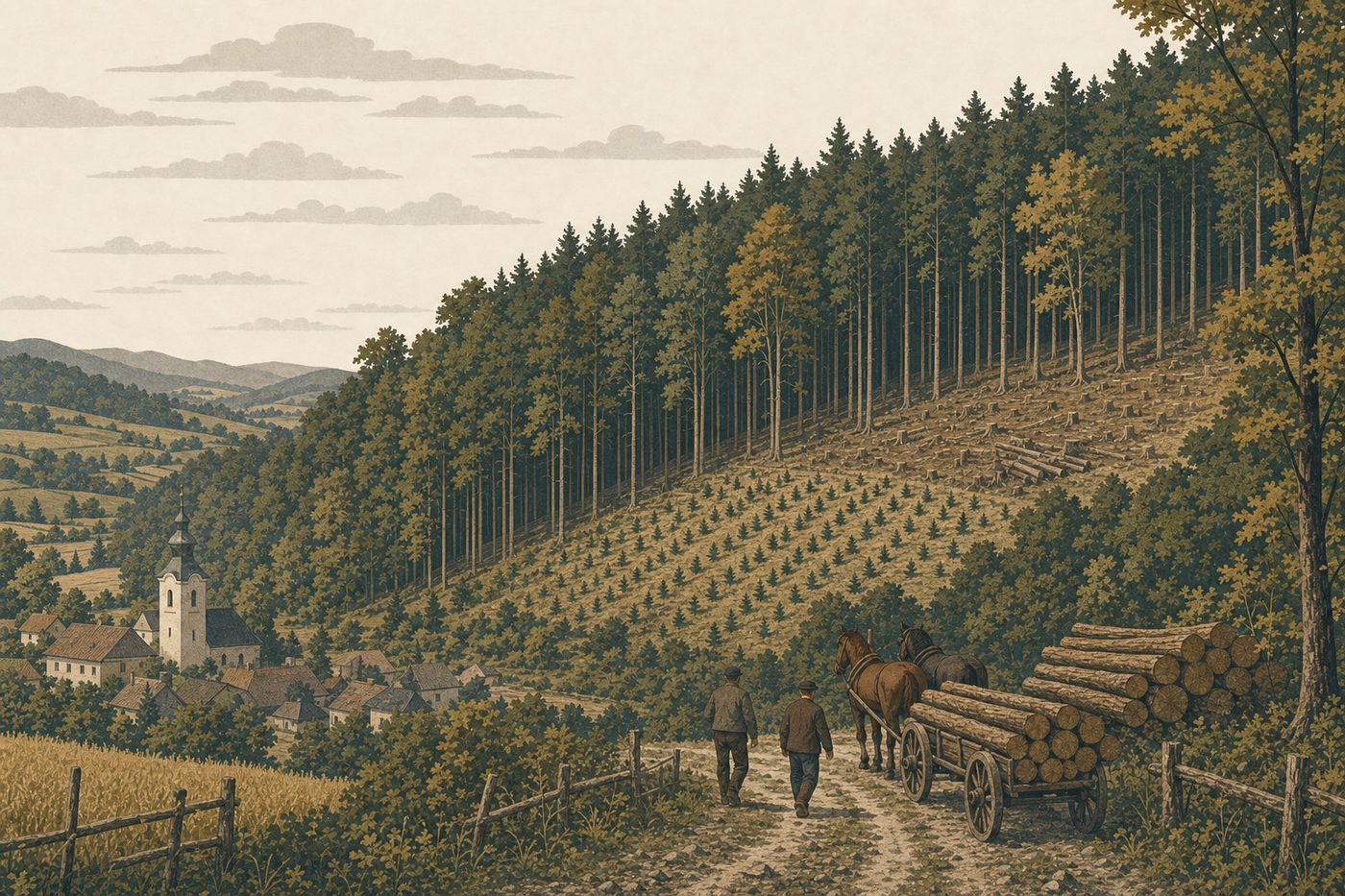
The passage in this book that changed how I read our own ground is not in the money chapters. It is a few paragraphs on external costs, and it puts a mechanism under a story I had only ever heard told as a moral. Where land belongs to nobody, or to someone who will not be holding it when the bill comes, the erosion of the soil and the felling of the forest are costs that never enter the calculation, and the man on the ground behaves exactly as you would expect. Mises's example is the American frontier, mined out under loose title, set against the forests of central Europe, which had supplied every town's timber and fuel and furnaces for centuries and were still in first-class condition with no conservation law at all, because "the owners of the forests were impelled to conservation by their own selfish interests." That is the fork Montgomery found in six thousand years of dirt, with the variable named. It was never greed against virtue. It was whether the person deciding carried the future. A currency that leaks is the same design flaw applied to money: the cost of spending it today lands on whoever holds it tomorrow.
The second thing is where he leaves me on my own, and he does it on purpose. Mises will not say that a long horizon is better than a short one. He will say what each one costs, and no more, because his whole method rests on refusing to rank anyone's ends. So when this farm treats patience and stewardship as goods, we are making a claim his economics declines to make for us. I would rather say that plainly than borrow his authority for a judgement he withheld. What he does give is the cleanest account I know of why the practice is hard: every arrangement that puts the decision in the hands of someone who does not own the outcome, a tenant, an overseer, a borrower, a bank that lends what nobody saved, produces the same result, and a good man inside it produces it too.
And on money, the sharpening. The case for a hard money is not that its price holds still; he says no money's does, and bitcoin's certainly has not. The case is about whose hand is on the supply. Gold's excellence was that the answer was nobody's. Bitcoin's is that the answer is written down. He would have questions, and the hardest one is his own rule that a money must first have been valued as something else, which is an argument still being had. But he also wrote that gold could one day be made too cheaply to serve and people would have to find another standard. We think they have. Ownership as a liability, an election held every day at the register, a builder who must count his own bricks because no one will count them for him: that is a description of a small farm that sells to the people who eat from it, and it is why we do.
What's happened since
The book arrived in 1949 at the low ebb of its school's reputation, and for a generation the mainstream regarded its method as a refusal to do science and its cycle theory as a curiosity. It has aged unevenly and in its favour. Rome scholars would still call his one-cause reading of the decline too clean, and the denial that economics can measure anything remains the objection that keeps it out of the departments. But the Ruritania passage became a description of the dollar system, the sentence about no soft landing has been quoted at the end of every credit boom since and rejected by whoever was presiding over the next one, and the calculation argument, which the profession had declared answered in the 1930s, was being cited after 1989 as the explanation of what happened to the economies that tried it. Read it for the master-builder and the director in the dark. Skip nothing in the money chapters. And take him at his word that the book is about everybody: its last sentence says a people who ignore what it teaches will not annul economics, they will stamp out society and the human race, and he did not mean it as a figure of speech.