

In short
In 1841 one of Charles Darwin's fields was plowed for the last time, and the stones that covered it clattered when his young sons ran down the slope. Thirty years later a horse could gallop its length and not strike one. Darwin cut a trench and found the stones exactly where they had been, under two and a half inches of fine earth. Nothing had been planted, nothing grazed. Worms had done it, a few inches a century, and the last book he wrote was about them.
Dirt is a geologist's answer to the other half of that arithmetic, which is how fast it leaves. David Montgomery studies how landscapes erode, and when he laid the timeline of soil loss over the timeline of civilizations ending they kept lining up, from Sumer to the country he was writing in. The mechanism is the same everywhere. People settle, farm the valley floor, feed more than the farmers, and the population grows into the surplus and past it. Farming climbs the hills, the plow bares the slopes, and the soil starts leaving faster than the worms can make it. Then an ordinary drought or an ordinary war, the kind the same people would have shrugged off a century earlier, finishes the job. He is careful about that last step, and the care is what makes the book hold.
The thesis
"Individual droughts, wars, and economic disruptions or dislocations may serve as the triggers for societal collapse, but the state of the land loads the gun." — Preface
The earth turned white
Nobody chose farming. At Abu Hureyra, on a bluff over the Euphrates, a couple of hundred people had settled into the good life of hunting gazelle and gathering from a hundred kinds of wild plant when the climate snapped back to near-glacial cold for a thousand years and the forest retreated north. The next-best land already had people on it. So they began cultivating the rye and wheat that survived the drying, which cost more work per calorie than gathering ever had, and Montgomery's summary is three words: they were forced into it. There was no going back. Rain-fed farming filled the uplands, eroded them, and pushed people down onto the floodplain between the Tigris and Euphrates, where canals and the people who organize canals produced Sumer: eight cities, a wall around Uruk six miles long, and the earliest writing in the world, much of it about rationing grain.
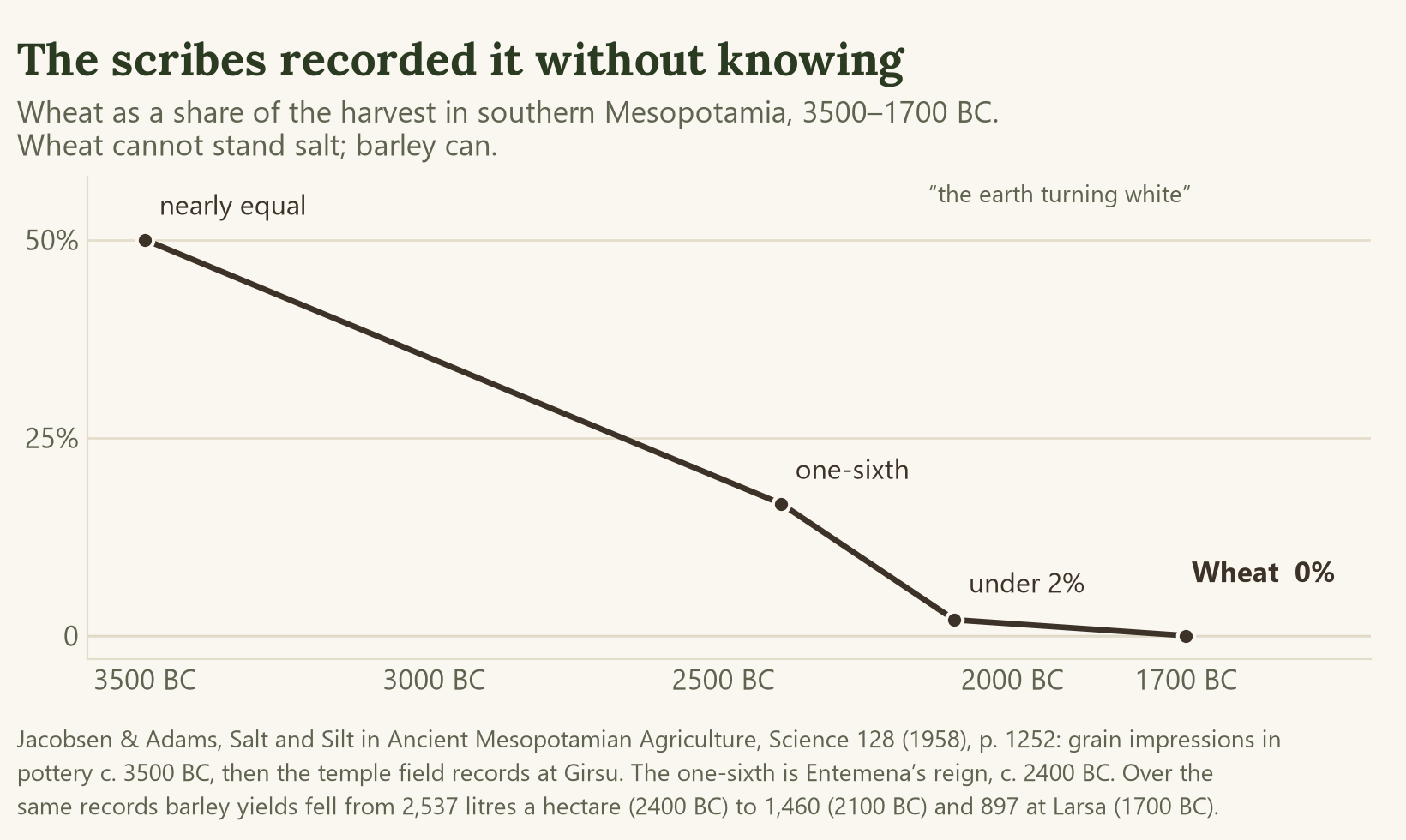
What killed it was in the water. Irrigating a hot floodplain lifts the water table, evaporation pulls the groundwater up through the soil, and the salt stays behind when the water goes. The temple scribes recorded the whole decline without knowing it, because wheat cannot stand salt and barley can. Around 3500 BC the harvests were nearly half and half. By 2400 BC wheat was a sixth of the crop, by 2100 it was under two percent, and by 1700 BC no wheat grew in southern Mesopotamia at all, barley yields had fallen by two-thirds, and the tablets describe the earth turning white. The cities fell to the Akkadians at the first serious dip in the harvest.
Egypt is the control. Same era, same crops, different river. The Nile flooded on schedule, dropped a millimeter of fresh Ethiopian silt on the fields, drained away, and took the water table ten feet down with it so the salt never rose. The valley fed the pharaohs, then Rome, then the Arabs, seven thousand years on the same ground. Nobody farmed better. The river was making a deposit every year, and Sumer's was not.
A road above its fields
Rome is the same story with better records, and the records let Montgomery say where the reflex lives. Romulus laid the city out in two-acre parcels, a size a family could work by hand; Cincinnatus was at his plow when they came to make him dictator. The early farms grew olives over grapes over grain over fodder in one stacked canopy that kept the ground covered all year. Then the ox and the iron plow arrived, saved labour, and doubled the land a family needed.
The turn came after Hannibal. His war emptied the countryside into the cities, the state paid its war debts in abandoned farmland, and a quarter of a million captives arrived to work it. Land, labour and capital were all suddenly cheap, and the estates that bought them grew wine and oil for export with slaves and overseers while the citizen-farmer became a figure of speech. The agronomists could see it. Columella opened his manual by quoting the illustrious men complaining that the soil had grown tired with age, and told them it was impious to think so: the land was fine, it was the treatment. He was ignored, because an overseer who moves on next year has no reason to haul manure uphill.
You can still see what happened. The Via Prenestina was laid flush with the ridge it runs along; by the 1960s its paving stones stood several feet proud of the plowed slopes around it, and a cistern built for a villa around AD 150 stood exposed by up to four feet of vanished ground. An inch a century, roughly, which no one alive would notice, and it took the topsoil off the heartland inside a thousand years. Pertinax offered the abandoned fields of central Italy free to anyone who would work them two years and found few takers; Diocletian stopped asking and bound the farmers to the land. By then a million people in the capital ate grain shipped in from Egypt and Africa.
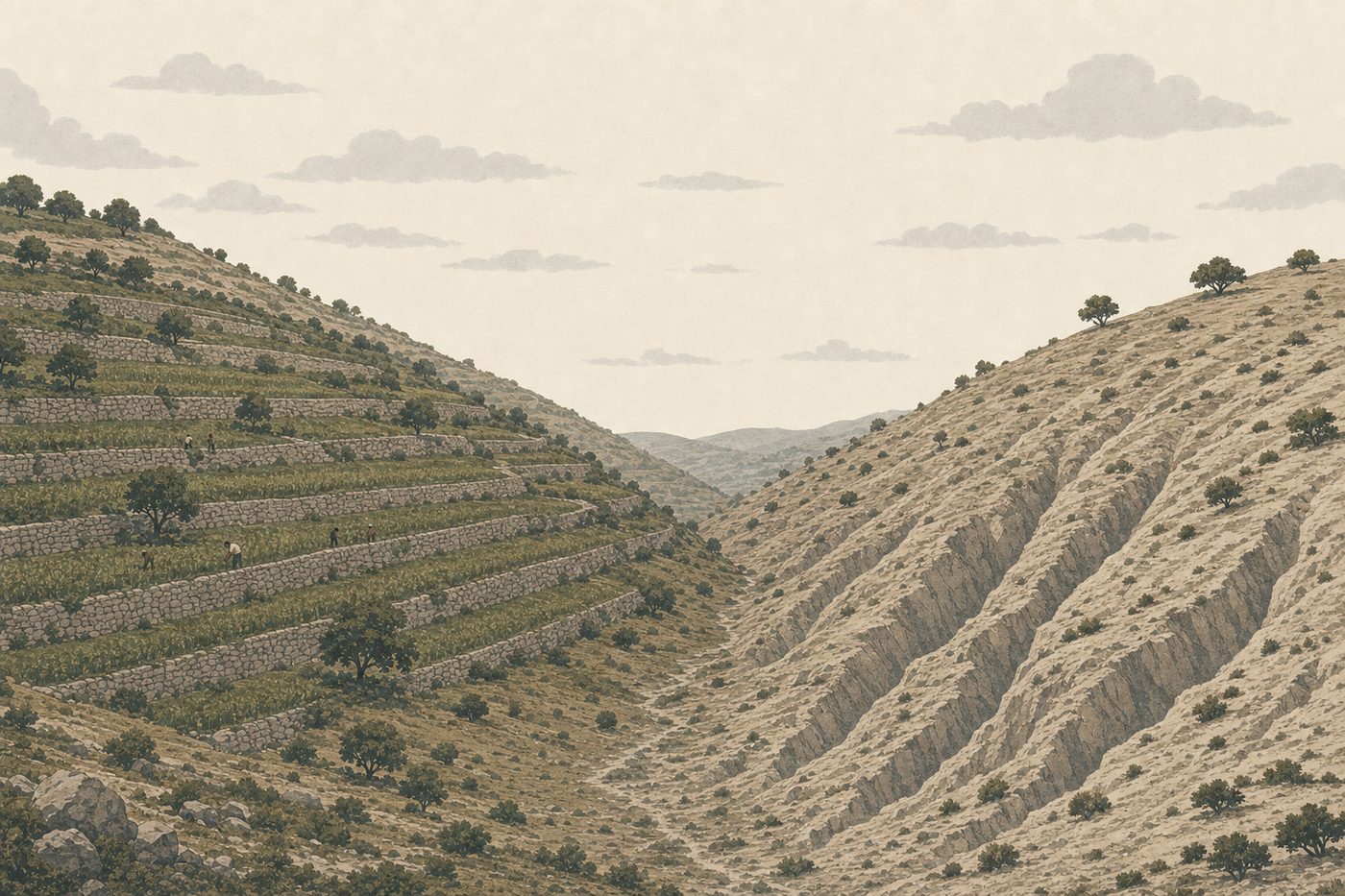
The provinces went the same way, later. On the eve of the Second World War Walter Lowdermilk walked Rome's African granary for the United States Department of Agriculture and found Timgad, a city Trajan built with a public library, a dozen bathhouses and marble flush toilets, holding a few hundred people in houses made from the rubble, its olive presses standing on slopes washed to rock. At Sousse he found olive trees fifteen hundred years old, alive, on the few slopes where Roman terraces still held the ground. The climate had not changed. The terraces had.
Are you moving?
Virginia was Rome with a cash crop. The colony was dying until John Rolfe found a tobacco London would smoke, and after that nothing else was planted, because tobacco fetched six times the price of any other crop and survived the crossing. It was hoed clean, so the ground lay bare through the summer storms, and it pulls ten times the nitrogen and thirty times the phosphorus out of the soil that a food crop does. A field gave three or four good harvests and was abandoned for fresh clearing to the west. Montgomery's line is nine words long: Virginia became a factory for turning topsoil into tobacco.
The founders knew, and Jefferson was blunt about why nobody did anything. Asked by an English agriculturalist how a man could grow five thousand bushels of wheat with cattle worth a hundred and fifty pounds, he explained that manure did not enter into it, because "we can buy an acre of new land cheaper than we can manure an old one." That sentence is the whole economics of the thing. As long as fresh ground costs less than keeping the old, the old goes.
When the geologist Charles Lyell toured Georgia in 1846 he stopped at a gully west of Milledgeville that had begun in the 1820s as cracks in a newly cleared field. It was fifty feet deep, two hundred wide and three hundred yards long. On the roads he passed thousands of families heading west, and the question strangers put to each other was simply "Are you moving?" One old man who had cleared his own farm and lived on it twenty years offered to sell Lyell the whole place on the spot: "I hope to feel more at home in Texas, for all my old neighbours have gone there."
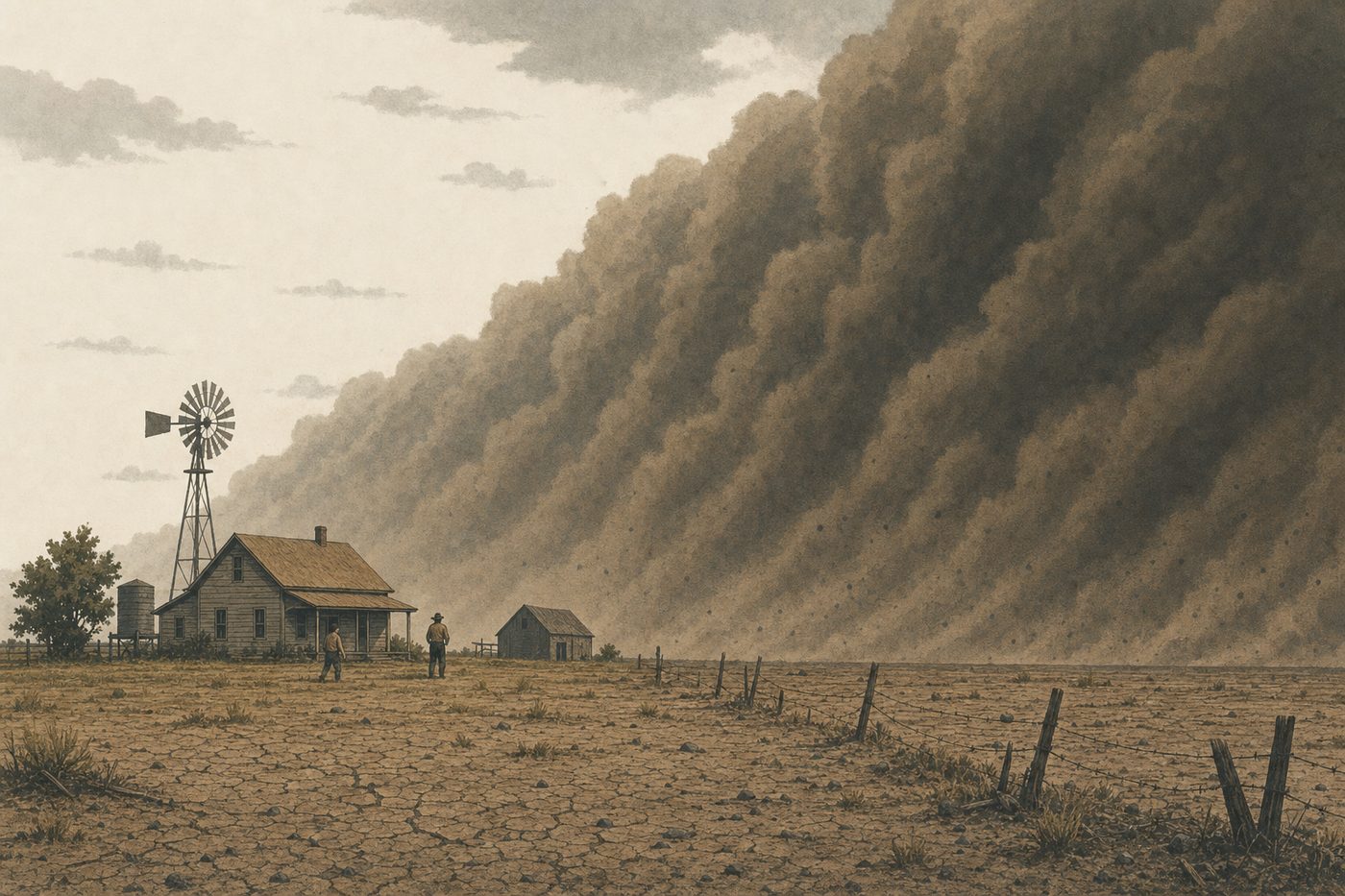
The plains were the last fresh ground, and forty million acres of prairie went under for the First World War's wheat prices. On May 9, 1934, a third of a billion tons of it left Montana and the Dakotas heading east at a hundred miles an hour; four pounds fell on every person in Chicago. The next spring Hugh Bennett was due to tell a Senate committee why the country needed a soil conservation service, so he had field agents phone in the progress of the next storm and timed his testimony so the sky went dark outside the windows as he spoke. He got his agency.
What the committee that investigated it found is the part of the book worth carrying around. The farmers had planted the plains to wheat at wartime prices, and when the price collapsed they planted more, not less, "in a desperate endeavor to get money with which to pay debt charges, taxes, and other unavoidable expenses. They had no choice in the matter." Their loans had set their horizon, and the horizon was next season. It did not stop when the dust did: farm credit was loosened, farm debt doubled inside a decade, and the farms that survived bought bigger machines and plowed more. By the 1970s the country was losing four billion tons of soil a year, a billion more than during the Dust Bowl, after forty years of conservation. A cistern on a farm in eastern Washington stuck a foot and a half out of the hilltop when it was built in 1911; by 1959 it stood six feet above the field. An inch a year, off a slope that grows wheat.
Sweet as a rat
Islands run the experiment with the exits sealed. On Easter Island the people who arrived with chickens and sweet potatoes had so much spare time that they carved hundreds of stone heads and rolled them across the island on logs, until there were no logs. The last statues lie unfinished at the quarry. When Europeans asked how the heads had been moved, the survivors said the statues walked, because no one alive had seen a tree big enough to explain it. The soil went storm by storm, in layers less than half an inch thick, and the culture faded about a century before the first ship arrived to find it.
Mangaia is smaller and worse. Slash-and-burn stripped its volcanic core to a subsoil that grows ferns and nothing edible, and the few valley bottoms that still held soil became the only thing worth fighting over. They ate the birds, the pigs, the dogs and the chickens, and a missionary recorded that the islanders' highest praise for any food was that it was "as sweet as a rat." Charred and gnawed human bones turn up in the rock shelters from about 1500 on.
Tikopia is under two square miles and carried five times Mangaia's population density in peace for over a thousand years, and Montgomery refuses to sell it as paradise. The islanders stopped burning, planted the whole island as a garden of coconut and breadfruit over yams and taro, and around 1600 the chiefs banished the pigs for what they did to the gardens. They also held the population flat by celibacy, contraception, abortion, infanticide and emigration by canoe; Montgomery asks which price was higher and does not answer. He does pass on one guess at why Tikopia chose as it did: the island was small enough that there were no strangers on it. Everyone who would pay for a bad decision was someone you knew.
A substitute for dirt
The modern answer to a thinning soil is to buy the fertility that used to come out of it. In 1898 the president of the British Association announced that civilised nations stood in deadly peril of not having enough to eat and that the chemist must come to the rescue, and eleven years later Fritz Haber ran liquid ammonia out of air for five hours in a laboratory in Karlsruhe. Half the nitrogen in the people now alive came through his process. It fed billions, and Montgomery does not pretend otherwise. What he adds is the ledger. The Department of Agriculture estimates that about half the fertilizer spread in the United States each year simply replaces nutrients that left in eroded topsoil, which puts the country in the position of burning one of the rarest things ever found in the earth to stand in for the commonest.
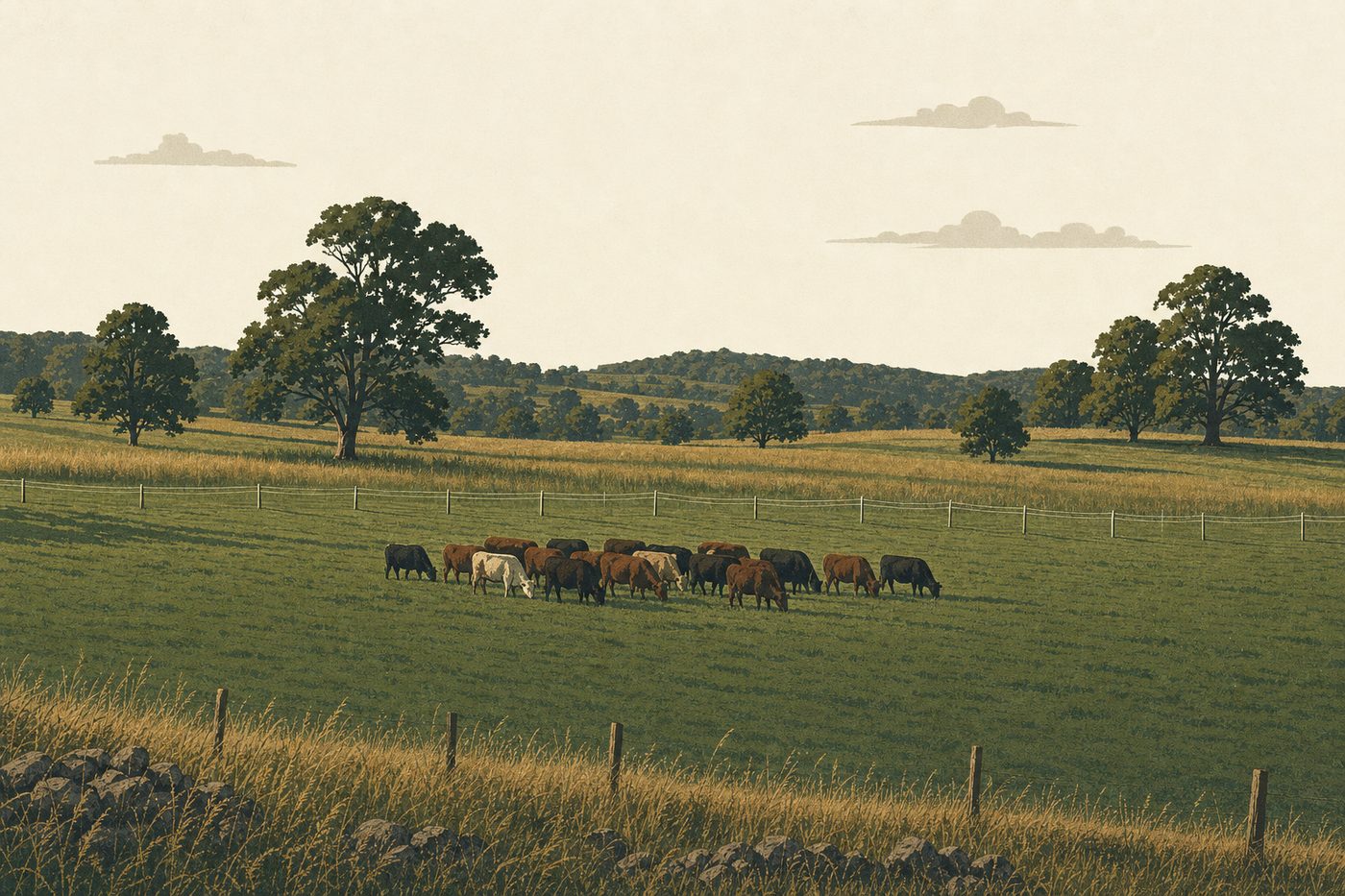
The alternative is not a theory; it is measured. Two wheat farms sit side by side near Spokane, first plowed within a year of each other. One went on to chemical fertilizer in 1948 and has shed more than six inches of topsoil since. The other never used it, grew green manure every third year, and its topsoil is now six inches thicker than its neighbour's, wetter, fuller of life, with the same yields. And in Montgomery's own yard, after five years of coffee grounds from the shop down the street and grass cuttings left where they fell, the lawn stands a quarter of an inch above the patio poured the same year. The worms are pumping it up. Darwin's field, at the scale of a house.
Through the Orenda lens
Montgomery says early on that a landscape's soil budget is a family budget, with income, expenses and savings, and that a society can live on the interest or eat the principal. That is the sentence I read the whole book through. Every case in it is a people spending a stock that took centuries to build and calling the proceeds income, and the reason none of them saw it is the reason nobody sees a currency leak: the loss is a fraction of an inch a year and the statement never arrives. I read this before I was a farmer, and what I felt was a pattern nobody talks about being confirmed. What I could not have said then was that I was already watching our version of it, in food that gets less nutritious and people who get less well, and had never threaded it back to the ground.
The book is also clear about where the reflex lives, and it is not ignorance. The Romans had manuals on manure. Jefferson knew. The Dust Bowl farmers knew. What they all had was a horizon set by something other than the land: a landlord in the city, an overseer paid on this year's crop, a loan that came due before the soil did. Rome, the antebellum South and the corporate farm are one arrangement three times, and Montgomery draws the moral without hedging: the ground should be owned by the people who work it. That is the case for a family farm made from the soil's side rather than the romantic one. It is also why a farm like this one sells to the people who eat from it. The financing contest is what sets the horizon, and the only way to win it is not to enter.
Where I read him a little differently is on money. He puts the soil account in deficit from the plow, before anyone struck a coin, so the extractive habit is older than the money that now amplifies it. But amplify it does: cheap credit turned the plains to wheat in 1917 and kept them in wheat when the price fell, and a currency that leaks makes eating the principal the rational move in every domain at once. Sound money lengthens the horizon; it does not supply the practice. The practice is the terrace, the cover, the manure, the animals moved before the grass is gone, and no monetary system has ever built one. That is the half we do here.
And the plain stake, for anyone who has never held a handful of it: everything is downstream of topsoil. The food, the health that comes out of the food, the stability of a country already on a razor's edge getting groceries from farm to shelf. Montgomery's arithmetic gives a plowed civilization eight hundred to two thousand years, and the American one has spent a third of its soil in two hundred. It may play out over centuries the way it did before. It may not. I am not taking the chance either way. You cannot eat money. You cannot eat AI.
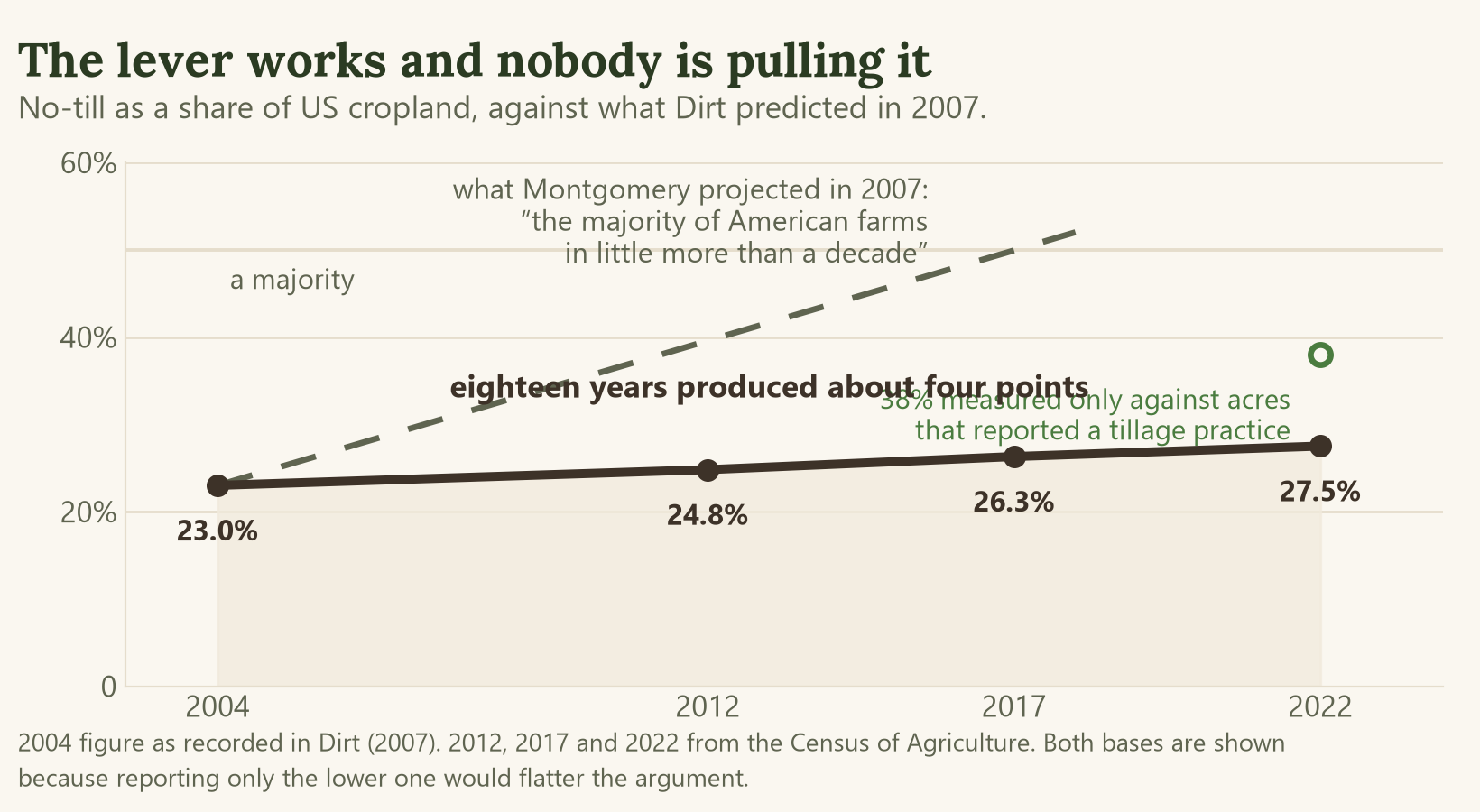
What's happened since
The book has aged in one direction. The objection when it came out was that it pushed individual cases too hard, and he had answered that on the page he made the claim. The measurements got worse: satellite mapping published in 2021 found that about a third of the cultivated Corn Belt, close to a hundred million acres, has lost its topsoil layer entirely, more than the Department of Agriculture had been counting. And the one prediction of his own that failed is the most useful thing here. In 2007 he recorded no-till on 23 percent of American cropland and expected the majority to follow inside a decade. The 2022 census puts it at 27.5 percent. The lever works, and eighteen years moved it four points. Read it for the pattern. Then go and look at your own ground, because the story, as he says, is out there in the dirt.