

In short
Murray Rothbard wrote this in 1965 and it runs to about sixty pages, which is the point of it. His fourteen-hundred-page treatise builds the whole economy from one man on an island; this pamphlet starts from the opposite end, with the one institution the treatise leaves out until its second book, and asks in plain words what it is. Not what it says it is, not what a civics class says, but what you would call it if you described its behaviour to someone who had never heard the word. His answer is a definition, and the rest of the essay is a walk through the record showing that the definition holds everywhere the thing has ever existed.
The definition is this: the state is the organisation in a territory that keeps a monopoly on the use of force, and, more precisely, the only organisation that gets its income by compulsion rather than by selling something or being given it. Every other body in a society has to produce and persuade. This one takes. From there he asks how such a thing begins, how it persuades the people it takes from to keep accepting it, how it slips every limit written to hold it, what it fears, how it behaves toward its neighbours, and whether anything in history has ever managed to keep it in check. His answer to the last question is no, and he says so.
The thesis
"Briefly, the State is that organization in society which attempts to maintain a monopoly of the use of force and violence in a given territorial area; in particular, it is the only organization in society that obtains its revenue not by voluntary contribution or payment for services rendered but by coercion." — What the State Is Not
The bandit of South Ruritania
The essay opens by clearing away the word "we." If we are the government, then whatever the government does to a person is voluntary on that person's part: the debt is owed to ourselves, the conscript is drafting himself, the man jailed for his opinions did it to himself. Rothbard pushes the sentence to its end to show where it goes, and then says the plain thing: we are not the government, and a majority deciding to do something to a minority does not make it the minority's choice.
What the state is comes from the sociologist Franz Oppenheimer, and the whole essay stands on his distinction. There are two ways to get what you want. You can make it, or trade what you made for what someone else made, and Oppenheimer called that the economic means. Or you can take it from the person who made it, and he called that the political means. The second cannot exist without the first, because there has to be something to take, so production always comes before predation and the market is older than any state. Crime is the political means done at random. The state is the same thing made regular.
"The State provides a legal, orderly, systematic channel for the predation of private property; it renders certain, secure, and relatively 'peaceful' the lifeline of the parasitic caste in society." — What the State Is
Where does one come from? Not from a social contract, which he says has never happened; from conquest. His picture is a tribe that used to loot and kill its neighbours and then works out that the neighbours are worth more alive, producing every year, with the conquerors settled among them collecting a fixed tribute. Then he gives the same story in miniature. In the hills of southern Ruritania a bandit gang takes physical control of the district, and after a while its chief proclaims himself King of the sovereign and independent government of South Ruritania. If he can hold the ground long enough, a new state has joined the family of nations and the bandits are the nobility of the realm. Nothing about them has changed except the length of time they have been there.
The intellectual bodyguard
A gang can take a district by force, but it cannot hold a country that way, because the people who run a state are always a small minority living off everyone else's surplus. To last, it needs the majority to accept it, and acceptance need not be enthusiasm; resignation will do, so long as it is general. Buying support with jobs and privileges only gets you the people on the payroll. For everyone else, Rothbard says, the state needs an idea, and the people who make ideas.
"Promoting this ideology among the people is the vital social task of the 'intellectuals.' For the masses of men do not create their own ideas, or indeed think through these ideas independently; they follow passively the ideas adopted and disseminated by the body of intellectuals." — How the State Preserves Itself
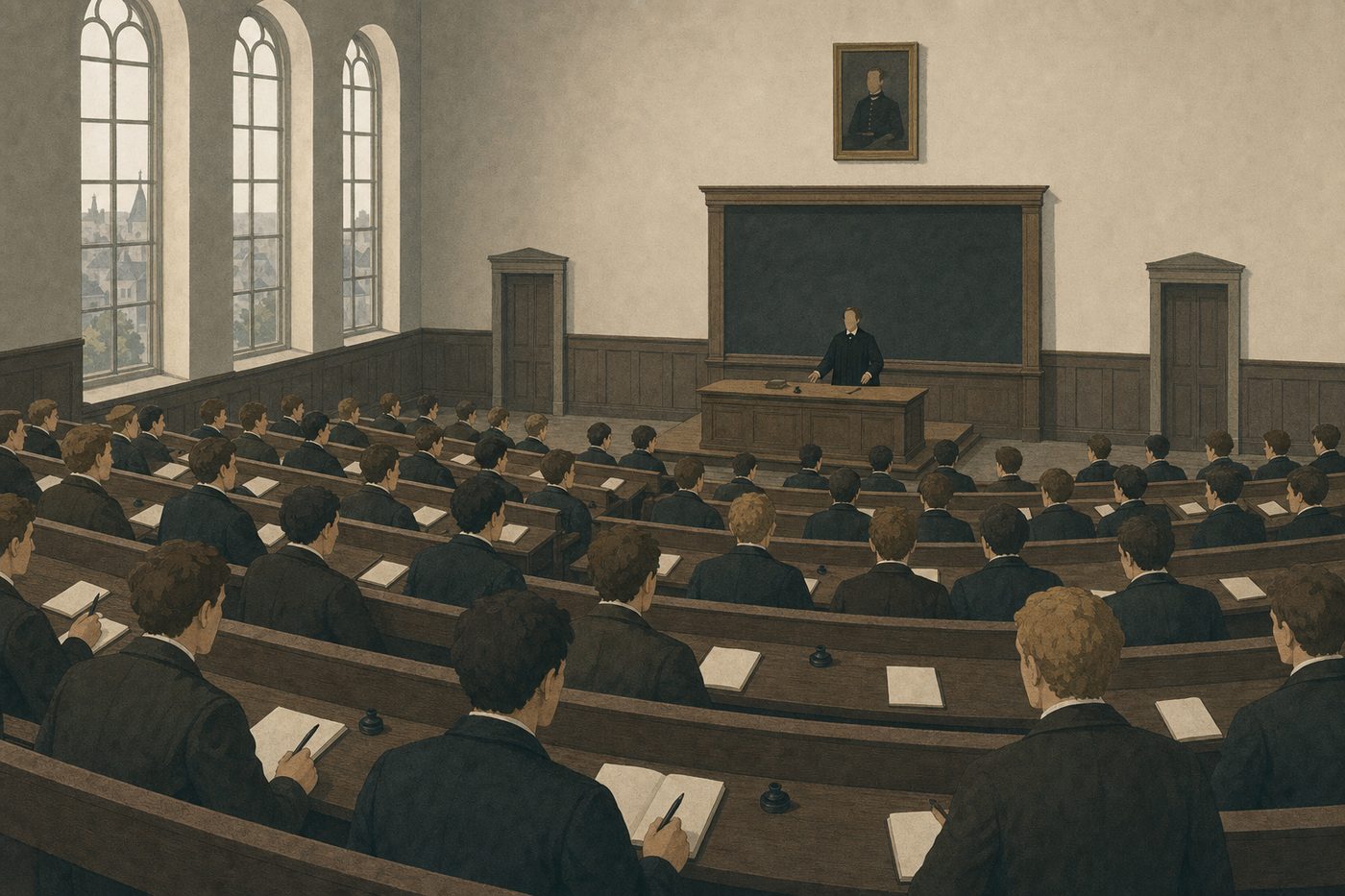
Why would intellectuals want the job? Because a living from the public is never secure, the public being mostly uninterested in intellectual matters, while the state offers a permanent berth, an income and prestige. His example is the professors of the University of Berlin in the nineteenth century, eager, in their own phrase, to be the intellectual bodyguard of the House of Hohenzollern; his modern one is the new science of strategy, in the service of the army, and the court historian, who is as old as courts.
Then he lists the arguments the bodyguard has used, and the list is the best part of the essay because every reader will recognise most of it. The rulers are wiser than the ruled, by divine right, by breeding or by expertise. The alternative to this rule is chaos. The state protects you from bandits, which it does, because it does not tolerate competition. It protects you from the state next door: when Ruritania is attacked by Walldavia, the first task is to convince the people of Ruritania that the attack is on them and not on their rulers, so that a war between two sets of nobles becomes a war between two peoples, each defending the men who tax it. Tradition, so that criticising the rulers becomes insulting your ancestors. Ridicule of the lone dissenter, since every dangerous idea must begin as one person's opinion. Inevitability, as in "death and taxes." The rejection of any conspiracy theory of history, since a search for conspiracies is a search for motives and for someone to blame, and a public that has been taught to blame social forces will not rise against anyone. Guilt, so that a rising standard of living is greed and a profit is exploitation. And, in a secular age, science, so that the robber who claims his spending helps his victims by boosting retail trade, who would be laughed at on the street, carries conviction once his claim is dressed in equations about the multiplier.
Judge in its own cause
Men have tried for centuries to write limits on the state, and the essay's third movement is about what happened to each attempt. Bertrand de Jouvenel's observation is the frame: every device meant to restrain power has ended up as a stamp of legitimacy on whatever power does. Divine law, which was to bind kings, became divine approval of kings. Parliament, which began as a check on the crown, became the crown. Natural rights became the right to a job.
The largest attempt was the American Constitution, and Rothbard's witness is not a critic of it but an admirer, the law professor Charles Black, who explained in 1960 what the Supreme Court is actually for. A government of limited powers has a standing problem: sooner or later almost everyone living under it is told something by it that he believes it has no power to say. Black's own examples are a man drafted who finds nothing in the Constitution about being drafted, a farmer told how much wheat he may grow, a man in a federal cell reciting "Congress shall make no law." What such a government needs is a way to satisfy these people that its growing powers are constitutional, and that, Black says, has been the main historical work of judicial review. A verdict of unconstitutional is a check; a verdict of constitutional is a far more useful thing, a licence. His example is the New Deal, which the court blocked for twenty-four months and then, without a single change in its membership, stamped, ending any serious public doubt about what Congress may do with the economy. The court is part of the government it judges. Black admits this makes the state a judge in its own cause, calls the result something of a miracle, and denies any alternative exists.
"For if a judicial decree of 'unconstitutional' is a mighty check to government power, an implicit or explicit verdict of 'constitutional' is a mighty weapon for fostering public acceptance of ever-greater government power." — How the State Transcends Its Limits
The one thinker who saw this coming, a century early, was John C. Calhoun. Rothbard quotes him at length on why a written limit fails: the party holding the government will read the constitution broadly and the party out of it narrowly, and in a contest between a reading backed by all the power of the state and a reading backed by nothing, the result is not in doubt. Calhoun's remedy was to give any large minority a veto, which for a state meant nullifying a federal law. Rothbard takes the idea and pushes it where Calhoun would not go. If a state may veto what is done to it, why not a county, a city, a trade? And what stops the states from tyrannising their own citizens and vetoing only the federal government's attempts to intervene, or the two levels agreeing to share the take? A consistent version of the veto ends at the individual, and a right of individual veto is a right of individual secession. He notes that down that road lie arrangements that could hardly be called states at all, and leaves it there.
What it punishes hardest
A state can die two ways, by conquest or by revolution, so war and revolution are the two things it fears, and both bring out its maximum effort and its maximum propaganda. War in particular. Under the words defence and emergency a state can impose on its people what they would resist in peacetime, and every modern war has left behind a permanent increase in what the state takes; Randolph Bourne's line, which Rothbard endorses, is that war is the health of the state. The proof he offers is an experiment anyone can run. Ask which crimes a state pursues hardest.
"The gravest crimes in the State's lexicon are almost invariably not invasions of private person or property, but dangers to its own contentment, for example, treason, desertion of a soldier to the enemy, failure to register for the draft, subversion and subversive conspiracy, assassination of rulers and such economic crimes against the State as counterfeiting its money or evasion of its income tax." — What the State Fears
Compare the effort spent on a man who hits a policeman with the effort spent on a man who hits you. The state's first priority is its own protection against its public, and almost nobody finds that strange in an institution whose stated purpose is the public's protection.
Parma watched from the walls
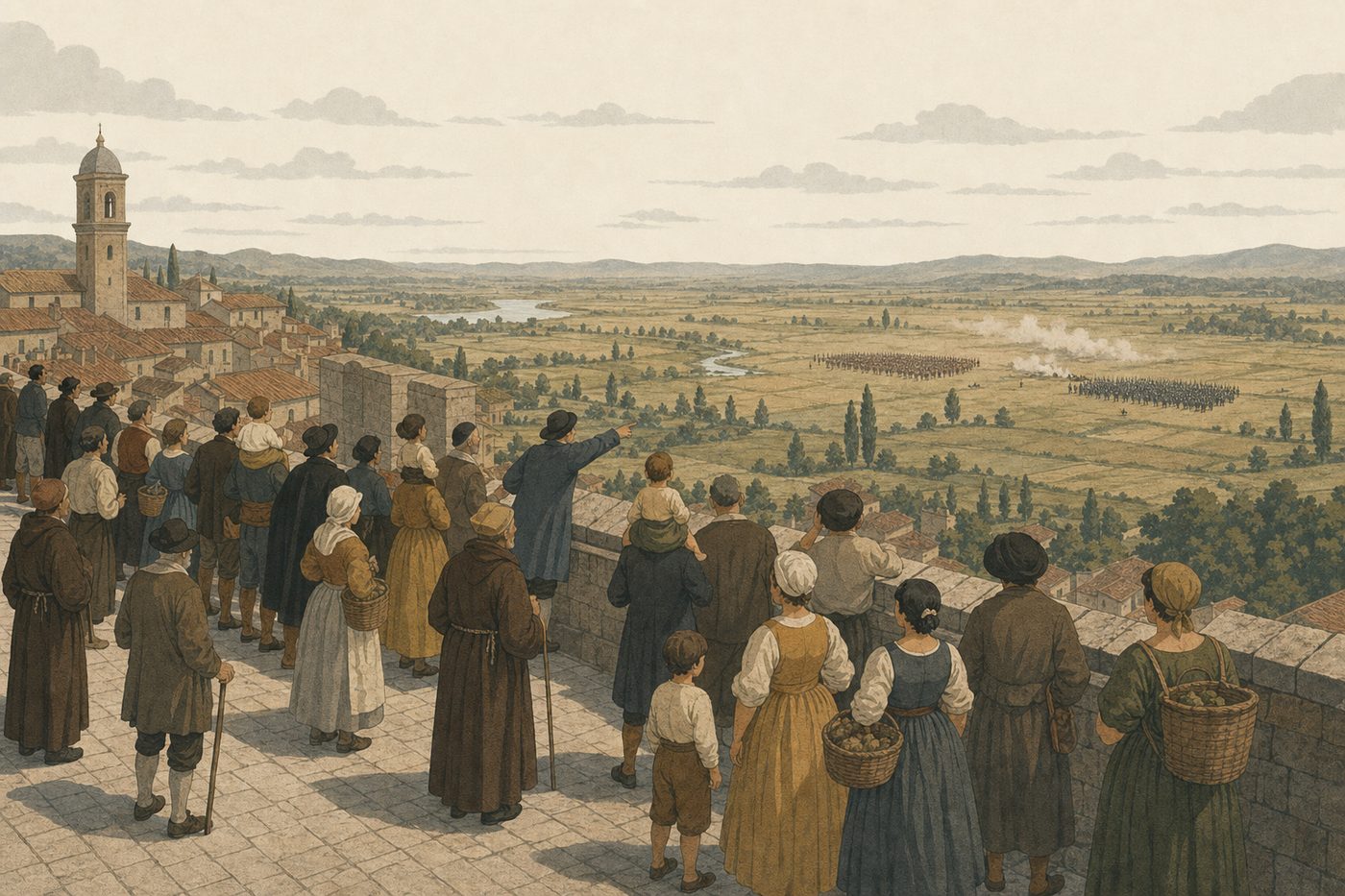
States divide the surface of the earth between them, and since only one can hold a territory, they collide. Rothbard's account of what used to restrain the collisions is one of the essay's surprises, because it is nostalgic. The laws of war and the rights of neutrals grew up, largely without any government over them, to keep war between states from reaching the people who lived under them. In fifteenth-century Italy the merchant cities hired soldiers for a campaign and dismissed them after it, generals manoeuvred rather than fought, a town that offered no resistance could not be sacked, so no town resisted, and civilians had little to fear from wars that were the business of professionals. In the eighteenth century letters crossed enemy lines uncensored, subjects of warring kings talked as friends when they met, and travellers did not think to leave a country their own was fighting. At the siege of Parma the citizens ran to the town walls to watch the battle in the open country beyond, their only fear being that either army might get inside the gates. Rothbard's comment on how far the twentieth century has moved from that is one sentence: the idea of keeping war to the state apparatus now seems more quaint than the original Constitution.
He adds a short argument about treaties that shows how literally he takes property. A contract binds because it moves a title: old Jones sold the land, so young Jones has no claim on it. A government owns nothing it rules, so a treaty moves no title, and a later government, or a revolution, is not the heir of the one that signed it, any more than a new tenant inherits the old tenant's debts. The sanctity of treaties, he says, has nothing in common with the sanctity of contract, which is why one is honoured and the other is not.
The race
The essay ends by naming the two forces whose contest is the shape of history. Albert Jay Nock called them social power and state power. Social power is what people can do to nature by working together: the tools, the knowledge, the trade, the standard of living. State power is the taking of that. Every so often social power leaps ahead, a new way of working is found, and for a while the state's share falls; the seventeenth to nineteenth centuries were such a time in the West. Then the state catches up, moves into the new ground, and takes its share again, and the twentieth century, in Rothbard's reading, was the catching up.
"State power, as we have seen, is the coercive and parasitic seizure of this production—a draining of the fruits of society for the benefit of nonproductive (actually antiproductive) rulers. While social power is over nature, State power is power over man." — History as a Race Between State and Social Power
In a footnote to that paragraph he lists the positions a state always holds whatever else it lets go: violence, the courts, the roads and the post, water where water is scarce, the schools. And then the last one, which is the reason to read the essay at all: in the modern economy, money is the critical command post. The essay's closing page admits that nothing tried so far, no constitution and no doctrine, has kept the state in check, and that new paths of inquiry will be needed. It does not say what they are.
Through the Orenda lens
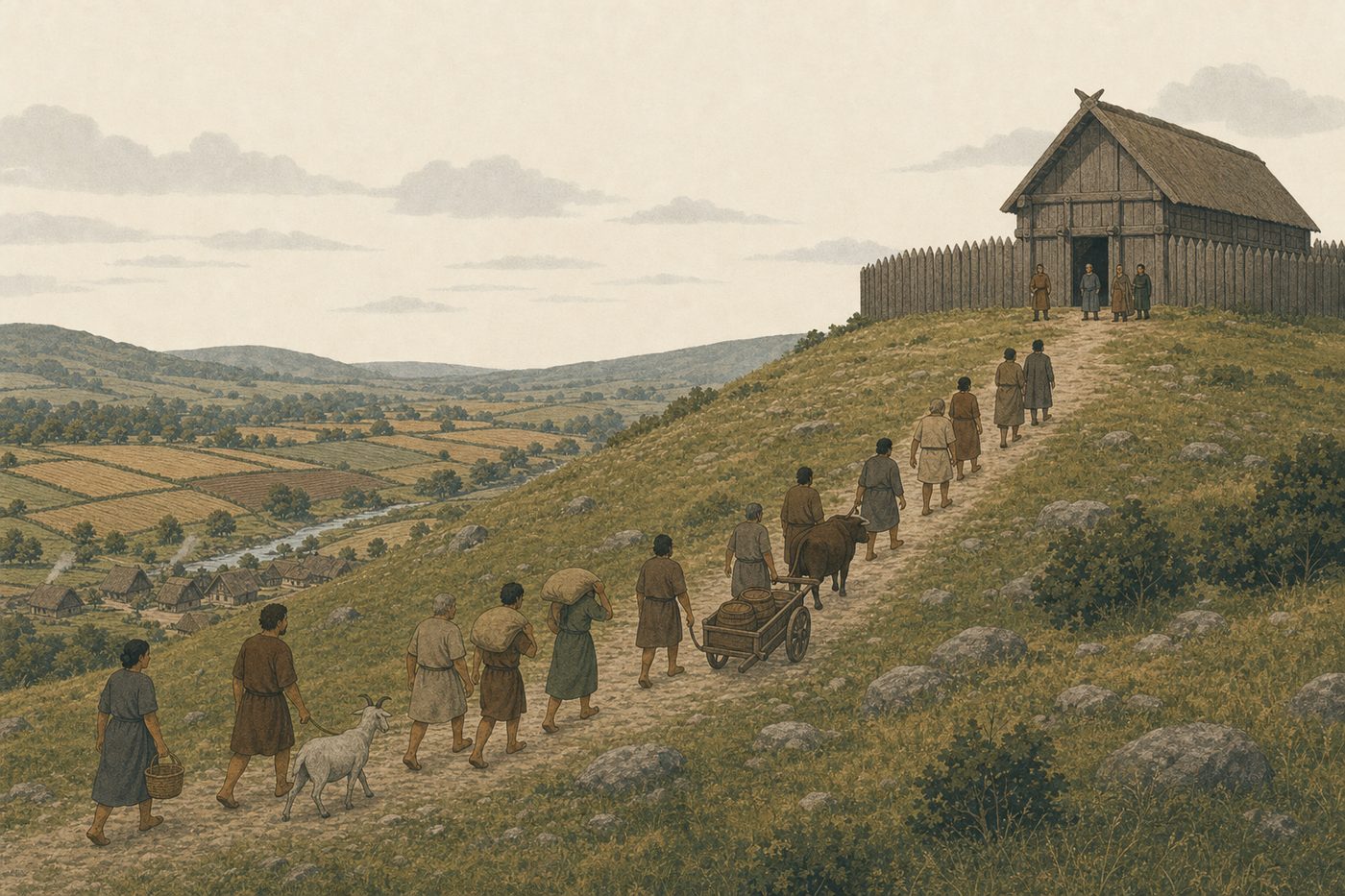
Read it for the footnote. Rothbard's list of what a state will never give up runs from the sword to the schoolroom and ends at the mint, and everything on this page follows from the fact that the last item on the list has, for the first time, been built where no state can reach it. A state that holds the money can take without a vote, by issuing more of it, and the essay's whole account of ideology exists because taking openly is the hard part. Dilution is the political means with the intellectual bodyguard built in: nobody has to be persuaded of anything, because nobody sees it happen. A money that cannot be issued is not an argument against the state. It is a command post that has moved.
The bandit chief is not only his story. A farm is the economic means in its plainest form, something made from ground and sun and time and sold to people who want it, and everyone who has ever run one knows the difference between a customer and a tax bill without needing Oppenheimer to name it. From the book, on what that means in practice:
"There are only two ways to acquire things in this world: produce them and trade voluntarily (what he called the 'economic means'), or take them by force (what he called the 'political means'). Holding your own keys is choosing the economic means. You earned it. You hold it. Nobody can take it without your consent."
The list of arguments is the part I would hand to anyone. Not because every state is the bandit of South Ruritania, but because the essay gives you a way to hear the arguments as arguments, and once you have heard "we owe it to ourselves" or "the experts have decided" as a device, you cannot unhear it. That is what he meant by independent intellectual criticism being the thing a state fears most, and it is the only weapon the essay offers.
Where it pushes back on us is worth saying plainly. Rothbard defines the state by how it is paid and builds everything on the definition, so a reader who thinks some taking is the price of the roads will not be argued out of it here; he is not addressed. The essay offers no remedy and admits it. And the conquest story of how states begin is one route among the ones the record shows, told as if it were the only one. We keep our savings in the one money the command post does not control, and we pay what the county asks and drive on its roads, and both of those are true at once. The essay is about seeing clearly, not about being pure.
What's happened since
The essay was first published in 1965 in a small journal, collected in 1974 among Rothbard's essays, and became the most widely read thing he wrote only after the Mises Institute put it out as a short book and a free file in 2009, which is the edition most people have held. Its influence ran two ways. The definition of the state by its revenue, and the two means, became the standard opening of a whole school of American libertarian writing, so that people who have never read the essay argue in its terms. Meanwhile the academic study of the state as a self-interested actor went a different route through public choice economics, which Rothbard's own footnote on the unanimity principle already regards as a diluted version of his point, and which was taken more seriously by the profession precisely because it stopped short of him. The conquest theory of the state's origin, which he took whole from Oppenheimer, is treated by archaeologists today as one of several ways early states formed, alongside irrigation, trade and religion; the essay's Ruritania is a story, not a finding. The portrait of intellectuals is a caricature that flatters no one, including its author, who was one. And the pages on Calhoun borrow the constitutional argument of a man whose own cause was the thing Rothbard's ethics condemned, which the essay does not pause to notice. What has changed the reading of it most is not a book but a fact: since 2009 there has been a money that is nobody's command post, and the last item in his footnote reads differently once it is no longer true everywhere. Read it in an afternoon, for the bandit chief and the list, and for the honesty of the final page.