

In short
Robinson Crusoe lands with nothing and finds he can pick twenty berries an hour, so he picks for ten hours and rests for fourteen. Then he notices that with a long stick he could knock fifty an hour off the trees. The stick takes ten hours to make, and for those ten hours he eats no berries and gains no rest. Whether he makes it depends on one thing: how much he minds waiting. If he does, on the sixth day five hundred berries a day start coming in, and he can take two of the hours back as leisure and still be twice as well fed. Everything after that, the bow for meat, the net for fish, the axe for the house, is the same decision at greater length, and the only thing that ever stops him investing more is that he would rather eat now.
That is the first hundred pages of Man, Economy, and State, and Murray Rothbard builds the rest of economics out of it. He began on the first day of 1952, wrote to Mises in 1959 that it was finished, and published it in 1962 with the third part cut off by the publisher and issued eight years later as Power and Market; this volume puts them back together. It is fourteen hundred pages, written entirely in ounces of gold rather than dollars, on the grounds that a dollar is an accidental local name and an ounce is a weight. The plan is simple and the execution is not: build the whole market from Crusoe up, with no force in it anywhere, and only then let the intervener in and count what he breaks.
The thesis
"The former breeds harmony, freedom, prosperity, and order; the latter produces conflict, coercion, poverty, and chaos." — PM, ch. 7, §4
Nails in Scotland
Money was never invented. A man with a plow to sell and a want of eggs finds nobody with eggs wants a plow, so he takes butter for it, because everyone takes butter, and buys his eggs with that. Every time someone does this the butter becomes easier to sell, which makes it the thing to take next time, and the loop runs until one or two goods have separated from the field. Rothbard's list of what won, locally, before gold did is the best sentence in the chapter: tobacco in Virginia, sugar in the West Indies, salt in Abyssinia, cattle in Greece, nails in Scotland, copper in Egypt, and beads, tea, cowrie shells and fishhooks besides. Gold and silver won the long game for the usual reasons: wanted for their own sake, scarce, divisible, and they do not rot.
Then he does something Mises proved and nobody else had drawn. Why is gold worth anything today? Because of what it bought yesterday, which depended on what it bought the day before. That looks like a circle, or an infinite regress, and Rothbard walks it backwards day by day until it stops: at the last day of barter, when gold was traded only as a metal and its price had nothing behind it but the desire for ornaments. The chain has a first link. Which is why a money cannot be declared into being by a government or a committee; it has to come out of something that was already worth having.
"Money must develop out of a commodity with a previously existing purchasing power, such as gold and silver had. It cannot be created out of thin air by any sudden 'social compact' or edict of government." — MES, ch. 4, §5B
He adds the clause people forget. Once a money is established, the direct use that started it does not have to continue. The chain has to have a first link; it does not need the first link kept polished.
Hume's morning
Imagine everyone wakes one morning to find the money in their possession has doubled. Rothbard borrows the picture from David Hume to ask the simplest question in the book: is anyone richer? The berries, the boats, the houses are the same as they were the night before. All that has changed is the unit, which now takes twice as many of itself to buy the same loaf. Goods are useful; more of them is a gain for somebody. Money is useful only for what it buys, so a bigger pile buys the same and each piece buys less. In his phrase money is dead stock, and it produces nothing.
"Every supply of money is always utilized to its maximum extent, and hence no social utility can be conferred by increasing the supply of money." — MES, ch. 11, §4
The morning is a fairy tale in one respect only. New money never arrives evenly. It enters somewhere, and whoever gets it first spends it at the old prices while whoever gets it last has already paid the new ones. So an increase in the supply of money helps nobody in total and helps some at the expense of others, and Rothbard names the two groups the way he names everything: just as half the country are taxpayers and half tax-consumers, half are inflation-payers and the rest inflation-consumers. The payers are whoever is furthest from the bank, which is to say the pensioner, the widow, the man on a fixed wage and the creditor who lent before prices moved. He also refuses to let the word slide. Inflation is not rising prices, which are a symptom that can be hidden by a good harvest or a new machine. It is the increase in the money itself, and that cannot be hidden from anyone who looks.
A warehouse that lent out your coat
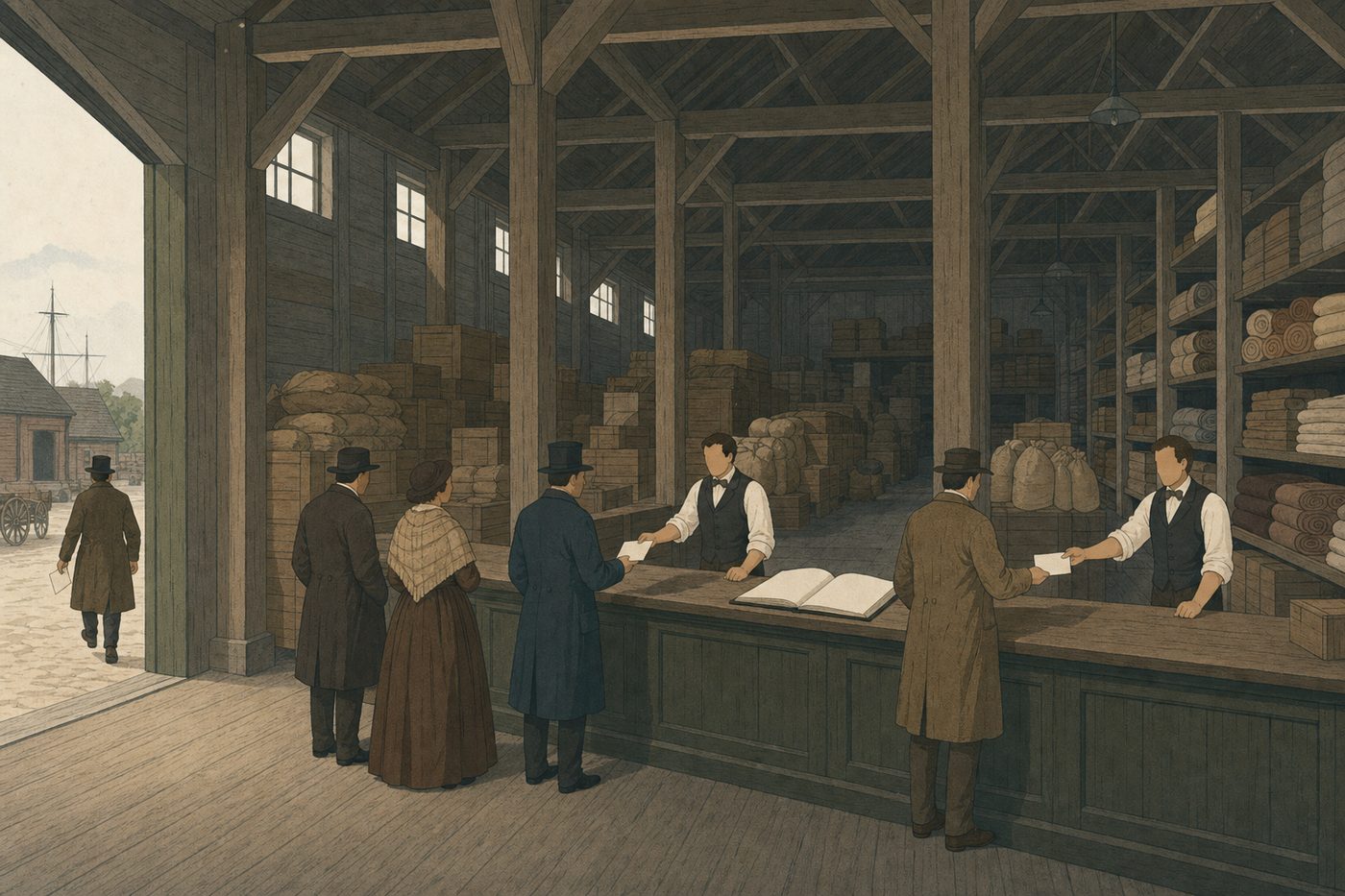
A bank, Rothbard says, is a warehouse that specialises in money, and he tells the rest as a story about a firm called the Trustee Warehouse Company. It keeps people's goods safe, gets a reputation for it, and people begin trading the receipts rather than collecting the goods. The company notices that on any given day only a few receipts come back. So it lends out what it is holding, or prints receipts for goods that are not there and lends those, and as long as the depositors do not all arrive at once, nobody is the wiser. Money is the good this works best on, because an ounce of gold is the same as any other and nobody asks for the one they left.
He will not soften what that is.
"It is, in fact, difficult to see the economic or moral difference between the issuance of pseudo receipts and the appropriation of someone else's property or outright embezzlement or, more directly, counterfeiting." — MES, ch. 11, §6B
If the vault holds twenty pounds of gold and the receipts say thirty, ten pounds of paper are fraudulent, and which ten is only discovered on the day of the run, when the last people in the queue find the shelves bare. The law calls this ordinary banking. Rothbard calls it what a court would call it if a grain warehouse did it, and his remedy is not a regulator but a rule: a receipt must have the thing behind it, every time. He argues against the free-banking position that several of his own school hold, which is worth knowing before anyone tells you sound money is one settled idea. In this book even the word "reserve" is misleading, because the gold in the vault was never the bank's to have a policy about.
The contractor's foundation
Rothbard's boom starts with a sum. Say the country is investing six million ounces and consuming four. The banks now create two million more and lend them to business. Nobody saved them; the stock of goods on the morning after is what it was. But the loans arrive at a lower rate of interest, and the interest rate is the one price that tells a businessman how much saving exists and therefore how long a project he can afford to start. Reading the false rate, firms bid for steel and land and men to begin things that only pay if the savings are real. The image is a contractor who has been told he has more material than he has, and who wakes to find he has spent all of it on a foundation big enough for a house he cannot now build.
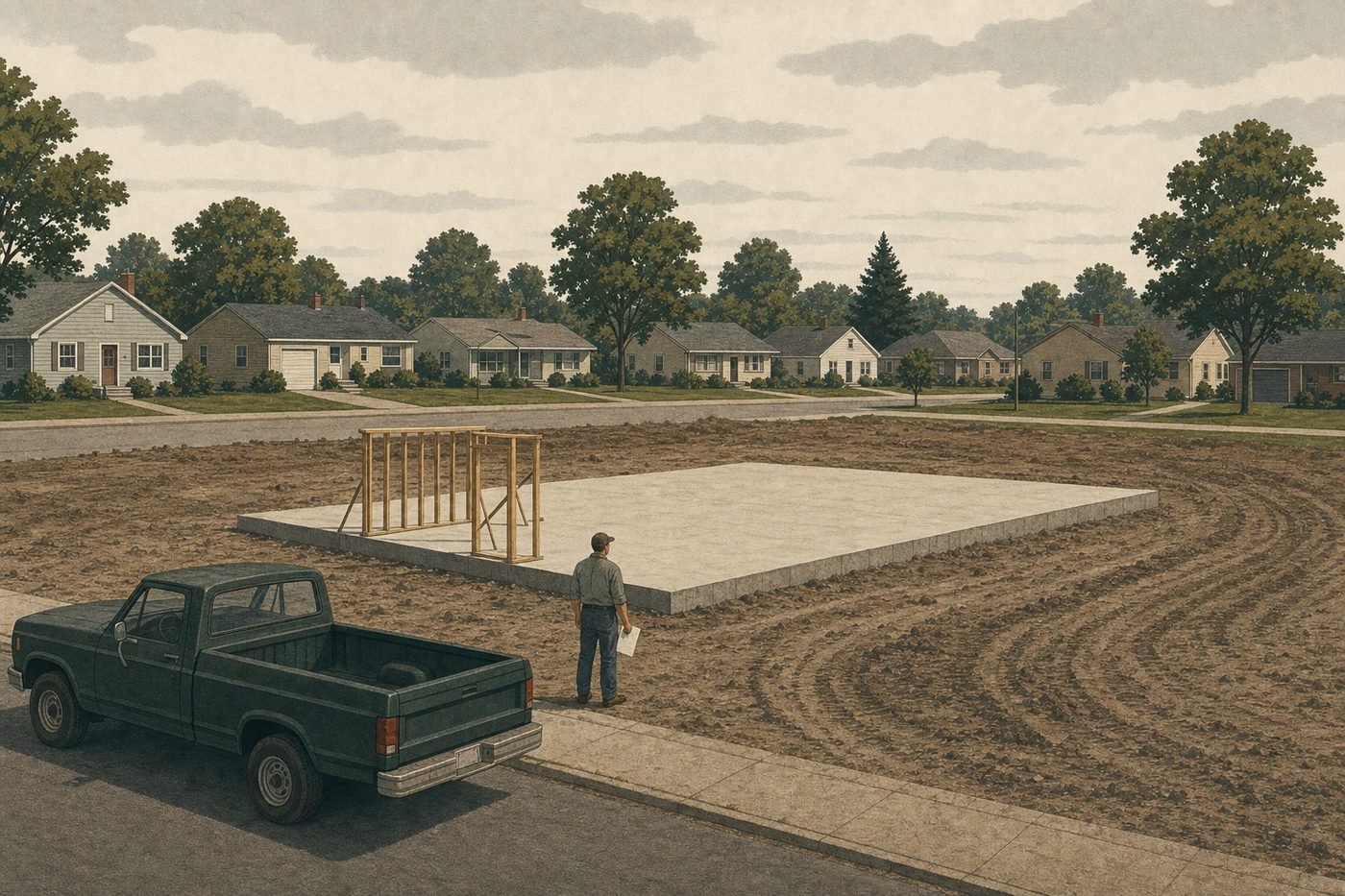
Then the part everyone else leaves out. The new money reaches the men who sold the steel and the land and the labour, and they spend it the way they always did, on the same split between now and later, because nothing about their patience has changed. The moment they do, the true rate reasserts itself, the half-built higher stages stop paying, and the foundation is exposed. That correction, the market putting its own price back, is the business cycle, and it means the bust is not the disease.
"The trouble occurs during the boom, when malinvestments and distortions take place; the crisis-depression phase is the curative period." — MES, ch. 12, §11B
The nineteenth-century economists who compared the depression to the morning after a drinking bout were laughed at, and Rothbard says the laughter is misdirected: the biology is exactly right. Every attempt to hold the boom together, propping wages, propping prices, another dose of credit, only postpones the reckoning and makes it larger, and the reason booms last for years rather than months is that the banks keep injecting before the last dose wears off. The prescription is one sentence, and it is the shortest in the book.
"The way to prevent a depression, then, is simple: avoid starting a boom." — MES, ch. 12, §11B
Tax-payers and tax-consumers
The second book lets force into the model, and its first move is to classify it: an intervener can command what you do with your own person or property, take from you or trade with you under threat, or forbid a deal between two other people. Most of what gets called economic policy is the third kind. But the second is the base of all of it, because every other intervention is paid for by the one Rothbard puts beside highway robbery in the same sentence, taxation. He then lets John C. Calhoun, of all people, make the point that Marx is usually credited with. Taxes are collected from everyone and paid out to some, so the fiscal process by simple arithmetic divides a country into two classes, those who pay in more than they get back and those who get back more than they pay, and sets them against each other over every budget. The market has no classes. The state makes them.
He shows the slope with the American farm program, and it is worth following to the end. In 1929 the government held some crop prices above the market. Surpluses appeared, made worse by farmers who left other crops to grow the guaranteed ones. Rather than repeal the support, it capped production with quotas based on each farm's past output, which froze farming in an old shape and rewarded the inefficient. Farmers paid not to grow the supported crops grew the unsupported ones instead, and the new surpluses there set up the next clamour. So came the soil bank, which paid farmers to leave land idle altogether. They put their worst acres into it, farmed the good ones harder, produced as much as before, and now received a cheque for the idle ground on top. Every step was the reasonable answer to the problem the previous step had made, and none of them could be undone by people who believed in the first one.
"On the market all is harmony. But as soon as intervention appears and is established, conflict is created." — PM, ch. 2, §2A
The last argument is the one that makes the book radical rather than merely conservative. A citizen of Montana and a citizen of Saskatchewan trade across the border every day with no government over the pair of them, and settle their disputes in each other's courts. If Canada and the United States can be separate without anyone calling it anarchy, why not the South from the Union, New York from the country, a city from the state, a block, a house, a person? He does not flinch from the last step. Then he does something rare for a man so sure of himself: he stops. The economist can only lay out the two sets of consequences, harmony and order on one side, conflict and chaos on the other. Which to choose is not his to say. "The citizen, the ethicist, must now choose."
Through the Orenda lens
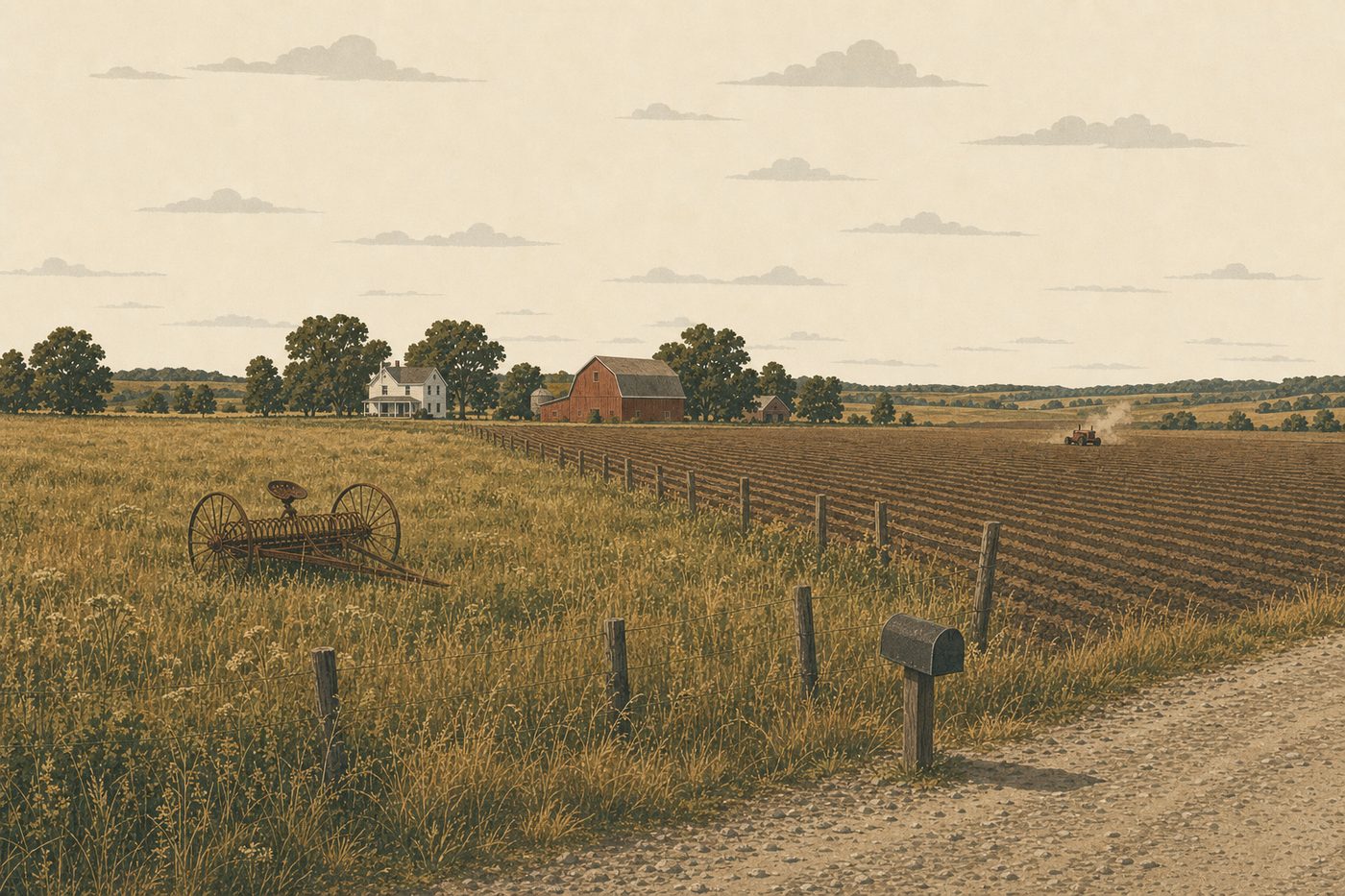
The soil bank is our story, and I did not expect to find it in a treatise on price theory. A programme designed to shrink output paid farmers to idle their poorest ground and farm their best harder, produced the same surplus, and added a cheque. Anyone who has run land knew what would happen the day it was announced, and the programme's authors did not, because they had never had to choose which acre to rest. That is the whole difference between the two books in this volume. The first is built by a man who has to count his own bricks. The second is what happens when someone who does not own the outcome starts giving orders about it.
The contractor is the same lesson at the scale of the economy, and it is the cleanest bridge I know between money and soil. He lays a foundation for a house the material cannot finish because a price lied to him about what he had. A farm mining its topsoil is reading a yield that does not price the topsoil, and it discovers the error a generation later in the same way, when the material runs out. Both are capital consumption dressed as production, and both are found out only when the truthful price returns. Rothbard's cycle is Montgomery's plantation with the signal named.
On money he sets me two problems, and I would rather show them than hide them. The first is the regression theorem. Rothbard says a money must begin as something people already wanted, and the hardest honest question anyone puts to us about bitcoin is what that something was. His own clause is the beginning of the answer, that the first link need not stay in use once the chain is running, but it is not the end of it, and this page is not going to pretend otherwise. The second is that he, like his teacher, will not say a long horizon is better than a short one. Time preference is a fact about action, and the economics cannot rank one man's patience above another's. When this farm calls patience a virtue, that is our claim, and we make it as farmers, not as Austrians. What the book does give, without reservation, is the weight. A monetary unit is an amount of a thing; a dollar is a name that used to mean one. We keep our savings in something that is still an amount of a thing, and we count in it.
What's happened since
The book arrived at the low point of its school's standing and the profession largely declined to notice it; the publisher had already cut the third part off. That part came out in 1970, the two were rejoined in 2004, and the ideas travelled in the meantime through a revival Rothbard did a great deal to organise. The cycle theory returned to argument after 2008, when a great many people found themselves standing on a capacious foundation. The monopoly and patent conclusions remain his own, and the claim that fractional reserve is fraud rather than a choice is still the minority position even among people who agree with him about everything else. The passage with the liveliest afterlife is the one on the regression theorem, which is now argued over by people who have never read the book, on both sides of the question whether a money can begin as a ledger. Read it for the walk back to the last day of barter and the farm program's slope. And notice, at the end of fourteen hundred pages of certainty, the sentence where he hands the decision to you.